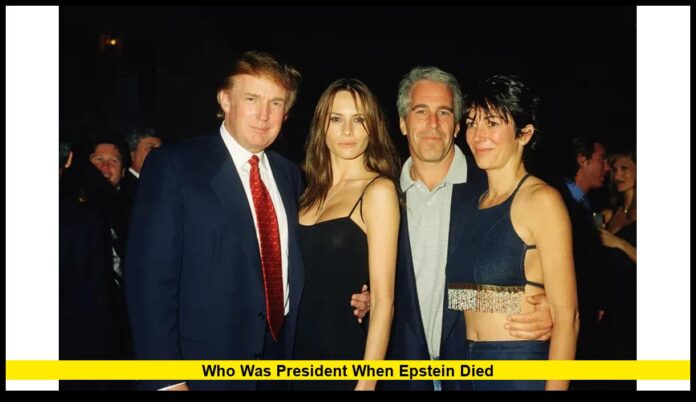
Who was president when Epstein died is a question that continues to draw attention as Americans revisit one of the most closely examined deaths in recent criminal justice history. Jeffrey Epstein died on August 10, 2019, while being held in federal custody in New York City. At that time, Donald J. Trump was the President of the United States, serving in the third year of his first term.
This answer remains unchanged today. Epstein’s death occurred under the Trump administration, during a period of heightened national focus on accountability, institutional oversight, and the handling of high-profile criminal cases.
Table of Contents
The Date That Anchors the Timeline
Jeffrey Epstein was found unresponsive inside his jail cell during the early morning hours of August 10, 2019. He was being held at the Metropolitan Correctional Center, a federal detention facility in Manhattan that houses pretrial detainees, including individuals facing serious federal charges.
Epstein had been arrested weeks earlier on sex trafficking charges involving minors. Due to the severity of the allegations and concerns about flight risk, he was denied bail and ordered to remain in custody while awaiting trial.
The official ruling classified his death as a suicide. That determination remains the formal conclusion, and no subsequent finding has altered the date, location, or legal status surrounding his death.
The President in Office at the Time
When Epstein died in August 2019, Donald Trump was serving as the 45th President of the United States. Trump had taken office on January 20, 2017, following his election victory the previous year.
There was no transition of power or interim administration during this period. Trump was fully in office, exercising executive authority over federal agencies, including those responsible for detention facilities and criminal prosecutions.
This establishes a clear and undisputed leadership context for Epstein’s death.
Why the Presidency Matters to the Question
The presidency matters because Epstein was in federal custody. Federal detention facilities operate under agencies that fall within the executive branch of government.
While the president does not manage day-to-day jail operations, the broader responsibility for federal institutions rests within the executive structure. That reality often leads the public to ask who was in office during major institutional failures or controversial events.
In Epstein’s case, that question consistently points to the Trump presidency.
A Straightforward Timeline of Events
A review of the timeline confirms the answer without ambiguity.
- January 20, 2017: Donald Trump sworn in as president
- July 2019: Epstein arrested on federal charges
- August 10, 2019: Epstein dies in federal custody
- January 20, 2021: Trump leaves office
This sequence places Epstein’s death clearly within Trump’s term.
Public Reaction Following Epstein’s Death
The response to Epstein’s death was immediate and intense. Americans across the political spectrum expressed shock and anger, largely because Epstein had been facing serious charges and was considered a key figure in a wider network of alleged abuse.
Many people questioned how a high-profile detainee could die while under constant supervision. Others focused on what his death meant for victims seeking justice.
Because these questions emerged during Trump’s presidency, public discourse often linked the timing of the death to the administration in power.
Federal Oversight and Jail Conditions
Epstein was housed at a facility run by the Federal Bureau of Prisons. That agency operates under the Department of Justice, which is part of the executive branch.
At the time of Epstein’s death, reviews later identified significant problems within the jail, including staffing shortages and failures to follow established monitoring procedures. These issues fueled further scrutiny and added to public frustration.
While these findings raised concerns about institutional management, they did not alter the established fact of who was president when Epstein died.
Why Confusion Sometimes Appears Online
Despite a clear historical record, confusion persists online. This is often due to Epstein’s long public history, which stretched across multiple decades and overlapped with several presidential administrations.
Epstein’s social and financial activities occurred during earlier periods, which sometimes leads people to mistakenly associate his death with other presidents. When timelines are not carefully separated, misinformation can spread easily.
A focus on confirmed dates helps prevent those misunderstandings.
The Political Climate in 2019
Epstein’s death occurred during a period of significant political tension in the United States. Trust in institutions was strained, and public skepticism toward government agencies was high.
The country was also entering a heated election cycle, which amplified reactions to any major controversy. In this environment, Epstein’s death became more than a criminal justice issue. It became part of a broader conversation about power, accountability, and transparency.
That climate contributed to the continued interest in leadership at the time.
What the Presidency Did Not Control
It is important to separate leadership context from operational responsibility. The president does not personally supervise federal detention centers or make decisions about individual inmates.
Operational failures at the jail were linked to staffing and procedural issues, not presidential directives. No verified evidence has shown direct involvement by the president in Epstein’s confinement or death.
Understanding this distinction helps keep discussions grounded in fact.
Why the Question Still Resurfaces
Years later, the question continues to resurface because Epstein’s case has not faded from public consciousness. Civil litigation, document disclosures, and renewed media focus keep the story alive.
Each time the case reenters the spotlight, readers often revisit basic facts to reorient themselves. Who was president when Epstein died remains one of the most common starting points.
The answer remains consistent, regardless of renewed attention.
The Role of Historical Accuracy
Historical accuracy plays a critical role in maintaining credible public discussion. When facts are misrepresented, trust erodes and confusion grows.
Clear answers to foundational questions help prevent distortion. In this case, the leadership context is straightforward and well documented.
Donald Trump was president when Epstein died. That statement reflects the historical record and has not changed.
Why the Answer Has Not Changed Over Time
No investigation, court ruling, or disclosure has altered the date of Epstein’s death or the presidency at the time. While debates continue about broader implications, the basic timeline remains fixed.
This consistency highlights the importance of relying on verified facts rather than speculation or assumptions.
The Lasting Impact of the Case
Epstein’s death continues to influence discussions about detention standards, inmate safety, and oversight of federal facilities. It also remains central to conversations about justice for victims.
These broader issues often prompt people to revisit the original moment and the leadership environment surrounding it. That is why the question persists years later.
Putting the Question Into Context
Asking who was president when Epstein died is not about assigning blame by default. It is about understanding context.
Leadership context helps frame how institutions responded, how investigations were handled, and how the public interpreted events at the time.
In August 2019, that context was the Trump administration.
A Clear and Final Answer
The historical record is clear and unchanged. Jeffrey Epstein died on August 10, 2019, while Donald J. Trump was serving as President of the United States.
This answer is factual, confirmed, and remains accurate today.
Conclusion
The question who was president when Epstein died continues to surface because Epstein’s case remains one of the most scrutinized events in modern criminal justice history. The answer is straightforward and supported by established timelines: Donald Trump was president at the time of Epstein’s death in federal custody.
Understanding this fact provides clarity amid ongoing discussion and ensures that conversations about the case remain grounded in reality.

