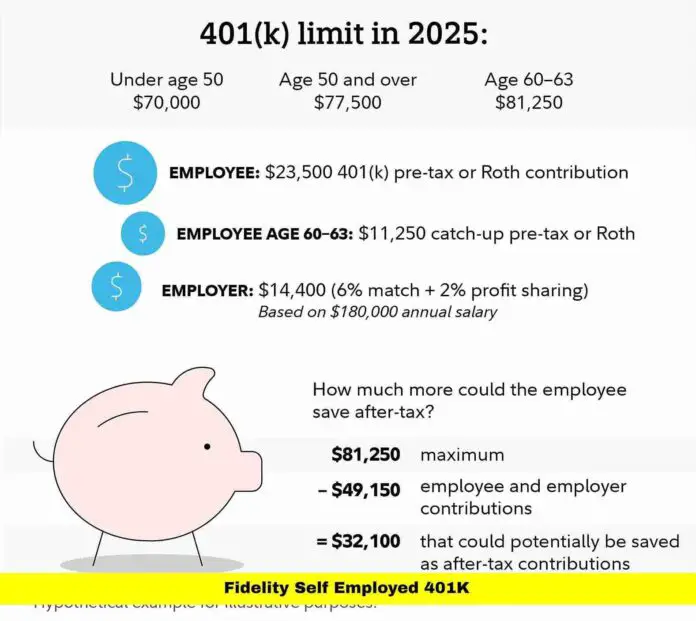
A fidelity self employed 401k is one of the most powerful retirement solutions available for self-employed individuals and small business owners in 2025. This plan allows business owners without employees to save more aggressively for retirement, offering both traditional pre-tax contributions and after-tax Roth options. With increased contribution limits and flexible investment options, it provides a unique opportunity for self-employed Americans to plan for the future while managing taxes efficiently.
In 2025, many self-employed professionals are exploring this retirement vehicle to maximize their savings and benefit from both immediate tax relief and long-term growth potential. The combination of employee and employer contributions allows for higher limits than most other retirement accounts. Understanding how to establish, fund, and manage this account can have a significant impact on financial security over time.
Table of Contents
Understanding the Self-Employed 401K
A self-employed 401(k) is designed specifically for business owners without employees, except for a spouse. Unlike traditional employer-sponsored plans, it allows the business owner to contribute both as the employee and the employer. This dual contribution feature significantly increases the potential for annual retirement savings.
The plan functions similarly to a traditional 401(k) in terms of tax advantages and investment options, but it is tailored to meet the unique needs of self-employed professionals. Participants can choose to make contributions on a pre-tax basis, reducing taxable income in the current year, or as Roth contributions, which grow tax-free for withdrawals in retirement. The flexibility of contribution types and investment choices makes it an ideal tool for small business owners looking to maximize retirement savings.
Eligibility Requirements
To participate in a self-employed 401(k), you must be a sole proprietor, independent contractor, or the owner of an LLC or corporation with no common-law employees other than yourself and optionally your spouse. Spouses may also participate if they earn compensation through the business.
This type of plan is not suitable for businesses with employees beyond the owner and spouse, as those individuals would generally require a traditional 401(k) or other employer-sponsored plan. Eligibility ensures that self-employed individuals can take advantage of the plan’s higher contribution limits while maintaining control over investment decisions and plan administration.
Contribution Limits for 2025
One of the most attractive features of this retirement plan is its high contribution limits. In 2025, individuals can contribute up to $23,500 as an employee deferral, with an additional catch-up contribution of $7,500 for participants aged 50 and older.
As the employer, you can contribute up to 25% of compensation as profit-sharing, which can significantly increase total retirement contributions. Combined, employee and employer contributions can reach a maximum of $70,000 per year. This high-limit structure allows self-employed individuals to accelerate their retirement savings, particularly in years when business income is strong, making it one of the most efficient retirement vehicles for small business owners.
Tax Advantages
A self-employed 401(k) offers significant tax benefits. Traditional contributions reduce taxable income for the year, providing immediate tax relief. Roth contributions, made with after-tax dollars, grow tax-free and can be withdrawn tax-free in retirement if certain requirements are met.
These options allow business owners to create a strategic balance between current tax savings and future tax-free income. Choosing the right mix of traditional and Roth contributions depends on current income, tax bracket, and anticipated retirement needs. This flexibility provides a powerful tool for self-employed individuals to manage both their retirement security and tax strategy efficiently.
Setting Up the Plan
Establishing a self-employed 401(k) involves creating a formal plan and adoption agreement. The process includes defining participant eligibility, contribution rules, and plan administration responsibilities. Once established, the plan must be properly documented and maintained for compliance with IRS regulations.
Owners can typically set up the plan online or through a financial institution, which provides guidance on required paperwork and adoption agreements. Selecting the appropriate contribution type and investment options is a critical part of this process. Proper setup ensures maximum efficiency in saving and avoids administrative or compliance issues in the future.
Investment Options
After establishing the account, participants can choose from a broad range of investment options, including mutual funds, stocks, bonds, and ETFs. This flexibility allows for portfolio diversification and aligns with the individual’s risk tolerance and retirement goals.
Managing investments requires periodic review to ensure allocation aligns with changing financial circumstances and market conditions. Regular monitoring and rebalancing are essential to maintain an effective growth strategy. Self-employed individuals have complete control over these investment choices, making the plan highly adaptable to personal retirement objectives.
Making Contributions and Deadlines
Employee contributions must generally be made by the business tax filing deadline, including extensions. Employer profit-sharing contributions are also due by the tax filing date, giving business owners flexibility in timing contributions based on income fluctuations.
This flexibility allows self-employed professionals to maximize contributions during profitable years and adjust contributions in lower-income periods. Proper planning ensures that all allowable contributions are made within IRS guidelines, taking full advantage of the high limits this plan offers.
Withdrawals and Retirement Distributions
Withdrawals from a self-employed 401(k) follow standard retirement account rules. Early withdrawals before age 59½ may incur a 10% penalty plus income taxes. Required minimum distributions typically begin at age 73, though Roth contributions may have separate rules if conditions for qualified distributions are met.
Roth contributions provide an advantage by allowing tax-free withdrawals in retirement, creating long-term growth potential without additional tax burden. Understanding these rules is critical for effective retirement planning, especially when combining multiple retirement accounts for a comprehensive strategy.
Record-Keeping and Compliance
Maintaining accurate records is essential for compliance. The plan administrator is responsible for keeping documents such as the adoption agreement, trust documents, and contribution records. Proper documentation ensures readiness for audits and tax reporting.
As the plan grows in value, additional IRS filings may be required, including forms that report contributions and plan activity. Adhering to record-keeping requirements ensures smooth plan operation and protects the participant from potential penalties or compliance issues.
Comparison to Other Retirement Plans
Compared with SEP IRAs or SIMPLE IRAs, a self-employed 401(k) offers higher contribution limits and greater flexibility. The ability to contribute both as employee and employer allows for accelerated savings in high-income years.
The addition of Roth options and diverse investment selections makes the plan particularly attractive for self-employed professionals seeking both tax advantages and investment control. For individuals aiming to build substantial retirement assets while retaining flexibility, this plan often outperforms other available options.
Strategic Considerations
Successful use of a self-employed 401(k) requires careful planning. Business owners should assess income variability, expected tax rates in retirement, and contribution limits to optimize savings. Combining contributions with other retirement vehicles can provide balanced tax and growth benefits.
Annual reviews of contributions, investment performance, and plan rules help maximize efficiency. Understanding both the short-term tax implications and long-term growth potential is essential to achieving retirement goals. A strategic approach ensures that the plan supports both business and personal financial objectives effectively.
Self-employed individuals can take full advantage of a 401(k) to secure a strong retirement foundation. How have you structured your retirement savings plan for your business? Share your thoughts and experiences below.

