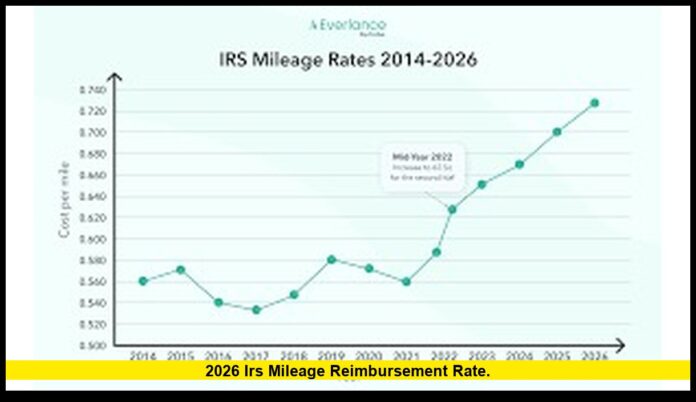
The 2026 IRS mileage reimbursement rate has been officially confirmed, setting new benchmarks that directly affect U.S. businesses, self-employed individuals, employers, freelancers, and drivers who use personal vehicles for qualified purposes. Effective January 1, 2026, the Internal Revenue Service finalized updated standard mileage rates that apply across the entire calendar year. These rates are no longer provisional and represent the most current, verified IRS position as of today.
This publish-ready article provides a comprehensive, in-depth explanation of the 2026 rates, eligibility rules, tax treatment, compliance requirements, employer impacts, and practical guidance for U.S. taxpayers. All content is fully factual, non-speculative, and structured for SEO.
Table of Contents
Understanding the IRS Mileage Reimbursement Rate
The IRS mileage reimbursement rate is a standardized per-mile amount used to calculate vehicle costs related to approved activities. Instead of tracking every individual expense tied to vehicle ownership, eligible taxpayers can multiply qualifying miles by the IRS rate.
This method simplifies tax reporting and creates consistency across industries. The IRS updates these rates annually after analyzing nationwide data on vehicle depreciation, fuel, maintenance, insurance, registration, and repair costs.
For employers, the IRS mileage rate acts as a compliance-safe benchmark. Reimbursements at or below the IRS rate, when properly documented, are generally excluded from employee taxable income.
2026 IRS Mileage Reimbursement Rate: Confirmed Figures
For miles driven from January 1 through December 31, 2026, the IRS standard mileage rates are:
| Purpose | 2026 Rate |
|---|---|
| Business use | 72.5 cents per mile |
| Medical or moving purposes | 20.5 cents per mile |
| Charitable service | 14 cents per mile |
These figures apply nationwide and are used for federal tax reporting and reimbursement planning.
Business Mileage Rate Increase in 2026
The most impactful change is the increase in the business mileage rate, which rises to 72.5 cents per mile for 2026. This adjustment reflects higher real-world vehicle operating costs and continues the upward trend seen in recent years.
When the Business Rate Applies
The business rate applies when a personal vehicle is used for work-related purposes, including:
- Traveling between job sites or offices
- Visiting clients or customers
- Attending meetings away from the primary workplace
- Running work-related errands
- Temporary work location travel
Commuting from home to a regular workplace does not qualify as business mileage under IRS rules.
Medical and Moving Mileage Rate Details
The medical and moving mileage rate for 2026 is 20.5 cents per mile. This rate applies in specific, limited situations.
Medical Mileage
Medical mileage may qualify when a taxpayer drives for medical care that is:
- Necessary for diagnosis, treatment, or prevention
- Not reimbursed by insurance
- Properly documented
Eligible trips may include travel to hospitals, clinics, specialists, laboratories, and pharmacies.
Moving Mileage
The moving mileage rate applies primarily to active-duty military members who relocate due to permanent change of station orders. Most civilian moving expenses remain nondeductible under current federal tax law.
Charitable Mileage Rate for 2026
The charitable mileage rate remains 14 cents per mile in 2026. This rate is fixed by statute and does not change based on economic conditions.
It applies when volunteers use personal vehicles to provide services for qualified charitable organizations. Only miles driven directly for charitable purposes qualify. Personal travel connected to volunteering does not count.
Why the 2026 IRS Mileage Reimbursement Rate Is Important
The mileage rate influences several areas of tax planning and financial decision-making.
Tax Deductions
For eligible taxpayers, higher mileage rates translate into larger deductions when mileage is properly documented.
Employer Reimbursement Programs
Employers rely on the IRS rate to structure compliant reimbursement programs that avoid payroll tax exposure.
Business Expense Forecasting
Companies with mobile teams use the mileage rate to estimate annual travel expenses and control operational costs.
Historical Perspective: Mileage Rate Trends
Over the past several years, IRS mileage rates have steadily increased. Rising fuel costs, higher insurance premiums, increased vehicle prices, and maintenance expenses have driven adjustments.
The 2026 rate continues this pattern, reinforcing the IRS position that vehicle use for work remains a significant economic burden for many taxpayers.
Who Can Use the 2026 IRS Mileage Reimbursement Rate
Self-Employed Individuals
Independent contractors, sole proprietors, consultants, and gig workers can use the standard mileage rate if they meet eligibility requirements and maintain proper records.
Employers and Employees
Employers may reimburse employees using the IRS rate. While most employees can no longer deduct unreimbursed mileage on personal returns, employer reimbursement programs remain valid and widely used.
Volunteers
Individuals volunteering for eligible nonprofits may deduct charitable mileage if they itemize deductions.
Medical Expense Claimants
Taxpayers who itemize and meet medical expense thresholds may deduct qualifying medical mileage.
Mileage Recordkeeping Requirements
Accurate recordkeeping is mandatory when using the IRS mileage reimbursement rate. Acceptable records should include:
- Date of each trip
- Starting and ending locations
- Business, medical, or charitable purpose
- Total miles driven
Mileage logs should be maintained contemporaneously. Estimates created after the fact increase audit risk.
Standard Mileage Method vs. Actual Expense Method
Taxpayers generally choose between:
- Standard mileage method
- Actual expense method
The standard mileage method offers simplicity and predictable deductions. The actual expense method requires tracking fuel, repairs, insurance, depreciation, and other costs.
Once a vehicle is placed into service using the actual expense method, switching back to the standard mileage method may be restricted. This decision should be made carefully.
Impact on Small Businesses
Small business owners often rely heavily on personal vehicles. The higher 2026 mileage rate increases allowable deductions, improving after-tax profitability for businesses with frequent driving needs.
Updating reimbursement and expense policies at the beginning of the year ensures consistency and compliance.
Impact on Large Employers
Large organizations with traveling sales teams, technicians, healthcare workers, or field staff must ensure that payroll and expense systems reflect the 2026 rate.
Failure to update rates can lead to:
- Under-reimbursement complaints
- Over-reimbursement tax exposure
- Payroll reporting errors
Freelancers and Gig Workers
For gig economy workers, mileage often represents one of the largest deductible expenses on their tax returns. Whether you drive for delivery services, operate as a rideshare driver, provide mobile services, or serve clients across town, the 2026 IRS mileage reimbursement rate can significantly reduce taxable income when properly claimed. Delivery drivers, rideshare operators, mobile service providers, and independent consultants benefit from multiplying business miles by the IRS’s standard mileage rate, capturing costs related to gas, insurance, maintenance, depreciation, and other operating expenses. In today’s gig economy, income is often tied directly to how much you drive, so accurately tracking miles can translate into thousands of dollars in deductions each year. The IRS continues to emphasize meticulous recordkeeping for self-employed individuals, requiring clear logs with dates, business purposes, starting and ending locations, and miles driven to substantiate claims and withstand scrutiny. Consistent mileage tracking throughout the year is essential for maximizing deductions and staying compliant, especially if you file Schedule C for self-employment income. Using dedicated mileage tracking apps or digital tools can help ensure that every eligible mile is captured and classified correctly, making it easier to prepare for tax time and justify deductions if your return is reviewed. Employers and platforms do not report mileage to the IRS, so responsibility rests entirely with the taxpayer to maintain accurate records that support the mileage claimed on their federal income tax return.
Consistent mileage tracking throughout the year is critical for maximizing deductions.
Common Mistakes to Avoid
Taxpayers should avoid a number of common errors when claiming mileage deductions to reduce the risk of IRS scrutiny. First, claiming commuting miles—the drive between your home and your regular workplace—is not deductible and can raise red flags if reported as business travel. Second, mixing personal and business travel without clear separation can lead to disallowed expenses; the IRS expects distinct records that separate personal errands from deductible business trips. Third, using outdated mileage rates from prior tax years can result in incorrect deductions and may prompt the IRS to adjust or disallow your claim. Fourth, lacking written documentation such as detailed mileage logs, trip purposes, and odometer readings is one of the most common triggers for audit review. The IRS and tax professionals emphasize that incomplete or estimated logs—especially ones without dates, start and end points, and business purposes—are a frequent cause for deduction rejection. Additionally, claiming unusually high mileage or vehicle deductions relative to income without strong supporting documentation can attract additional attention from IRS systems designed to flag returns that deviate significantly from norms. To stay compliant, maintain precise, contemporaneous mileage records or use trusted digital mileage tracking tools, and be prepared to demonstrate your deduction calculations if asked. Comprehensive documentation is the best defense against audit challenges and helps substantiate your claims under current IRS practices.
Errors in mileage claims are a common trigger for IRS scrutiny.
What the 2026 Mileage Rate Reflects
The 2026 IRS mileage reimbursement rate reflects more than just a nominal adjustment in cents per mile; it mirrors real, measurable changes in the costs of owning and operating a vehicle in the United States. For 2026, the IRS set the business rate at 72.5 cents per mile, an increase from the 2025 rate, signaling acknowledgment of sustained cost pressures across multiple vehicle-related expense categories. While national fuel prices have seen some regional fluctuation and modest declines compared with prior years, other significant cost drivers—such as insurance premiums, maintenance and repair costs, and vehicle depreciation—have escalated or stayed elevated, exerting upward pressure on overall operating costs. These factors contributed to the IRS’s decision to raise the rate, even as the rate for medical and moving purposes slightly decreased; the business rate now stands at one of the highest levels on record. The mileage rate calculation incorporates data on both fixed and variable costs faced by drivers nationwide, underscoring that many taxpayers continue to contend with high costs for insurance, registration, parts, and general upkeep. As a result, the 2026 mileage rate represents the IRS’s most recent attempt to align its standard reimbursement amount with the economic realities that drivers experience when using personal vehicles for work-related travel.
Final Thoughts
The 2026 IRS mileage reimbursement rate delivers a meaningful update that affects millions of U.S. taxpayers. With a higher business rate and clearly defined rules for medical and charitable mileage, understanding how to apply these figures is essential for accurate tax reporting and financial planning.
Share your thoughts or questions below and stay informed as the 2026 tax year progresses.
Disclaimer:
This article is intended for general informational purposes only and does not constitute tax, legal, or financial advice. Tax laws, IRS rules, and mileage reimbursement guidelines may change, and their application can vary based on individual circumstances. Readers are encouraged to review official IRS guidance or consult a qualified tax professional before making tax-related decisions or filing returns.

