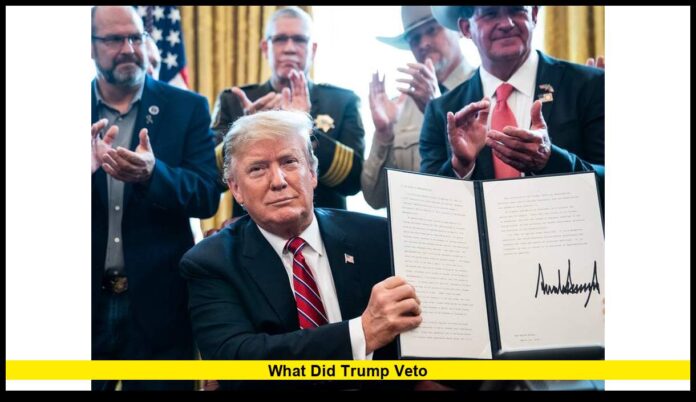
Donald Trump issued ten vetoes during his presidency from 2017 to 2021. Most focused on border security, defense spending, and limits on military actions in Yemen and Iran. His first veto defended his border wall funding, and his most notable—on the 2021 defense bill—was overridden by Congress, the only successful override of his term.
When Americans ask “what did Trump veto,” they’re looking back at one of the most assertive presidential records in modern history. During his single term from January 2017 to January 2021, former President Donald J. Trump used his veto power ten times, rejecting legislation passed by Congress that he said undermined national security, border control, or his administration’s agenda.
As of December 2025, these ten vetoes remain a key part of the political discussion around Trump’s governing style and his influence on U.S. policy. No new vetoes have been issued by him since leaving office, since only a sitting president holds that authority.
Table of Contents
Understanding the Presidential Veto Power
Before exploring individual examples, it helps to clearly understand what a presidential veto actually is and why it matters in American government.
Under the U.S. Constitution, the president has the authority to reject any bill that Congress passes. This rejection is called a veto. When the president vetoes a bill, it doesn’t immediately become law. Instead, the legislation is returned to Congress along with a written explanation outlining the president’s objections.
Once a vetoed bill goes back to Congress, lawmakers have one final option: they can attempt to override the veto. However, this is intentionally difficult to achieve. To override, both the House of Representatives and the Senate must approve the bill again with a two-thirds majority vote. Because that level of agreement is rare, most vetoes stand as final.
The veto power serves as one of the strongest checks and balances in the U.S. political system. It allows the president to prevent laws that they believe could harm national interests, violate constitutional principles, or conflict with their administration’s policies.
For former President Donald Trump, the veto was more than a procedural tool — it was a reflection of his leadership style. He used it as a way to assert control, challenge congressional opposition, and defend what he viewed as executive authority. His approach was often bold, direct, and uncompromising, mirroring his overall political identity: confrontational, executive-focused, and unapologetically nationalistic.
Through his use of the veto, Trump emphasized a belief that the president should have broad power to act decisively on matters of national security, immigration, and defense, even when that stance put him at odds with members of both political parties.
Trump’s First Veto: The National Emergency at the Border (2019)
Donald Trump’s first presidential veto came on March 15, 2019, after Congress passed a bipartisan resolution to block his declaration of a national emergency at the southern border.
- Context: Trump had declared an emergency to redirect military funds for construction of a U.S.–Mexico border wall.
- Congressional Reaction: Both chambers voted to overturn the declaration, arguing it was an overreach of executive power.
- Veto Outcome: Trump vetoed the resolution, marking his first official rejection of congressional authority. The House later attempted an override but failed to secure enough votes.
This episode became one of the most defining moments of his presidency, setting the tone for his confrontations with both Democrats and dissenting Republicans.
Vetoes on Foreign Policy and Military Engagement (2019–2020)
During his presidency, Donald Trump frequently clashed with Congress over the direction of U.S. foreign policy and military involvement abroad. Lawmakers from both parties sought to reassert congressional authority over war powers, while Trump aimed to maintain strong executive control over national security decisions. His vetoes in this area clearly reflected that determination.
1. Yemen War Powers Resolution (April 2019)
In April 2019, Congress passed a bipartisan resolution invoking the War Powers Act to end U.S. military assistance to the Saudi-led coalition in Yemen. The move came after growing concerns about civilian casualties and the humanitarian crisis caused by the conflict.
Trump vetoed the resolution, calling it a “dangerous attempt to weaken the presidency.” He argued that the United States was not directly engaged in combat in Yemen and that halting support would damage strategic alliances with Saudi Arabia and the United Arab Emirates. The veto was sustained, as Congress failed to reach the two-thirds majority needed to override it.
This decision reaffirmed Trump’s view that the president must retain flexibility and independence in foreign affairs, especially in volatile regions.
2. War Powers Resolution on Iran (May 2020)
In May 2020, following heightened tensions after the U.S. drone strike that killed Iranian General Qasem Soleimani, Congress passed another resolution under the War Powers Act. The measure sought to limit Trump’s authority to take further military action against Iran without congressional approval.
Trump vetoed the resolution, describing it as “an unnecessary and dangerous limitation” on his ability to protect American interests. He maintained that the strike on Soleimani was a lawful act of self-defense and warned that restricting presidential powers could embolden adversaries.
As with the Yemen measure, Congress was unable to override the veto, leaving Trump’s decision intact.
A Consistent Presidential Philosophy
Both vetoes illustrate Trump’s unwavering stance on executive authority in matters of war and peace. He believed that national defense decisions should not be subject to congressional micromanagement, particularly during times of global uncertainty.
By blocking these resolutions, Trump reinforced a long-standing presidential principle: the commander-in-chief must have the freedom to act swiftly to protect the nation, even if that puts the executive branch at odds with Congress.
These foreign policy vetoes stand among the clearest examples of how Trump used presidential power to assert control over military and diplomatic decisions, shaping America’s role on the world stage during his term.
Vetoes Related to Defense Policy and National Security
Trump was especially active when it came to defense spending. His most publicized veto was tied to the National Defense Authorization Act (NDAA) — a massive annual bill that funds the military.
National Defense Authorization Act for Fiscal Year 2021 (December 23, 2020)
- Reason for Veto: Trump objected to provisions that required renaming military bases honoring Confederate figures and did not repeal Section 230 of the Communications Decency Act, which shields tech companies from liability for user content.
- Congressional Action: Both the House and Senate overwhelmingly overrode his veto, marking the first and only successful override of Trump’s presidency.
This event demonstrated the limits of presidential authority when bipartisan consensus emerges.
Vetoes on Domestic Policy and Oversight
Trump also used the veto to block congressional efforts that challenged his administration’s domestic policies.
1. Defense Authorization and Arms Sales Resolutions (July 2019)
In July 2019, Trump vetoed three separate resolutions aimed at halting U.S. arms sales to Saudi Arabia and the United Arab Emirates. Lawmakers cited concerns over human rights abuses and civilian deaths in Yemen. Trump defended the sales as crucial for U.S. economic and strategic interests.
2. Congressional Disapproval of Border Wall Funding (October 2019)
After his initial border wall funding was challenged, Trump again vetoed a resolution attempting to terminate the national emergency declaration. This reaffirmed his commitment to completing the wall despite congressional resistance.
Veto on a Bipartisan Defense Bill for Troop Withdrawals (December 2020)
In late 2020, Trump vetoed another major defense policy bill, objecting to limits on his power to withdraw U.S. troops from Afghanistan and Germany. He also criticized the lack of reforms to Section 230, showing how tech regulation became one of his key issues in the final months of his presidency.
Although this veto did not hold — Congress successfully overrode it — it reflected Trump’s ongoing focus on executive independence and his disdain for what he viewed as establishment politics in Washington.
Summary: Trump’s Ten Vetoes (2019–2021)
During his four years in office, Donald Trump issued ten presidential vetoes, each revealing how he used executive power to push his political priorities and challenge Congress. His vetoes covered a wide range of issues — from border security and foreign policy to military authority and student loan regulations. Together, they show a consistent pattern: Trump viewed presidential power as something to be used boldly, even when it meant standing alone against bipartisan opposition.
Below is a clearer, more detailed summary of what Trump vetoed during his presidency:
| Date | Bill/Resolution | Primary Issue | Outcome |
|---|---|---|---|
| March 15, 2019 | H.J.Res. 46 | Blocked Congress’s attempt to end his national emergency declaration at the southern border, which allowed funding for the border wall. | Sustained |
| April 16, 2019 | S.J.Res. 7 | Rejected a resolution to end U.S. military involvement in the Saudi-led conflict in Yemen. | Sustained |
| July 24, 2019 | S.J.Res. 36 | Disapproved of Congress’s move to stop arms sales to Saudi Arabia, defending it as vital for U.S. jobs and security. | Sustained |
| July 24, 2019 | S.J.Res. 37 | Blocked a similar resolution halting weapons sales to the United Arab Emirates. | Sustained |
| July 24, 2019 | S.J.Res. 38 | Rejected a broader attempt to limit U.S. arms sales to other countries involved in Middle East conflicts. | Sustained |
| October 15, 2019 | S.J.Res. 54 | Prevented Congress from canceling his border wall emergency declaration for a second time. | Sustained |
| May 6, 2020 | S.J.Res. 68 | Blocked limits on his authority to take military action against Iran without congressional approval. | Sustained |
| May 29, 2020 | H.J.Res. 76 | Rejected efforts to overturn his administration’s rule on student loan forgiveness for defrauded borrowers. | Sustained |
| December 23, 2020 | H.R. 6395 | Vetoed the National Defense Authorization Act (NDAA) for 2021, objecting to limits on troop withdrawals and refusal to repeal Section 230. | Overridden by Congress |
| January 1, 2021 | H.R. 6395 (override completed) | Congress finalized the override of his NDAA veto, marking the only successful veto override during his presidency. | Override Successful |
Interpreting Trump’s Veto Record
Each of these ten decisions highlights how Trump used his veto power to defend his core beliefs. His border wall vetoes underscored his determination to secure the southern border, while his foreign policy vetoes emphasized his insistence on maintaining strong presidential control over military and diplomatic actions.
Trump’s Yemen and Iran vetoes showed his resistance to congressional efforts to limit his authority in foreign conflicts. Likewise, his student loan veto reflected a preference for stricter financial accountability rather than broad forgiveness.
The December 2020 veto of the National Defense Authorization Act was the most politically dramatic. Trump’s objections included removing protections for tech companies and renaming military bases that honored Confederate figures. When Congress overrode that veto, it marked the only time lawmakers successfully reversed one of his decisions — a rare act of bipartisan unity.
Overall, Trump’s veto record paints a clear picture of a president who governed with conviction and confrontation. Whether dealing with immigration, defense, or foreign affairs, he consistently positioned himself as the final authority, even when it meant challenging both political parties.
These ten vetoes not only shaped the policies of his administration but also sparked lasting debates about the boundaries of presidential power and the ongoing balance between Congress and the White House.
The Political Impact of Trump’s Vetoes
Trump’s veto strategy was a reflection of his combative political identity. His approach drew both strong praise and intense criticism:
- Supporters viewed his vetoes as proof he was protecting American sovereignty, military strength, and executive independence.
- Critics saw them as attempts to bypass democratic checks and consolidate power in the executive branch.
His frequent use of vetoes on military and foreign policy issues also signaled a deep mistrust of congressional oversight in areas traditionally dominated by the presidency.
How Trump’s Veto Record Compares Historically
Trump issued 10 vetoes in four years, which places him in the mid-range among modern presidents. For comparison:
- Barack Obama issued 12 vetoes.
- George W. Bush used 12.
- Bill Clinton issued 37.
- Franklin D. Roosevelt holds the record with over 600.
However, Trump’s vetoes were particularly high-profile and politically charged, often tied to immigration, defense, or executive authority — areas central to his political identity.
What His Vetoes Reveal About His Leadership Style
Donald Trump’s use of the veto power offers a clear window into his governing philosophy and leadership style. Each veto he issued wasn’t simply a procedural decision — it was a deliberate statement about how he viewed the presidency and his role as a leader. His veto record reveals three defining characteristics that consistently shaped his time in office.
1. Defiance of bipartisan pressure
Throughout his presidency, Trump often found himself at odds not just with Democrats, but with members of his own Republican Party. Yet, even under intense political pressure, he rarely backed down. When Congress passed bipartisan resolutions challenging his actions — such as efforts to limit his emergency declaration at the southern border or restrict U.S. involvement in Yemen — Trump stood firm. His vetoes became symbols of defiance, showing a president who preferred confrontation over compromise. To his supporters, this was proof of strength; to his critics, it reflected stubbornness and resistance to collaboration.
2. Emphasis on executive power
Trump consistently defended what he viewed as the rightful authority of the presidency. He believed that the commander-in-chief should have broad control over military operations, national security decisions, and the enforcement of federal laws. His vetoes on the Yemen and Iran War Powers resolutions were clear examples of this belief. Trump argued that restricting his ability to act quickly in matters of defense would endanger national interests. His approach underscored a leadership style that valued decisiveness and independence from congressional limitations.
3. Direct appeal to his political base
Perhaps more than any other modern president, Trump understood the importance of maintaining a strong connection with his supporters. Each veto he issued was presented not just as a policy choice, but as a stand for the American people against what he often described as the “Washington establishment.” He framed his rejections of congressional actions as victories for sovereignty, border security, and the working class. This populist tone reinforced his bond with voters who saw him as an outsider fighting entrenched political interests.
Taken together, these three themes — defiance, executive strength, and populist messaging — define the essence of Trump’s leadership. His use of the veto power reflected a president who viewed compromise as weakness and bold action as a necessity.
Even in 2025, years after leaving the White House, Trump’s leadership style remains unmistakable. His rhetoric continues to echo the same principles that guided his vetoes: unwavering confidence, a deep belief in presidential authority, and an enduring appeal to his loyal political base.
Trump’s Vetoes and Their Long-Term Legacy
Although Donald Trump’s presidency concluded in January 2021, the impact of his vetoes continues to echo through American politics and policymaking. Each veto he issued revealed not only his priorities but also his vision of presidential power — one that favored decisive action, minimal restraint, and a strong sense of executive independence.
Trump’s border wall vetoes significantly shaped how future administrations and lawmakers view the use of emergency powers. When he declared a national emergency to fund construction of the southern border wall, it set off one of the most heated constitutional debates of his term. Congress tried to block the declaration twice, and both times Trump used his veto to keep it in place. Those actions prompted years of discussion about whether presidents should be able to redirect federal funds without direct congressional approval. Even today, policymakers reference those vetoes when debating the boundaries of executive authority during emergencies.
His defense bill vetoes had a similar influence on the conversation around military policy. By rejecting the National Defense Authorization Act (NDAA) in 2020, Trump challenged Congress on issues ranging from troop deployments to Section 230 — the law governing online platform liability. Although Congress ultimately overrode that veto, it sparked legislative efforts to more clearly define the limits of presidential power in defense spending and troop withdrawal decisions.
Beyond specific policies, Trump’s veto record left a broader political legacy. It demonstrated how a president could use the veto not just as a safeguard against bad legislation, but as a strategic weapon to assert control, send a political message, and rally public support. Each rejection became part of his broader image as a leader willing to fight the establishment and stand firm against opposition from both parties.
By 2025, with Trump still a major figure in American politics, his veto history serves as a touchstone for how he governed — bold, unilateral, and unafraid to challenge institutional norms. His actions continue to influence how candidates, lawmakers, and voters think about the balance of power between Congress and the presidency.
In many ways, Trump’s vetoes have outlasted his term in office, leaving behind a lasting reminder that the stroke of a president’s pen can reshape the boundaries of American government for years to come.
In short, when asking “what did Trump veto,” the answer reveals much more than a list of bills — it reveals a presidency defined by confrontation, conviction, and control.
What are your thoughts on how Trump used his veto power? Share your opinion below and join the conversation about presidential authority in America.

