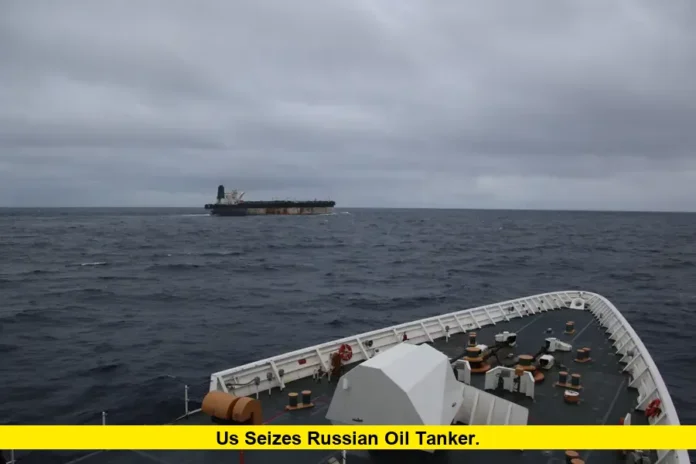
The United States successfully seized a Russian-flagged oil tanker on Wednesday following a dramatic weeks-long pursuit across the Atlantic Ocean, marking one of the most significant maritime enforcement actions in the ongoing sanctions campaign against Venezuela and its allies. The operation to seize the vessel, which attempted to evade capture by changing its name and hoisting a Russian flag mid-voyage, represents a bold escalation in Washington’s efforts to crack down on sanctioned oil shipments and shadow fleet operations.
The tanker, originally known as the Bella 1 and later renamed the Marinera, was intercepted by US forces in international waters between Iceland and the United Kingdom. The US Coast Guard Cutter Munro led the pursuit, tracking the vessel through treacherous Atlantic storms for more than two weeks before Navy SEALs conducted a boarding operation to take control of the ship. The seizure occurred around 7 a.m. Eastern Time on Wednesday, according to US European Command.
Table of Contents
Dramatic Pursuit Across the Atlantic
The saga began in late December when the Bella 1 approached Venezuelan waters with the apparent intent to load sanctioned oil. On December 20, the US Coast Guard attempted to board the vessel, but the crew refused to allow American personnel aboard. Instead of complying with the boarding order, the tanker reversed course and fled into the Atlantic Ocean.
During its escape attempt, the crew took extraordinary measures to avoid capture. They painted a crude Russian flag on the ship’s hull and officially changed the vessel’s name to Marinera. By January 1, the tanker had been registered in Russia’s official maritime registry, a move that Moscow granted without the standard inspections and administrative formalities typically required for ship registration.
US Homeland Security Secretary Kristi Noem described the pursuit as a testament to American determination. The crew of the USCGC Munro pursued the vessel across the high seas and through dangerous weather conditions, maintaining constant surveillance despite the tanker’s attempts to evade detection. The operation involved coordination between the Department of Homeland Security, the US Coast Guard, and the Department of Defense.
Russian Naval Presence Complicates Operation
The pursuit took on international dimensions when Russian military assets arrived to escort the fleeing tanker. A Russian submarine and several warships were deployed to shadow the Marinera as it sailed through the North Atlantic. The presence of Russian naval forces raised the stakes considerably, creating a tense standoff between American and Russian military assets on the high seas.
Multiple surveillance aircraft from the United States and allied nations tracked the vessel’s movements. US P-8 Poseidon maritime patrol aircraft flying from an RAF base in Britain monitored the tanker closely, while Irish and French aircraft also provided surveillance support. The United Kingdom’s Ministry of Defence confirmed it had provided enabling support for the operation, including pre-planned operational assistance and aerial surveillance.
Despite the Russian military presence in the general vicinity, there were no reports of confrontations between US and Russian forces during the boarding operation. US officials confirmed that Navy SEALs, flown to the scene by members of the 160th Special Operations Aviation Regiment known as the “Night Stalkers,” successfully took control of the vessel without incident.
Vessel’s Sanctioned History and Shadow Fleet Ties
The Bella 1 has a long history of involvement in sanctioned oil operations. The tanker was placed on the US sanctions list in June 2024 for its role in transporting cargo on behalf of Hezbollah, the Iran-backed terrorist organization. Between 2021 and 2025, the vessel reportedly transported more than 7 million barrels of Iranian crude oil and approximately 4 million barrels of Venezuelan crude to China.
The tanker is part of what officials describe as the shadow fleet, a network of vessels that illegally transport oil from sanctioned nations including Russia, Iran, and Venezuela. These ships typically employ various evasion tactics, including flying false flags, disabling their transponders, and falsifying their location data to avoid detection by maritime authorities.
The US Office of Foreign Assets Control, the Treasury Department’s financial intelligence and enforcement agency, had previously designated the ship’s owner for carrying sanctioned cargo. The vessel’s connections to Hezbollah made it a particularly significant target for US enforcement efforts.
Second Tanker Seized in Caribbean Waters
In a coordinated operation conducted simultaneously with the Marinera seizure, US forces apprehended a second sanctioned tanker in the Caribbean Sea. The vessel, identified as the Motor Tanker Sophia, was intercepted in international waters near the Caribbean in a pre-dawn operation conducted by the Department of Homeland Security in coordination with the Department of Defense.
US Southern Command announced that the Sophia was fully loaded and conducting illicit activities when it was apprehended. The operation occurred without incident, with the Coast Guard taking control of the vessel and preparing to escort it to the United States for final disposition.
Homeland Security Secretary Noem praised both operations as examples of effective law enforcement. She described them as two safe and successful boardings conducted within hours of each other, demonstrating the capability and determination of US maritime forces to enforce sanctions anywhere in the world.
White House Declares Vessels Stateless
At a White House press briefing, Press Secretary Karoline Leavitt defended the legality of the seizures. She stated that the Marinera had been deemed stateless after flying a false flag, making it subject to US jurisdiction. According to Leavitt, the vessel had a judicial seizure order issued by a US federal court, which authorized the boarding and capture operation.
The designation of the tanker as stateless is significant under international maritime law. Leavitt explained that because the vessel changed its flag registration while at sea, which is not permitted under international law unless there is a legitimate change of ownership or registration, the ship lost the protection normally afforded to vessels flying a recognized national flag.
The crew members aboard the Marinera are now subject to prosecution for violations of federal law. They will be brought to the United States for potential criminal charges if deemed necessary. Attorney General Pam Bondi announced that federal authorities are investigating the crew for failing to comply with Coast Guard orders and for their role in the sanctions-evasion network.
Russian Government Condemns Seizure
Russia’s reaction to the seizure was swift and condemnatory. The Russian Transport Ministry issued a statement asserting that US naval forces had violated international maritime law by boarding the vessel in international waters. The ministry emphasized that under the 1982 UN Convention on the Law of the Sea, freedom of navigation applies on the high seas, and no state has the right to use force against vessels properly registered in other jurisdictions.
Russian officials said they lost all contact with the Marinera after US forces boarded the ship. The Transport Ministry had granted the tanker temporary authorization to sail under the Russian flag on December 24, just days before the vessel was intercepted.
The Russian Foreign Ministry demanded that the United States ensure humane and dignified treatment of crew members, particularly Russian nationals aboard the vessel, and called for their prompt return home. A senior Russian politician described the American action as outright piracy and a clear violation of maritime law.
Senator Andrei Klishas of the Putin-aligned United Russia party and Leonid Slutsky, chairman of the State Duma Committee on International Affairs, both condemned the seizure through Russian state media. Slutsky told the TASS news agency that the action was unquestionably a violation of maritime law and UN conventions.
Part of Broader Venezuelan Oil Blockade
The seizure of the Marinera and the Sophia represents the latest phase in a comprehensive US military pressure campaign against Venezuela’s oil exports. The operation, which began in December, aims to enforce sanctions and cut off revenue streams for the Venezuelan government and its allies.
The blockade intensified after US forces captured Venezuelan President Nicolás Maduro on January 3. Following his capture, at least 16 tankers fled Venezuelan ports in an attempt to evade the US quarantine. Many of these vessels employed evasion tactics such as transmitting false names and position data or completely disabling their Automatic Identification System transponders.
Several other sanctioned oil tankers operating near Venezuela have changed their flags to Russia in recent weeks. At least three vessels, the Malak (renamed Sintez), the Dianchi (renamed Expander), and the Veronica (renamed Galileo), switched from flags of convenience like Comoros and Guyana to Russian registration, according to the Russian Maritime Register of Shipping and maritime tracking services.
Secretary of State Marco Rubio explained that the tanker seizures are part of broader stabilization efforts for Venezuela. He stated that Venezuelan authorities understand that the only way they can move oil, generate revenue, and avoid economic collapse is by cooperating with the United States. The seized oil from these vessels is expected to be part of negotiations between Washington and Caracas.
Defense Secretary Affirms Global Enforcement
Secretary of Defense Pete Hegseth emphasized that the blockade of sanctioned and illicit Venezuelan oil remains in full effect anywhere in the world. His statement on social media made clear that the Trump administration is willing to pursue enforcement actions regardless of geographic location or the involvement of other nations.
The Marinera seizure is particularly significant because the vessel was not carrying any oil at the time of its capture. Despite being empty, US authorities pursued the tanker because of what it represents, its role in the shadow fleet network, and its history of sanctions violations. The pursuit and capture send a strong message to other vessels involved in illicit oil transportation.
UK Defence Secretary John Healey praised the operation and emphasized the depth of the UK-US defense partnership. Britain has already sanctioned more than 500 Russian vessels as part of efforts to combat shadow fleet operations, which officials say has contributed to a reported 27 percent drop in Moscow’s oil revenues since late 2024.
International Maritime Law Debate
The seizure has sparked debate about the limits of enforcement under international maritime law. Some maritime law experts have questioned whether the United States had the legal authority to board the vessel in international waters, particularly after it had been registered under the Russian flag.
Former head of the Irish Coast Guard Chris Reynolds told Irish media that the US should not have been allowed to board the tanker. He described the development as very serious and argued that the Marinera had the right of free passage on the high seas. According to Reynolds, the only circumstances under which the US could legally board a vessel in international waters would be if it was believed to be involved in piracy, human trafficking, or similar crimes specifically enumerated in international conventions.
However, US officials maintain that the seizure was conducted pursuant to a warrant issued by a US federal court and that the vessel’s change of flag at sea rendered it stateless under international law. The concept of statelessness removes the protections normally afforded to vessels flying a recognized national flag, potentially giving the US legal grounds for the boarding.
The White House also pointed to what it described as the vessel’s false flag designation. Officials argued that because the crew painted a Russian flag on the hull and changed the ship’s registration while fleeing from US authorities, rather than through proper administrative channels with a legitimate change of ownership, the flag was not valid under international maritime conventions.
Shadow Fleet Operations Under Scrutiny
The incident highlights the growing challenge of shadow fleet operations that enable sanctioned nations to continue exporting oil despite international restrictions. These vessels typically operate by frequently changing names, flags, and transponder signals to avoid detection and enforcement.
Maritime security analysts note that flag-hopping, the practice of rapidly switching ship registrations between different countries, has become a common tactic for evading sanctions. In the case of the Marinera, the vessel’s swift registration under the Russian flag without standard inspections raised suspicions that Moscow was deliberately attempting to shield the tanker from US enforcement.
The shadow fleet poses significant challenges for sanctions enforcement because these vessels often operate in a legal gray area. They may be owned by shell companies, use fraudulent documentation, and employ crews who are willing to disable safety equipment and identification systems to avoid detection.
The tanker had previously turned off its transponders while at sea, according to the UK Ministry of Defence, in an apparent attempt to elude pursuers. Such behavior is particularly dangerous because it prevents other vessels from tracking the ship’s location, increasing the risk of collisions and maritime accidents.
Political Implications and Congressional Response
The tanker seizures have sparked political debate in Washington. As senators prepared for briefings on US operations related to Venezuela, partisan divisions emerged over the administration’s strategy. Democrats have pressed for clarity on the long-term plan and questioned the legal basis for some military actions.
Senate Minority Leader Chuck Schumer criticized the administration’s approach, stating that officials appeared to lack a clear plan for subsequent steps. Some senators have signaled plans to force a war powers vote this week to potentially limit further military action without congressional authorization.
However, supporters of the enforcement actions argue that the seizures demonstrate the administration’s commitment to maintaining economic leverage over Venezuela and enforcing international sanctions against nations that support terrorism and evade international law. They contend that the operations fall within existing legal frameworks for maritime interdiction and sanctions enforcement.
Venezuela Oil Deal on the Horizon
President Donald Trump stated Tuesday that Venezuela would hand over between 30 and 50 million barrels of oil to the United States. The announcement suggests that negotiations are underway regarding Venezuelan oil reserves, which have emerged as a key component of the administration’s energy strategy.
The seized tankers and their cargo could potentially be part of these negotiations. Secretary of State Rubio indicated that Venezuelan authorities are cooperating because they recognize that their economic survival depends on working with the United States rather than continuing to evade sanctions.
Venezuela’s oil production has declined significantly since the early 2000s due to corruption, mismanagement by the state oil company PDVSA, and international sanctions. Former President Nicolás Maduro had previously accused the United States of attempting to plunder Venezuelan oil resources, but his capture appears to have changed the dynamic of the relationship.
The Trump administration has made clear that Venezuela’s vast oil reserves are central to its regional strategy. The combination of military pressure, sanctions enforcement, and the capture of key Venezuelan leaders appears designed to compel cooperation from whatever government emerges in Caracas.
Future of Maritime Sanctions Enforcement
The successful seizure of the Marinera after a weeks-long pursuit across the Atlantic Ocean demonstrates the Trump administration’s willingness to expend significant military resources to enforce sanctions. The operation required sustained surveillance, international coordination, and the deployment of elite special operations forces.
Maritime security experts suggest that the seizure will likely have a deterrent effect on other shadow fleet operators. However, they also note that sanctioned nations and the companies that profit from illicit oil trade will continue to develop new evasion tactics.
The involvement of Russian naval assets in attempting to protect the Marinera indicates that sanctions enforcement may increasingly involve direct confrontations between major powers. While no shots were fired in this instance, the presence of Russian submarines and warships created a potentially volatile situation that could have escalated.
The United Kingdom’s active participation in the operation, providing both surveillance support and basing for US aircraft, demonstrates that America’s allies are willing to support aggressive sanctions enforcement despite the potential for diplomatic friction with Russia.
What do you think about this high-stakes maritime operation? Share your thoughts in the comments below and follow our coverage for the latest developments on this unfolding situation.

