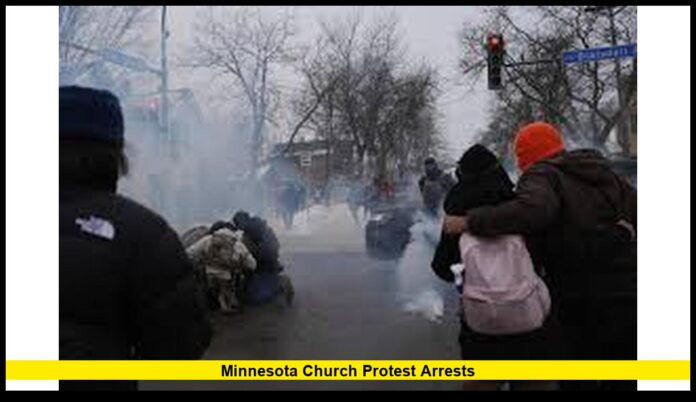
Minnesota church protest arrests have unfolded this week after federal authorities detained three activists tied to an anti-immigration enforcement protest that disrupted a Sunday worship service at Cities Church in St. Paul, Minnesota. The arrests, announced Thursday, have ignited intense discussion about protest tactics, religious freedom, and federal enforcement of civil rights laws.
Table of Contents
What Happened Inside the Church
On Sunday morning, a group of protesters entered Cities Church during a scheduled service and began vocalizing opposition to U.S. Immigration and Customs Enforcement (ICE). They specifically targeted a pastor at the church who also serves as the acting field office director for ICE in Minnesota. The protest included chants calling for ICE to leave and criticism of recent immigration enforcement actions in the state. The service was temporarily interrupted as a result of the demonstration.
The demonstration was part of broader protests against ICE operations in the Twin Cities, which have drawn national attention. Protest organizers said they were motivated by frustration with federal immigration enforcement policies and recent controversial incidents involving ICE in Minnesota.
Federal Arrests Announced
Federal authorities confirmed on Thursday, January 22, 2026, that three individuals were arrested in connection with the protest. The arrests were executed under federal statutes designed to protect the free exercise of religion and prevent interference with others’ constitutional rights.
The three people detained are:
- Nekima Levy Armstrong – A civil rights attorney and local activist who helped organize the protest.
- Chauntyll Louisa Allen – A member of the St. Paul School Board and community organizer.
- William Kelly – An activist known for his public opposition to ICE operations.
Officials allege that the actions of these individuals violated a federal law that prohibits obstructing access to places of worship and conspired to interfere with others’ rights during a religious service.
Legal Proceedings and Charges
After their arrests, the three protesters were taken into federal custody and appeared before a magistrate judge in St. Paul. Court proceedings included hearings on bond and conditions of release. Federal prosecutors are pursuing charges related to conspiracy and interference with the free exercise of religion, reflecting the seriousness with which authorities are treating disruptions in houses of worship.
Bond was granted to at least two of the activists with travel restrictions and conditions that limited their movements. Prosecutors indicated they would appeal some of those bond conditions. The defendants remain in custody as legal proceedings continue.
Journalist at Protest Not Charged
A prominent media figure who livestreamed the protest from inside the church was not charged in connection with the demonstration. A magistrate judge declined federal prosecutors’ request to approve charges against the journalist, finding insufficient evidence to support criminal conduct and underscoring protections for newsgathering and First Amendment activities. The journalist’s legal team stated that recording the event was within the scope of protected press activity.
The decision not to charge the independent journalist has been seen by legal observers as a notable affirmation of press freedoms, even as authorities pursue charges against individuals directly involved in organizing or leading the protest.
Reactions from Officials and Community Leaders
The Minnesota church protest arrests prompted a variety of responses from political leaders, faith groups, and community organizations:
- Federal officials responsible for the arrests emphasized that disrupting religious services and blocking worshippers’ access to a house of worship would not be tolerated.
- Some conservative political figures and government leaders publicly supported the decision to enforce federal statutes protecting places of worship and criticized the protest as an inappropriate tactic.
- Critics of the arrests argued that the enforcement actions represent an overreach that could chill protest activity and free speech, especially regarding immigration policy debates.
- Supporters of the arrested activists gathered outside the federal courthouse in St. Paul, holding signs and calling for their release and defending their right to protest.
Church leadership also weighed in, expressing concern about the interruption of worship and affirming the congregation’s right to conduct services without disruption. Leaders called for respect for religious spaces even amid intense political disagreements.
Background: Broader Context of Protesters’ Grievances
The protest at Cities Church occurred amid heightened tensions over immigration enforcement in Minnesota. Local activists have been vocal in their opposition to how ICE has conducted operations in the state, particularly after a recent incident involving a fatal shooting by an ICE officer. That event sparked protests across the Twin Cities and intensified calls for accountability and policy reform.
Demonstrators have argued that aggressive enforcement actions have eroded trust between immigrant communities and law enforcement, prompting more assertive direct actions, including inside a church service. Opponents of the protest tactics counter that interrupting worship crosses a line and alienates potential allies in broader reform efforts.
Timeline of Key Developments
- Sunday, January 18, 2026 – Protesters enter Cities Church during worship service and disrupt the event.
- Monday, January 19, 2026 – Federal civil rights investigations begin following the incident.
- Thursday, January 22, 2026 – Minnesota church protest arrests are announced for three activists.
- Thursday, January 22, 2026 – Magistrate judge rejects attempt to charge an independent journalist present at the protest.
What to Expect Next
As the legal process moves forward, federal prosecutors will continue preparing their cases against the arrested individuals. Appeals related to bond and charges are expected, and further court dates will be scheduled in the coming weeks. The broader political and social debates over immigration enforcement and protest tactics are likely to remain in the spotlight as this story develops.
Federal and local officials have indicated their intention to ensure that houses of worship remain places where people can exercise their religious beliefs free from obstruction, while activists and civil liberties advocates watch closely for how protest rights are balanced with those protections.
Share your thoughts on this developing story in the comments and stay tuned for more updates on Minnesota church protest arrests.

