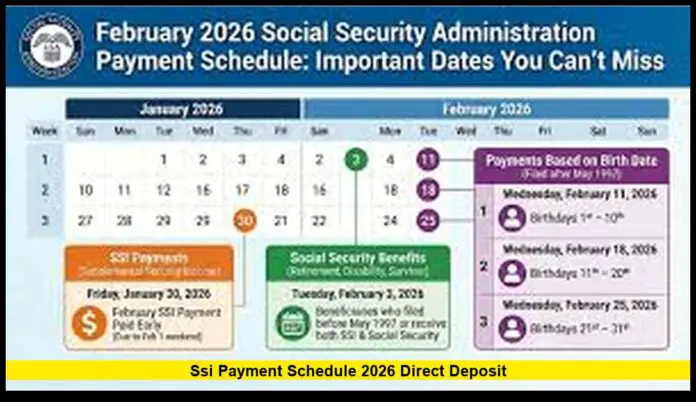
The 2026 SSI direct deposit payment schedule typically sends payments on the 1st of each month, or the preceding business day if the 1st falls on a weekend or federal holiday.
Millions of Americans depend on monthly Supplemental Security Income to cover basic living expenses, making payment timing just as important as payment amounts. The ssi payment schedule 2026 direct deposit has drawn close attention this year because several payments are arriving earlier than usual, creating changes in how recipients manage their monthly budgets.
This in-depth report explains how the 2026 SSI payment calendar works, why certain months include early deposits, how much beneficiaries receive in 2026, and what recipients should do to stay financially prepared throughout the year.
Table of Contents
Understanding How SSI Payments Are Issued
Supplemental Security Income (SSI) follows a strict federal payment schedule set by the Social Security Administration. Under normal conditions, SSI benefits are issued on the first day of each month, regardless of a recipient’s age, disability status, or location.
However, when the first of the month falls on a weekend or federal holiday, payments are automatically moved to the last business day of the previous month. This ensures beneficiaries receive their funds on time without delays.
In 2026, this adjustment happens multiple times, leading to early payments in months like February, March, August, and November. For example, the March 2026 SSI payment was issued on February 27, 2026, because March 1 fell on a weekend.
As a result, some months may appear to have two SSI payments, while others may have none, even though beneficiaries still receive the correct total amount for the year.
Additionally, SSI benefits increased in 2026 due to a 2.8% cost-of-living adjustment (COLA), raising the maximum monthly federal payment to about $994 for individuals and $1,491 for couples, which directly affects the amount deposited on each scheduled payment date.
Why Early SSI Payments Occur in 2026
Early SSI payments in 2026 are driven entirely by calendar alignment, not by policy changes or benefit increases. When the first day of a month falls on a Saturday, Sunday, or federal holiday, the Social Security Administration does not process payments on that day. Instead of delaying funds, payments are issued on the last business day before the first, ensuring recipients receive their money on time.
This scheduling shift can create situations where two payments arrive very close together, such as one at the end of a month and the next at the start of the following month. After that, there may be a longer gap before the next deposit, which can feel confusing if you’re not expecting it.
In 2026, this pattern occurs several times—most notably around March, June, September, and November payment cycles—because of how weekends fall on the calendar. These early deposits are part of the standard system and are not errors or bonuses.
It’s important to remember that early payments are simply advance payments for the upcoming month, not extra income. Even if you receive two deposits in a short period, your total annual SSI benefits remain exactly the same, and careful budgeting can help manage the longer gap that sometimes follows.
Confirmed SSI Payment Timing at the Start of 2026
The first quarter of 2026 clearly demonstrates how SSI scheduling rules are applied in real time:
- January 2026 benefits were issued on December 31, 2025, because January 1 is a federal holiday (New Year’s Day)
- February 2026 benefits were delivered on January 30, 2026, since February 1 fell on a Sunday
- March 2026 benefits were sent on February 27, 2026, as March 1 also landed on a weekend
These adjusted dates were applied uniformly across all recipients. Whether individuals received funds through direct deposit or via a Direct Express® debit card, payments followed the same early-release schedule.
This consistent approach ensures that recipients are not affected by banking closures or federal holidays, while still maintaining the integrity of the monthly benefit cycle.
What the Rest of the 2026 SSI Calendar Looks Like
For the remainder of 2026, SSI payments mostly return to their standard schedule, with benefits issued on the first day of each month. This predictable structure allows recipients to plan their finances with confidence throughout most of the year.
Any adjustments that do occur follow a consistent and transparent rule: if the first of the month falls on a weekend or federal holiday, the payment is simply moved to the previous business day. There are no exceptions, delays, or last-minute changes built into the system.
In 2026, a few additional early-payment months will appear later in the year due to this same calendar pattern, but the logic never changes. Importantly, these are not bonus payments or extra deposits—they are just advanced payments for the upcoming month.
Overall, the SSI schedule remains one of the most reliable federal payment systems. As long as beneficiaries understand how weekends and holidays shift timing, they can accurately anticipate every deposit and avoid confusion when payments arrive earlier than usual.
Direct Deposit and How SSI Funds Reach Beneficiaries
Direct deposit remains the fastest and most secure way to receive SSI benefits in 2026. When enrolled, payments are electronically transferred to a beneficiary’s bank account on the official payment date set by the Social Security Administration.
In most cases, funds are available early in the morning on the payment date, though some banks may display the deposit as pending the night before, depending on their internal processing systems. Credit unions and certain online banks may even release funds slightly earlier, but this varies by institution.
Direct deposit continues to be the preferred option because it offers clear advantages:
- Faster access to funds compared to paper checks
- Greater security, reducing the risk of theft, fraud, or lost payments
- Consistent delivery, with no dependence on postal service delays
- Automatic processing, eliminating the need for manual handling
Once direct deposit is set up, it stays active without interruption unless the beneficiary updates their banking details or switches payment methods. This reliability ensures that SSI recipients receive their benefits smoothly and on time every month, regardless of external factors like weather, mail disruptions, or holidays.
SSI Payment Amounts in 2026
SSI benefits increased in 2026 following a 2.8% cost-of-living adjustment (COLA), helping recipients keep pace with inflation and rising everyday expenses.
For 2026:
- The maximum federal SSI payment for an individual is $994 per month
- The maximum federal SSI payment for a couple is $1,491 per month
However, not every recipient receives the maximum amount. Actual SSI payments can vary based on several key factors:
- Other income (such as wages, Social Security benefits, or pensions)
- Living arrangements (for example, whether someone lives alone or receives support from others)
- State supplements, which may increase benefits depending on where you live
As a result, some individuals may receive reduced payments, while others may see higher total monthly benefits due to additional state-level assistance. This flexible structure ensures SSI support is tailored to each recipient’s financial situation.
State Supplements and Combined Payments
In addition to federal SSI benefits, many states offer supplemental payments to provide extra financial support. These state-funded amounts are designed to help cover higher living costs and vary widely depending on where a recipient lives.
State supplements may be delivered in two ways:
- Combined payments, where the state amount is included with the federal SSI deposit
- Separate payments, issued on a different date by the state agency
Because of this, some recipients may notice multiple deposits within the same month—one from the federal government and another from their state. The timing of these supplemental payments does not always align with the standard SSI schedule, which can create differences in when funds appear.
Not all states provide supplements, and the amounts, eligibility rules, and payment timing can differ significantly. Factors such as living arrangements, level of care, or disability status may also influence how much additional support is provided.
Understanding whether your state participates in SSI supplementation—and how those payments are issued—can help explain why your total monthly benefit varies and why deposits may not always follow the same pattern as federal SSI payments.
Budgeting Around Early SSI Deposits
Early SSI payments can make monthly budgeting more challenging, especially when funds arrive sooner but still need to last the same amount of time. Receiving a payment early does not mean extra money—it simply shifts when the funds are available.
To manage early deposits effectively:
- Spread the payment across the full upcoming month, not just the days immediately after it arrives
- Avoid spending too quickly, even if two deposits come close together
- Track expenses weekly, which helps maintain consistency during longer gaps between payments
- Set aside fixed amounts for essentials like rent, groceries, and utilities as soon as the deposit arrives
Many recipients also benefit from marking payment dates on a calendar or using reminders to clearly see when the next deposit is coming. This makes it easier to plan ahead, especially during months where there may be a longer wait between payments.
Building even a small buffer—when possible—can also help reduce stress during these gaps and create more stability throughout the year.
Common Misunderstandings About SSI Payments
Each year, early SSI payments lead to confusion, especially when deposits don’t follow the usual monthly pattern. Understanding the facts can help avoid unnecessary concern:
- Early payments are not bonus payments — they are simply issued ahead of schedule due to weekends or holidays
- Two deposits in one month do not increase total benefits — one of those payments is for the following month
- Payment timing does not affect eligibility — your qualification and benefit amount remain unchanged regardless of when funds arrive
These misunderstandings are common, particularly during months with adjusted schedules. By recognizing that timing shifts are purely administrative, recipients can better plan their finances and avoid misinterpreting normal payment variations.
What to Do If an SSI Payment Is Late
SSI payments are typically very reliable, but occasional delays can happen due to bank processing issues, holidays, or recent account changes. If your payment does not arrive as expected, there are a few practical steps to take.
First, check your bank account carefully, including any pending or scheduled transactions, as some deposits may appear later in the day depending on your financial institution. It’s also important to confirm the official payment date, especially in months when payments are issued early due to weekends or holidays.
If the deposit is still missing, wait at least one to three business days, since minor delays can occur during processing. During this time, avoid assuming the payment is lost, as most issues resolve automatically.
If the payment has not arrived after this window, the next step is to contact the Social Security Administration directly to report the issue and verify your payment status. They can confirm whether the payment was sent and help identify any problems.
Keeping your banking details current and accurate is one of the most effective ways to prevent delays, especially if you’ve recently changed accounts or financial institutions.
Preparing for the Year Ahead
The SSI program continues to serve as a critical financial lifeline for seniors and individuals with disabilities in 2026. With a clear understanding of payment timing, deposit methods, and benefit amounts, recipients can make more informed financial decisions and avoid unnecessary surprises.
Staying aware of how weekends, holidays, and early payment schedules affect deposits is especially important this year, as several months include adjusted payment dates. Planning ahead for these shifts helps ensure that funds last through longer gaps between deposits.
By combining this awareness with careful budgeting, tracking expenses, and prioritizing essential costs, beneficiaries can better manage their monthly income. Even small steps—like setting reminders for payment dates or allocating funds at the start of each month—can make a meaningful difference.
With the right approach, SSI recipients can reduce financial stress, stay organized, and maintain greater stability throughout the year, regardless of how the payment calendar shifts.
Key Takeaways for SSI Recipients in 2026
- SSI is normally paid on the first of the month, following a consistent federal schedule
- Weekend and holiday rules can shift payments earlier, sometimes creating back-to-back deposits
- Direct deposit offers the fastest and most reliable access to your benefits
- Payment amounts increased in 2026 due to the annual cost-of-living adjustment (COLA)
- Budgeting is especially important during early-payment months, when longer gaps between deposits can occur
Staying informed about how SSI works—especially timing changes and payment rules—is one of the most effective ways beneficiaries can manage limited income, avoid confusion, and maintain financial stability throughout the year.
How are you adjusting your monthly plans around SSI payment timing this year? Share your thoughts and stay tuned for future updates.

