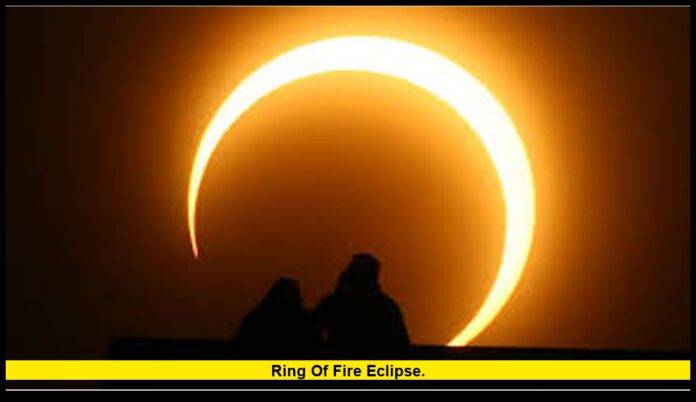
The ring of fire eclipse on February 17, 2026 has just occurred, and astronomers and skywatchers worldwide are buzzing about this rare celestial spectacle. This annular solar eclipse turned the Sun into a brilliant “ring of fire” — visible only in remote regions — and remains one of the most striking astronomical events of the year.
Table of Contents
What a Ring of Fire Eclipse Is
A ring of fire eclipse, also called an annular solar eclipse, happens when the Moon passes between the Earth and the Sun but is at a greater distance from Earth in its orbit. Because the Moon appears slightly smaller than the Sun in the sky, it doesn’t block the Sun completely. Instead, a thin, blazing ring of sunlight surrounds the dark silhouette of the Moon at maximum eclipse.
This effect is distinct from a total solar eclipse. During a total eclipse, the Moon fully covers the Sun, plunging areas of the Earth into a dramatic yet brief darkness. In contrast, the ring of fire eclipse never achieves full darkness, although daylight dims noticeably. The Moon’s shadow still falls on Earth, creating partial eclipses over broad regions.
Timing of the 2026 Ring of Fire Eclipse
On Tuesday, February 17, 2026, the ring of fire eclipse unfolded across a series of phases that lasted several hours. While the path of full annularity was confined to Antarctica, the partial phases stretched across parts of southern continents and oceans.
Key Timing (Universal and EST):
- Partial eclipse begins: Early morning (UTC and EST)
- Maximum annularity (ring of fire): Midday UTC
- Partial eclipse ends: Later afternoon UTC
In U.S. local time (Eastern Time), the eclipse began around 4:56 a.m., peaked near 7:12 a.m., and concluded by 9:27 a.m..
Where the Ring of Fire Was Visible
Annular Phase (Full Ring of Fire):
The narrow band of annularity — where the full ring of fire could be seen — passed almost entirely over Antarctica and adjacent Southern Ocean waters. This made direct viewing possible mainly for scientists, research personnel, and very few visitors in the region.
Most of Antarctica’s vast ice fields and remote seas experienced the peak of the eclipse, where the Moon covered approximately 96.3% of the Sun’s diameter.
Partial Eclipse Zones:
Although the full ring was exclusive to Antarctica, partial eclipses were visible across portions of the Southern Hemisphere, including:
- Southern Argentina and Chile
- Southern Africa, including parts of South Africa and Mozambique
- Madagascar and nearby islands
- Sections of the Atlantic, Pacific, and Indian Oceans
In many of these regions, skywatchers reported seeing the Moon take a significant “bite” out of the Sun during the partial phases.
Does This Eclipse Matter for the U.S.?
While the ring of fire was not visible from the United States, the event remains important to American skywatchers and scientists alike. Live broadcasts and scientific feeds allowed observers coast-to-coast to experience the spectacle in real time, with expert commentary and detailed imaging shared online.
The real excitement for U.S. audiences comes with other eclipse events later in 2026, including a total solar eclipse on August 12 that will be visible from parts of Greenland, Iceland, and northern Spain — and as a partial eclipse in broader Europe and Africa.
Why this Eclipse Happens
The timing of eclipses like this one depends on the relative positions of the Sun, Earth, and Moon. Solar eclipses occur only during a new moon, but they do not happen every lunar cycle because the Moon’s orbital plane is tilted relative to Earth’s orbital path around the Sun.
Only when the new moon aligns with one of the two points where the Moon’s path crosses Earth’s orbital plane — called nodes — does an eclipse occur.
In this case, the Moon was near its farthest point from Earth (closer to apogee), meaning its apparent size was too small to fully block the Sun. That created the distinctive ring — a glowing perimeter of sunlight — at the peak of the eclipse.
Safety Tips for Viewing Solar Eclipses
At all phases of any solar eclipse, looking directly at the Sun without proper protection can cause permanent eye damage. Here’s how to stay safe:
- Use ISO-certified solar eclipse glasses at all times when observing the Sun.
- Do not substitute regular sunglasses. Their lenses do not block enough sunlight.
- If using cameras, binoculars, or telescopes, make sure to equip them with approved solar filters.
- Never look directly into unfiltered optics aimed at the Sun.
Even during partial phases, solar brightness remains intense and can harm your eyes without proper protection.
How Eclipses Fit Within Eclipse Seasons
The February 17 ring of fire eclipse is part of a broader eclipse season — a period during which the Sun, Earth, and Moon align in ways that make eclipses possible. This cycle lasts about five weeks and typically includes both a solar and lunar eclipse.
In 2026, this ring of fire event was followed by a total lunar eclipse on March 3, visible from many parts of Earth. Eclipse seasons repeat roughly every six months, with two or three eclipses per season.
Scientific and Cultural Significance
Although this particular ring of fire was not widely visible in populated areas, it still holds scientific and cultural importance:
- Astronomical Research: Eclipses help scientists refine models of Earth-Moon orbital mechanics and solar behavior.
- Public Interest: Even remote events boost public awareness of astronomy and ignite curiosity about space.
- International Collaboration: Worldwide coverage and shared observations connect viewers globally, regardless of location.
This eclipse reminds us that celestial motion follows precise, predictable cycles that humanity has studied throughout history.
What’s Next in Solar Eclipses
After the February 17 ring of fire eclipse, several notable solar eclipses lie ahead:
- August 12, 2026: A total solar eclipse visible from parts of Europe, Greenland, and Iceland — with partial views spreading into wider areas.
- February 6, 2027: Another annular solar eclipse with visibility across parts of South America.
These future events will draw significant interest, both from travelers planning eclipse tours and from scientists seeking more data from different vantage points.
Quick Facts at a Glance
| Event | Detail |
|---|---|
| Date | February 17, 2026 |
| Type | Annular (ring of fire) solar eclipse |
| Peak Annularity | Antarctica |
| Partial Visibility | Southern parts of South America, Africa, and near oceans |
| U.S. Visibility | Not visible in continental U.S. |
The ring of fire eclipse of February 17, 2026 dazzled a hidden corner of the world but captivated people everywhere through real-time coverage. Its precision, beauty, and cosmic choreography remind us how interconnected and dynamic our solar system truly is.
What part of this year’s eclipse fascinated you most? Share your experience or thoughts in the comments below!

