The low income subsidy medicare program remains one of the most consequential affordability protections embedded within the federal health insurance structure in 2026. Designed to shield financially vulnerable beneficiaries from high prescription drug costs, this program directly influences access, medication adherence, plan participation, and long-term health outcomes across the United States. As Medicare Part D continues to evolve through benefit redesign and cost-containment reforms, this subsidy stands at the center of prescription affordability policy.
For healthcare economists, compliance officers, plan sponsors, state administrators, and policy strategists, understanding the operational depth of this program is not optional. It shapes enrollment flows, premium benchmarks, cost-sharing obligations, federal expenditures, and beneficiary protections in measurable ways. Its reach extends far beyond premium support. It stabilizes vulnerable populations and reinforces the structural integrity of the Medicare prescription drug benefit.
Legislative Origins and Structural Foundation
The subsidy was established alongside the launch of Medicare Part D in 2006. At that time, policymakers recognized that simply offering prescription coverage would not be enough for beneficiaries living near or below poverty thresholds. Without financial assistance, many individuals would remain unable to afford premiums, deductibles, and copayments even after coverage became available.
The program was therefore embedded into Part D as a permanent, federally administered affordability safeguard. Since its introduction, Congress has refined income thresholds, resource calculations, and cost-sharing rules to reflect economic changes and broader healthcare reform initiatives. Adjustments over time have expanded eligibility and strengthened protections, ensuring that more beneficiaries can qualify for comprehensive assistance.
Unlike optional assistance programs, this subsidy operates as a structured entitlement for those who meet defined financial criteria. It integrates directly into the Medicare administrative system, reducing the need for separate claims processing at the pharmacy level. Once eligibility is confirmed, cost reductions apply automatically within the beneficiary’s drug plan.
Eligibility Framework and Financial Assessment Standards
Eligibility hinges on two primary criteria: countable income and countable resources. Beneficiaries must be enrolled in Medicare Part A or Part B. Income assessments consider wages, Social Security benefits, pensions, and other recurring revenue streams, while excluding certain categories defined under federal guidelines.
Resource calculations evaluate liquid assets such as savings accounts, checking balances, investments, and additional real property not used as a primary residence. Importantly, a primary home, vehicle, and personal belongings generally do not count against resource limits. These exclusions prevent modest asset ownership from disqualifying applicants.
Income eligibility typically extends to individuals earning up to approximately 150 percent of the federal poverty level. Resource thresholds are indexed and adjusted periodically. These limits are designed to ensure the program targets individuals facing genuine financial vulnerability while preserving fiscal accountability.
Automatic eligibility applies to individuals who already receive Supplemental Security Income, full Medicaid benefits, or assistance through Medicare Savings Programs. This automatic enrollment mechanism minimizes administrative duplication and accelerates benefit access.
Premium Protection and Benchmark Alignment
One of the most visible components of the program is premium support. Beneficiaries who qualify for full assistance generally pay no monthly premium if they enroll in a benchmark prescription drug plan in their region. Benchmark plans are defined annually based on regional premium averages.
If a beneficiary chooses a plan with a premium above the benchmark, the subsidy covers the benchmark amount while the individual pays the difference. This structure balances consumer choice with fiscal discipline. It also incentivizes plan sponsors to remain competitively priced within benchmark thresholds.
From an actuarial perspective, benchmark alignment plays a key role in plan participation rates. Plans positioned within benchmark limits often attract a significant share of subsidy enrollees, influencing regional market dynamics.
Deductible Elimination and Copayment Reductions
In addition to premium assistance, the program eliminates or dramatically reduces annual deductibles. For many qualifying beneficiaries, prescription coverage begins immediately without requiring satisfaction of an upfront deductible.
Copayment reductions provide further relief. Generic medications carry minimal copayments, while brand-name drugs are subject to capped amounts significantly lower than standard Part D cost-sharing levels. Once beneficiaries reach the catastrophic spending threshold defined by Medicare, cost sharing drops to zero for covered prescriptions for the remainder of the year.
This layered cost protection structure ensures that beneficiaries with chronic conditions or high drug utilization avoid unmanageable financial exposure. For policy analysts, these protections represent a critical safeguard against cost-related medication nonadherence.
Elimination of Late Enrollment Penalties
Another important provision removes late enrollment penalties for eligible individuals. Standard Part D rules impose permanent premium surcharges for beneficiaries who delay enrollment without creditable coverage. For low-income individuals who qualify for assistance, those penalties are waived.
This waiver recognizes that financial hardship or lack of awareness may have contributed to delayed enrollment. By removing penalty barriers, the program promotes equitable access and reduces long-term financial consequences for vulnerable populations.
Enrollment Pathways and Administrative Coordination
Enrollment occurs through two primary mechanisms. Automatic enrollment applies to beneficiaries receiving Medicaid, Supplemental Security Income, or certain Medicare Savings Program benefits. For others, direct application through the Social Security Administration is required.
Once approved, eligibility status is transmitted electronically to Medicare and plan sponsors. Cost-sharing adjustments then appear automatically within the beneficiary’s prescription drug plan. Pharmacies process claims reflecting subsidy-level copayments in real time.
This administrative coordination requires seamless data exchange between federal agencies, state Medicaid systems, plan sponsors, and pharmacy benefit managers. Accuracy in eligibility reporting ensures that beneficiaries receive appropriate financial protections at the point of sale.
Monthly Enrollment Flexibility and Plan Switching Rights
Eligible beneficiaries benefit from expanded enrollment flexibility compared to standard Medicare participants. They may change prescription drug plans or Medicare Advantage plans with drug coverage outside the traditional annual open enrollment window.
This flexibility allows beneficiaries to respond quickly to formulary changes, pharmacy network adjustments, or evolving medication needs. It also enhances consumer autonomy in selecting plans aligned with specific therapeutic requirements.
Frequent plan-switching rights introduce competitive pressure into the marketplace. Plan sponsors must maintain stable formularies and accessible pharmacy networks to retain enrollment among subsidy beneficiaries.
Automatic Assignment and Reassignment Protections
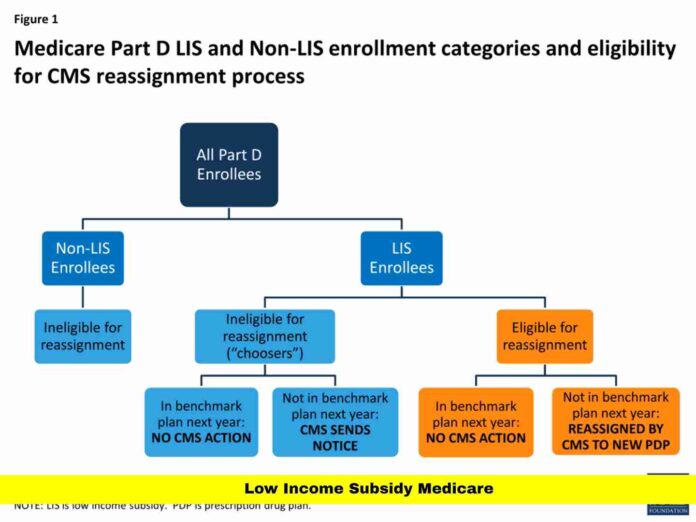
When beneficiaries qualify for assistance but have not actively selected a plan, Medicare assigns them to a benchmark plan to prevent coverage gaps. This automatic assignment ensures immediate prescription access.
If a beneficiary’s current plan exits the market or exceeds benchmark limits, reassignment protocols protect continuous eligibility for premium coverage. Individuals retain the right to select an alternative plan, but reassignment prevents involuntary loss of benefits.
This safety mechanism is particularly important for individuals managing complex medication regimens who cannot afford interruptions in therapy.
Coordination with Medicare Savings Programs
The subsidy frequently overlaps with Medicare Savings Programs administered at the state level. These programs assist with Part B premiums and, in some cases, cost sharing for hospital and medical services.
When beneficiaries qualify for both types of assistance, financial relief extends across both prescription and medical benefits. This comprehensive cost protection significantly reduces overall out-of-pocket spending.
State Medicaid agencies play a central role in identifying eligible individuals and facilitating data transfer for automatic enrollment. Effective coordination between federal and state systems enhances program efficiency and reduces administrative burdens.
Impact on Medication Adherence and Healthcare Utilization
Reducing prescription costs has measurable clinical and economic effects. Beneficiaries facing minimal copayments are more likely to adhere to prescribed therapies. Improved adherence reduces the risk of disease progression, emergency interventions, and hospital admissions.
Chronic conditions such as hypertension, diabetes, heart failure, and chronic obstructive pulmonary disease require consistent medication management. Financial barriers often lead to skipped doses or delayed refills. By minimizing these barriers, the program supports better long-term health outcomes.
Health economists consistently associate prescription affordability with reduced overall healthcare expenditures due to lower acute care utilization.
Plan Sponsor Considerations and Risk Adjustment
From a plan sponsor perspective, subsidy enrollees represent a population with elevated medication utilization and often multiple chronic conditions. Accurate risk adjustment and reimbursement modeling are critical to maintaining plan sustainability.
Federal payment structures account for higher utilization rates among low-income beneficiaries. Plan sponsors integrate subsidy enrollment projections into pricing strategies and formulary development decisions.
Understanding the behavioral and clinical characteristics of this population informs network design, pharmacy contracting, and care management initiatives.
Outreach and Enrollment Gaps
Despite the breadth of protections available, some eligible individuals remain unenrolled due to lack of awareness or misunderstanding of eligibility rules. Outreach initiatives target seniors, disabled beneficiaries, caregivers, and community health advocates.
Simplifying application procedures and clarifying asset exclusions can improve participation rates. Expanding awareness strengthens equity within the Medicare system by ensuring that assistance reaches all qualifying individuals.
Closing enrollment gaps also improves aggregate health outcomes and enhances the cost-effectiveness of federal healthcare spending.
Fiscal Sustainability and Policy Debate
Federal investment in the program reflects a policy commitment to protect vulnerable beneficiaries. While program costs are significant, policymakers view them within the context of broader healthcare savings achieved through improved medication adherence and reduced acute care utilization.
Debate continues regarding long-term sustainability, potential eligibility refinements, and integration with ongoing Medicare Part D reforms. As prescription drug pricing and healthcare inflation remain national priorities, this subsidy will likely remain central to policy discussions.
Its design balances fiscal oversight with social protection. Maintaining that balance will shape future legislative conversations.
Future Outlook in a Changing Medicare Landscape
The Medicare ecosystem continues to evolve with benefit redesign initiatives, spending caps, and drug pricing reforms. Within this shifting environment, the subsidy functions as a stabilizing anchor for low-income beneficiaries.
Continued modernization of administrative systems, data integration, and outreach strategies will determine how effectively the program serves future generations of Medicare participants.
Healthcare leaders, policymakers, and plan administrators must remain attentive to regulatory updates and enrollment trends to ensure optimal implementation.
The low income subsidy medicare structure stands as one of the most important pillars of prescription affordability in the United States. By reducing premiums, eliminating deductibles, lowering copayments, and protecting beneficiaries from catastrophic spending, it safeguards access to essential medications for millions.
Its operational complexity requires coordinated oversight, but its impact on financial security and health outcomes remains profound.
Have thoughts on how prescription affordability programs can evolve further? Share your perspective and stay informed as Medicare policy continues to develop.

