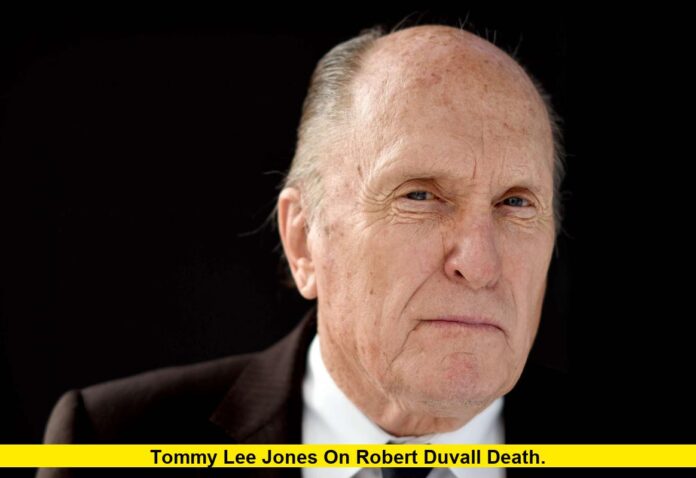
Legendary actor Tommy Lee Jones on Robert Duvall death shared heartfelt remarks as the entertainment world continues to process the loss of one of Hollywood’s most enduring icons. Duvall, who died at age 95 on February 15, 2026 at his home in Middleburg, Virginia, left behind a career that spanned seven decades and influenced generations of performers and audiences alike. His passing has sparked widespread remembrance across film and television communities, with Jones among those paying tribute to a dear friend, mentor, and costar.
Just days after Duvall’s death, Jones acknowledged the profound impact of his late colleague’s life and work. The two actors are forever linked in the minds of fans through their unforgettable performances in the landmark Western miniseries Lonesome Dove, where Duvall’s character Gus McCrae and Jones’ role as Woodrow F. Call became one of the most beloved on-screen partnerships in television history.
If this story matters to you, share your thoughts in the comments below and follow for more updates on Hollywood tributes.
Duvall’s career reached toward the very heights of American cinema, touching classics from The Godfather to Apocalypse Now. His passing has stirred deep reflection from peers and fans who admired his craft and character. In this article, we explore the legacy of Robert Duvall, the nature of Jones’ reaction, and why this moment resonates so widely across the cultural landscape.
Table of Contents
A Cinematic Giant: Robert Duvall’s Legacy
Robert Duvall stands among the most enduring and transformative performers in American film history. Born on January 5, 1931, in San Diego, California, Duvall built a career defined not by celebrity spectacle but by quiet intensity, meticulous craft, and emotional truth. Over more than six decades, he developed a reputation as an actor’s actor—someone capable of disappearing into roles with remarkable subtlety while commanding the screen with unmistakable authority.
From the earliest stages of his career, Duvall demonstrated an extraordinary ability to inhabit complex characters. His breakthrough came during the New Hollywood era, when American cinema was shifting toward more layered, morally ambiguous storytelling. In The Godfather, Duvall portrayed Tom Hagen, the calm and calculating consigliere of the Corleone family. While others in the film delivered explosive performances, Duvall’s restrained, measured presence provided balance and depth. His Tom Hagen was loyal yet pragmatic, compassionate yet shrewd—a performance that earned him widespread acclaim and an Academy Award nomination.
He later delivered one of the most unforgettable characters in war cinema with his portrayal of Lt. Colonel Bill Kilgore in Apocalypse Now. The role showcased Duvall’s ability to blend charisma with madness. His now-legendary surfing-obsessed officer, delivering lines that became part of cinematic folklore, revealed how effortlessly Duvall could shift between menace, humor, and authority within a single scene. The performance earned him an Academy Award nomination for Best Supporting Actor and remains one of the defining roles of his career.
Duvall’s range, however, extended far beyond crime sagas and war epics. He excelled in intimate character studies and emotionally grounded dramas, culminating in his Academy Award win for Best Actor for Tender Mercies (1983). In that role, he portrayed a washed-up country singer seeking redemption, offering a quiet, deeply human performance that resonated with critics and audiences alike. The film underscored what had already become clear: Duvall’s strength lay in authenticity. He avoided theatrical excess, favoring emotional precision and lived-in realism.
His television work was equally impactful. In the acclaimed miniseries Lonesome Dove, Duvall brought warmth, wit, and emotional complexity to the role of Gus McCrae. The character’s humor, courage, and philosophical outlook made him one of the most beloved figures in Western storytelling. Duvall’s performance captured both the romantic spirit and harsh realities of frontier life, helping elevate the miniseries into a cultural landmark.
It was during Lonesome Dove that Duvall shared the screen with Tommy Lee Jones, who portrayed Woodrow F. Call. The chemistry between the two actors became one of the production’s defining strengths. Their contrasting styles—Duvall’s relaxed, expressive charm and Jones’ stoic intensity—created a dynamic partnership that felt authentic and deeply textured. Over time, their collaboration became emblematic of a golden era in American acting, built on craft rather than spectacle.
Beyond awards and iconic roles, Duvall’s legacy rests on consistency. He moved seamlessly between leading and supporting parts, independent films and major studio productions, always prioritizing character over fame. Directors valued his discipline and preparation, while fellow actors admired his generosity on set. His performances never felt performative; they felt lived.
With an Academy Award, multiple Golden Globe victories, BAFTA recognition, and decades of critical praise, Duvall’s achievements are extensive. Yet his true legacy lies in influence. Generations of actors cite him as a model of restraint and depth. Film scholars frequently reference his body of work when discussing the evolution of modern American acting.
Robert Duvall’s career reflects the power of subtlety in a medium often dominated by spectacle. Whether commanding a battlefield, navigating organized crime politics, or riding the open plains of the American West, he brought dignity and emotional truth to every role. His work remains woven into the fabric of American cinema—timeless, studied, and deeply respected.
Tommy Lee Jones on Robert Duvall’s Death: Remembering a Friend and Colleague
When news of Robert Duvall’s passing prompted tributes across the entertainment world, Tommy Lee Jones offered reflections that carried both professional reverence and personal warmth. Jones did not simply describe Duvall as a towering figure in American cinema; he spoke of him as a craftsman whose discipline, restraint, and integrity shaped an entire generation of performers.
In his remarks, Jones emphasized Duvall’s unwavering commitment to authenticity. He noted that Duvall approached every role with seriousness and preparation, never allowing ego to overshadow the work. To Jones, Duvall represented a model of artistic honesty—an actor who understood that powerful storytelling often lies in what is withheld rather than what is displayed. That philosophy, Jones suggested, influenced not only their collaborations but also his own approach to performance.
Their most celebrated partnership remains the landmark miniseries Lonesome Dove. Set against the sweeping backdrop of the American frontier, the series explored friendship, aging, honor, and sacrifice. Duvall’s portrayal of Gus McCrae radiated humor and emotional openness, while Jones’ Woodrow F. Call embodied stoicism and internal conflict. The contrast between the two characters created a dynamic that felt lived-in and genuine, elevating the narrative beyond a traditional Western adventure.
Jones reflected on how that on-screen chemistry grew from mutual trust. Both actors came from strong theatrical foundations and shared a deep respect for language and character development. During filming, their collaboration was marked by focus and simplicity—no grand gestures, just two seasoned professionals serving the story. The result was a partnership that viewers still discuss decades later, proof that authentic performances can transcend time.
Beyond their shared screen history, Jones highlighted Duvall’s demeanor off-camera. He described him as composed, thoughtful, and generous with fellow cast members. In an industry often defined by shifting alliances and competitive ambition, Duvall stood out for his steadiness. According to Jones, that calm presence created an environment where others could do their best work.
The tribute also underscored Duvall’s broader impact on Hollywood. Jones acknowledged that Duvall’s career—from crime sagas to intimate dramas—demonstrated extraordinary range. Yet what impressed him most was consistency. Whether playing a supporting role or carrying a film as its lead, Duvall brought the same level of intensity and preparation. That reliability, Jones suggested, earned him admiration not just from audiences but from peers who understood the demands of the craft.
As the entertainment community continues its period of reflection, Jones’ words resonate because they capture both sides of Duvall’s legacy: the cinematic icon and the trusted colleague. His remembrance reminds audiences that behind legendary performances are real friendships, shared experiences, and bonds formed through years of storytelling.
In honoring Robert Duvall, Tommy Lee Jones ultimately honored the enduring power of collaboration. Their work together remains a benchmark for character-driven drama, and Jones’ tribute ensures that Duvall will be remembered not only as a master actor, but as a steadfast friend whose influence will echo through generations of film and television.
Hollywood Responds: Tributes and Remembrances Pour In
Following news of Robert Duvall’s death, tributes have rushed in from actors, filmmakers, and fans. Musicians and entertainers, including Tim McGraw, spoke of Duvall as one of the greats whose influence will endure. Duvall’s career, marked by milestone achievements and unforgettable characters, has made him a touchstone for anyone who loves film.
In addition to public statements, social media platforms have filled with personal reflections from fans recalling how Duvall’s performances shaped their own experiences with cinema. These remembrances often highlight moments that felt transcendent — scenes that communicated emotional depth, grit, humor, or wisdom — testifying to Duvall’s range and skill.
As homage pours in from around the world, Jones’ own tribute stands out as a reminder of the real friendships and collaborations at the heart of storytelling.
Rising from the Shadows: The Place of Lonesome Dove in Modern Memory
The continued resonance of Lonesome Dove speaks to the timelessness of great narratives. Although set in the late 19th century frontier, the miniseries explored universal themes that still captivate viewers today: loyalty, aging, sacrifice, and the passage of time. Duvall’s and Jones’ performances remain benchmarks against which many contemporary Westerns are compared.
Modern audiences accessing this work through streaming platforms or repeat airings see layers in these portrayals that go beyond genre expectations. Meanwhile, younger viewers discover these performances for the first time, often citing the emotional honesty and depth that Duvall and Jones brought to their roles.
These ongoing rediscoveries help sustain Robert Duvall’s presence in cultural conversation even after his passing, showing how art continues to connect across generations.
What’s Next in the Wake of This Loss?
Film institutions and fan communities are planning memorial screenings, retrospectives, and celebrations of Duvall’s work. These events aim not only to honor his achievements but also to introduce his contributions to new audiences who might not have grown up with his films.
As public interest in Duvall’s legacy grows, Tommy Lee Jones’ reflections are likely to remain part of how the world remembers him — not just for the roles he played, but for the way he influenced collaborators and fans alike.
In remembering Duvall, audiences are also reminded of the bonds that form between artists whose paths cross in moments of creativity and shared purpose.
We’d love to hear what Robert Duvall’s work has meant to you — share your thoughts and stay connected for more stories that celebrate Hollywood’s most unforgettable figures.

