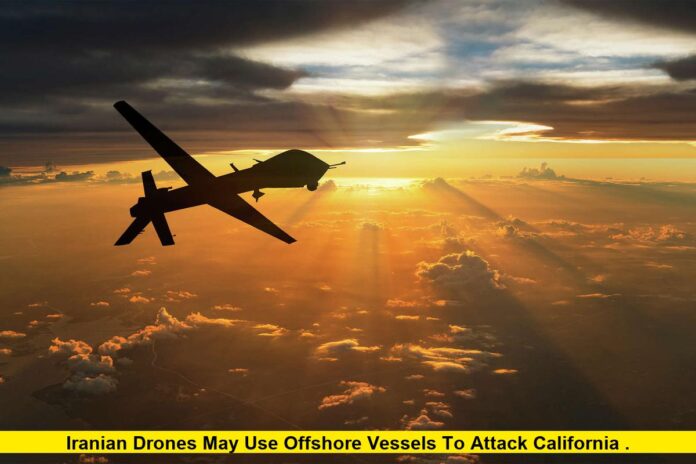
The FBI has sent a serious alert to law enforcement agencies across California warning that Iranian drones may be used in a retaliatory strike against the West Coast. The bulletin, distributed in late February 2026, states that as of early February, Iran allegedly aspired to launch a surprise attack using unmanned aerial vehicles from an unidentified vessel positioned off the coast of the United States — with unspecified targets in California directly in the crosshairs.
Federal officials stated they had no specific information regarding the exact timing, method, targets, or perpetrators of the alleged plot. Despite that uncertainty, the alert was significant enough to be distributed to police departments across the state, putting local agencies on heightened notice as the broader U.S.-Iran conflict continues to escalate at a dangerous pace.
If this story concerns you, share it with someone in California who needs to stay informed.
What Sparked the Warning?
The alert did not emerge in a vacuum. It came just as the United States and Israel launched a coordinated military assault on Iran in late February 2026. Those strikes were part of an operation aimed at dismantling Iran’s nuclear and missile capabilities — including a prior campaign that had already targeted key Iranian nuclear facilities at Fordow, Natanz, and Isfahan.
Iran’s supreme leader, Ali Khamenei, was killed during the conflict, and Mojtaba Khamenei was officially named as the country’s new supreme leader on March 8, 2026. The sudden shift in Iranian leadership, combined with ongoing U.S. military action, has dramatically raised the possibility of asymmetric retaliation — and American soil is no longer considered off-limits in that calculation.
President Trump, when asked by reporters whether he was worried about Iranian retaliation reaching U.S. territory, responded simply: “No, I’m not.” Still, the FBI’s decision to issue the bulletin to California law enforcement tells a more cautious story.
How California Officials Are Responding
State officials moved swiftly once the details of the warning became widely known. Governor Gavin Newsom publicly acknowledged that his administration had been aware of the threat information and said the state had elevated its security posture since the conflict began.
Newsom said California had established a State Operations Center immediately after the war started and had been coordinating with the Office of Emergency Services and local law enforcement partners to ensure that relevant information was shared in real time. He added that drone-related concerns had been on his administration’s radar from the start, and that dedicated work groups had already been assembled to address those specific risks.
A spokesperson for Newsom’s office described the FBI bulletin as one of many security updates the state receives from federal partners on a daily basis, emphasizing that California had already been operating at a heightened security level.
Senator Alex Padilla also weighed in publicly, saying he had been in contact with state and local partners and had reached out to Trump administration officials requesting additional detail on federal efforts to counter any potential threats.
Is This Threat Considered Credible?
Law enforcement officials have been careful to avoid triggering unnecessary public alarm. Counterterrorism sources described the threat as not currently deemed credible, framing the FBI bulletin as a precautionary measure rather than an indication of an imminent attack. A California-based federal law enforcement official went further, calling the bulletin “not actionable” in its current form.
That said, national security analysts are not dismissing the underlying concern. Iran has a documented history of using unconventional and asymmetric tactics to project force beyond its borders. Intelligence officials have noted for years that Iran maintains networks of operatives and relationships across Mexico and South America — giving it potential pathways to position equipment, including drones, much closer to American shores than most people realize.
The idea of launching an attack from an offshore vessel is not considered far-fetched by experts. The key question remains whether Iran currently has the operational capacity to execute such a plan, particularly given the heavy military losses it has sustained in recent weeks.
Iran’s Naval Capacity Has Taken a Major Hit
One factor that may significantly reduce Iran’s ability to carry out a drone strike from the sea is the destruction of a large portion of its naval fleet. A recent U.S. Central Command operation reportedly eliminated 16 Iranian naval vessels near the Strait of Hormuz — a development that raises serious questions about whether Iran still possesses the ships needed to position drones within striking distance of the California coastline.
Iran’s Revolutionary Guard has responded to the ongoing U.S. bombing campaign by vowing to block oil traffic through the Strait of Hormuz until American strikes cease — a threat that has already rattled global energy markets. But blocking a waterway and executing a precision drone attack on U.S. soil are two very different operational challenges, and experts say Iran’s window for the latter has likely narrowed considerably.
A Broader Drone Threat Picture
The Iran alert is not the only drone-related security concern American officials are currently tracking. Intelligence agencies have also been monitoring the growing use of drones by Mexican drug cartels, with a late 2025 bulletin noting that cartel leaders had allegedly authorized drone attacks carrying explosives against U.S. law enforcement and military personnel along the southern border.
Officials described that scenario as unprecedented but operationally plausible, given how rapidly cartel drone technology has advanced. Combined with the Iranian threat, the warnings paint a picture of a security environment in which unmanned aerial vehicles have become a primary tool for adversaries looking to challenge U.S. interests without direct military confrontation.
To counter these evolving threats, the U.S. military has deployed advanced anti-drone systems, including an AI-powered platform compact enough to fit in a pickup truck and capable of identifying and neutralizing hostile drones even in GPS-denied or electronically jammed environments.
What Residents Should Know Right Now
For Californians, the takeaway from officials remains one of awareness and preparation rather than fear. Law enforcement agencies up and down the state — including departments in Los Angeles, San Francisco, Oakland, and San Jose — have confirmed they are actively coordinating with federal partners and keeping a close eye on the situation as it develops.
The FBI’s Joint Terrorism Task Force distributed the memo specifically to ensure that local departments had the information they needed to respond quickly if conditions changed. The broader message from state and federal officials is that the threat environment is elevated, real-time monitoring is ongoing, and residents should trust that the appropriate agencies are engaged.
The situation between the U.S. and Iran is moving fast — what do you think this means for American safety at home? Drop your thoughts in the comments below and keep checking back as this story develops.

