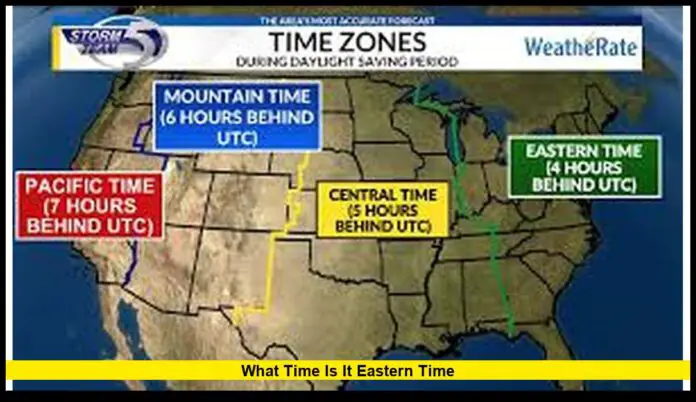
What time is it Eastern Time is a common question across the United States, especially for people coordinating schedules, watching national events, or communicating across time zones. As of March 12, 2026, the Eastern Time Zone is observing Eastern Daylight Time (EDT), which is UTC−4, after daylight saving time began on Sunday, March 8, 2026.
The Eastern Time Zone is the most populated time zone in the United States. It covers major cities such as New York, Washington, D.C., Atlanta, and Miami. Millions of Americans rely on Eastern Time to schedule business meetings, television broadcasts, financial markets, and online events.
Understanding how Eastern Time works helps people across the country stay synchronized with national schedules.
Table of Contents
What Is Eastern Time in the United States?
Eastern Time (ET) is one of the four primary time zones used in the contiguous United States. It serves the eastern portion of the country and includes both Eastern Standard Time (EST) and Eastern Daylight Time (EDT) depending on the time of year.
Here is how the system works:
| Time Period | Name | UTC Offset |
|---|---|---|
| Early November – Early March | Eastern Standard Time (EST) | UTC −5 |
| Early March – Early November | Eastern Daylight Time (EDT) | UTC −4 |
Since March 8, 2026, the region has been operating on Eastern Daylight Time after clocks moved forward by one hour for daylight saving time.
States That Use Eastern Time
The Eastern Time Zone covers a large part of the eastern United States. It includes entire states as well as some partial regions.
States fully in Eastern Time
- New York
- Florida (most of the state)
- Georgia
- South Carolina
- North Carolina
- Virginia
- West Virginia
- Pennsylvania
- New Jersey
- Delaware
- Maryland
- Connecticut
- Rhode Island
- Massachusetts
- Vermont
- New Hampshire
- Maine
- Ohio
- Michigan (most areas)
Areas partially in Eastern Time
- Florida’s western panhandle uses Central Time.
- Some counties in Indiana historically followed different schedules, though most now observe Eastern Time.
This time zone covers more than 150 million Americans, making it the most influential time zone for national schedules.
Why Eastern Time Is So Important in the U.S.
Many national institutions operate based on Eastern Time.
Major sectors that follow ET include:
- U.S. financial markets such as the New York Stock Exchange and Nasdaq
- National television networks scheduling prime-time programming
- Federal government operations in Washington, D.C.
- Major sports leagues including the NBA, NFL, and MLB
Because these institutions run on Eastern Time, announcements and event schedules often reference it even for audiences in other time zones.
For example, a televised event listed at 8:00 p.m. ET airs at:
- 7:00 p.m. Central
- 6:00 p.m. Mountain
- 5:00 p.m. Pacific
This standard keeps national broadcasts consistent across the country.
How Daylight Saving Time Affects Eastern Time
Daylight saving time plays a major role in determining the current Eastern Time.
In the United States, clocks move forward in the spring and back in the fall.
2026 Daylight Saving Time Dates
| Event | Date | Change |
|---|---|---|
| DST Begins | March 8, 2026 | Clocks move forward one hour |
| DST Ends | November 1, 2026 | Clocks move back one hour |
When daylight saving time begins, the time zone shifts from Eastern Standard Time (UTC−5) to Eastern Daylight Time (UTC−4).
This change provides longer daylight in the evening months.
Major Cities in the Eastern Time Zone
Many of the United States’ largest metropolitan areas operate on Eastern Time.
Some of the most prominent cities include:
- New York City, New York
- Washington, D.C.
- Atlanta, Georgia
- Miami, Florida
- Boston, Massachusetts
- Philadelphia, Pennsylvania
- Charlotte, North Carolina
- Detroit, Michigan
Because these cities serve as economic and cultural hubs, Eastern Time often becomes the default reference point for national schedules.
Comparing Eastern Time With Other U.S. Time Zones
The United States spans several time zones from east to west.
Understanding how Eastern Time compares with others helps people coordinate travel, business meetings, and online events.
| Time Zone | Difference from Eastern Time |
|---|---|
| Central Time | 1 hour behind |
| Mountain Time | 2 hours behind |
| Pacific Time | 3 hours behind |
| Alaska Time | 4 hours behind |
| Hawaii-Aleutian Time | 5 hours behind |
For instance, when it is 12:00 p.m. Eastern Time, the time across the country is:
- 11:00 a.m. Central
- 10:00 a.m. Mountain
- 9:00 a.m. Pacific
These differences play a major role in scheduling national events.
Why People Search “What Time Is It Eastern Time”
Millions of online searches occur every day for the question what time is it Eastern Time, particularly during major national events.
People often search for the time because of:
- National television broadcasts
- Live streaming events
- Stock market opening and closing hours
- Flight schedules
- Online gaming or global meetings
Eastern Time serves as the standard reference in many announcements, making it essential for people in other regions to convert their local time.
Eastern Time and Financial Markets
Financial markets in the United States operate strictly on Eastern Time.
The two largest exchanges follow this schedule:
| Market | Opening Time | Closing Time |
|---|---|---|
| New York Stock Exchange | 9:30 a.m. ET | 4:00 p.m. ET |
| Nasdaq | 9:30 a.m. ET | 4:00 p.m. ET |
Pre-market and after-hours trading also follow Eastern Time.
Because global investors monitor these markets, Eastern Time has become a reference point in international finance.
Eastern Time in Television and Streaming
National television networks also schedule programming around Eastern Time.
Prime-time television typically runs from:
8:00 p.m. to 11:00 p.m. Eastern Time
Many networks announce schedules as “8/7c,” meaning:
- 8:00 p.m. Eastern Time
- 7:00 p.m. Central Time
Streaming services also release certain programs based on Eastern Time because many media companies operate from New York or the East Coast.
Technology and Automatic Time Updates
Modern devices automatically adjust to Eastern Time when users live within the region.
Smartphones, computers, and smart home devices use internet time servers to maintain accurate clocks.
These systems automatically:
- Switch between EST and EDT
- Adjust during daylight saving time
- Sync with global time standards
Because of this technology, most Americans rarely need to manually update their clocks.
Travel and Time Zone Awareness
Travelers frequently need to know the correct Eastern Time when flying or driving between states.
Airlines list departure and arrival times using the local time zone of each airport.
For example:
- A flight departing New York at 3:00 p.m. ET and arriving in Los Angeles may land at 6:00 p.m. PT.
Without understanding the time zone difference, travelers might assume the flight duration is much longer.
Knowing the relationship between time zones prevents confusion when planning trips.
Eastern Time and International Coordination
Eastern Time also plays a major role in global communication.
Many international companies coordinate with U.S. partners based on ET because major financial institutions and government offices operate in that time zone.
For example:
- London operates five hours ahead of Eastern Standard Time.
- Tokyo runs fourteen hours ahead during standard time periods.
These differences require careful scheduling for global business meetings and virtual conferences.
Why Eastern Time Often Serves as the National Reference
Eastern Time became the standard reference point in the United States due to the concentration of major institutions along the East Coast.
Key factors include:
- New York City serving as the financial capital
- Washington, D.C. hosting federal government operations
- Large population centers in the eastern region
- Media networks historically based in New York
Because of these influences, many announcements simply list the schedule in Eastern Time.
People across the country then convert that time to their local zone.
Understanding the Current Eastern Time System
Anyone asking what time is it Eastern Time should remember that the time depends on the daylight saving schedule.
As of March 12, 2026, the United States Eastern Time Zone is observing Eastern Daylight Time (UTC−4) after the spring clock change earlier in March.
The time zone will remain on daylight saving time until November 1, 2026, when clocks move back one hour and the region returns to Eastern Standard Time.
This cycle repeats every year unless federal law changes the daylight saving system.
What time zone do you use, and how often do you convert Eastern Time for events or broadcasts? Share your experience in the comments and join the discussion.

