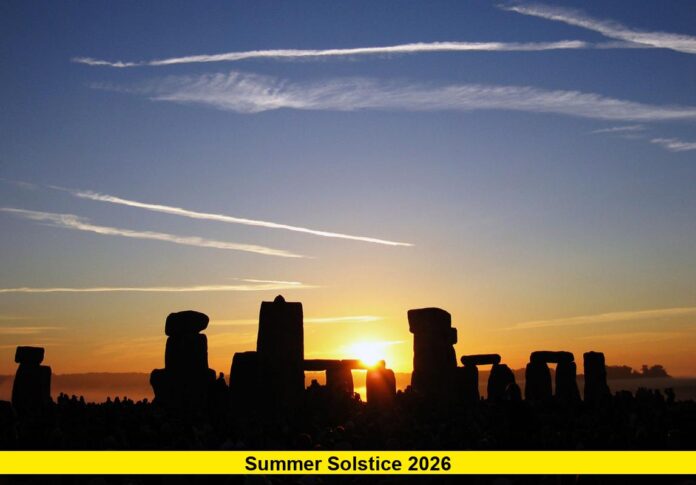
The most luminous day of the year is almost here. The Summer Solstice 2026 falls on Sunday, June 21, 2026, marking the official astronomical start of summer in the Northern Hemisphere and delivering the longest period of daylight of the entire year. Whether you are an astronomy enthusiast, a nature lover, or simply someone curious about the science behind the seasons, this complete guide covers everything you need to know about the Summer Solstice 2026.
Table of Contents
What Is the Summer Solstice?
The Summer Solstice is the precise moment when the Sun reaches its northernmost position relative to Earth’s equator, resulting in the maximum period of daylight for the Northern Hemisphere. According to astronomers, it is not a full-day event but rather a single instant — known as the solstice moment.
The word “solstice” originates from the Latin solstitium, meaning “sun standing still,” reflecting the way the Sun’s path appears to pause at its highest point before beginning its slow retreat southward.
Earth’s axis is tilted at approximately 23.5 degrees relative to its orbital plane. At the June solstice, the Northern Hemisphere is tilted at its maximum angle toward the Sun, causing the Sun to climb to its highest arc in the sky and solar energy to strike the surface at the steepest possible angle — producing the peak warmth and light we associate with summer.
Summer Solstice 2026: Date and Exact Time
The Summer Solstice 2026 occurs on Sunday, June 21, 2026. The exact solstice moment is the same worldwide; only local clock times differ. Key time zone conversions are as follows:
- UTC: 08:24–08:25
- EDT (Eastern Daylight Time): 4:24 AM
- CDT (Central Daylight Time): 3:24 AM
- BST (British Summer Time): 9:24 AM
As per astronomical records, the Summer Solstice can fall on June 20, 21, or — in very rare cases — June 22. A June 22 solstice last occurred in 1975 and is not expected again until 2203, making the June 21 date for 2026 the norm rather than the exception.
How Long Is the Longest Day of 2026?
The length of the longest day varies considerably depending on your latitude. According to astronomers, the farther north a location sits, the more daylight hours it receives on the solstice:
- Mid-northern latitudes (~40°N): Approximately 15 hours of daylight
- London, UK: Roughly 16–17 hours of daylight
- Arctic Circle and beyond: The Sun does not set at all — a phenomenon known as the Midnight Sun
- Equator: Day length remains close to 12 hours year-round, with minimal seasonal variation
Interestingly, while June 21 is the longest day in terms of total daylight, it is not always the date of the earliest sunrise or latest sunset. As per astronomical data, the earliest sunrise at mid-latitudes in the Northern Hemisphere typically occurs about 5–10 days before the solstice, while the latest sunset arrives 5–10 days after it. This quirk results from Earth’s elliptical orbit and the inclination of its rotational axis.
A Special Coincidence: Summer Solstice and Father’s Day 2026
The Summer Solstice 2026 shares its date with Father’s Day 2026, both falling on Sunday, June 21. This double celebration creates a rare and memorable occasion for families to honor dads while soaking in the year’s most sun-drenched day. The Sunday timing is also a genuine convenience — a weekend solstice allows outdoor gatherings, sunrise watching, and festival attendance without the constraint of a workday following.
The Science Behind the Summer Solstice
Understanding what drives the Summer Solstice begins with Earth’s tilt. As the planet orbits the Sun throughout the year, its 23.5-degree axial tilt causes the Northern and Southern Hemispheres to alternate in receiving the most direct sunlight — creating the changing seasons.
At the moment of the June solstice, the Sun reaches its maximum northern declination of +23.44°, positioned directly above the Tropic of Cancer (latitude 23.44°N). On this day, anyone standing on the Tropic of Cancer at solar noon will cast no shadow at all — the Sun is directly overhead.
Following the solstice, the days gradually begin to shorten as the Sun’s path retreats southward, setting the stage for autumn and eventually winter.
It is also worth noting what scientists call the “lag of the seasons.” Even though the Summer Solstice delivers the most direct sunlight, the hottest weather typically arrives weeks later — in late July and August — because the Earth takes time to absorb and radiate accumulated heat. This is similar to why afternoons are hotter than midday.
Summer Solstice Around the World: Global Traditions and Celebrations
The Summer Solstice has been observed by human civilizations for thousands of years. In 2026, its Sunday timing makes global celebrations more accessible than ever.
Stonehenge, United Kingdom
Perhaps the world’s most iconic solstice celebration takes place at Stonehenge in Wiltshire, England. According to English Heritage, free access to Stonehenge is being provided on Saturday, June 20 and Sunday, June 21, 2026 to celebrate the Summer Solstice — one of the rare occasions each year when visitors are permitted to walk among the ancient stones themselves.
As the Sun rises at approximately 4:52 AM behind the Heel Stone, it shines its beam directly into the heart of the stone circle — an alignment that has mesmerized onlookers for millennia. Modern Druids, Pagans, spiritual groups, and curious travelers from around the world gather for chants, quiet rituals, drumming, and communal reflection. In recent years, the event has drawn tens of thousands of visitors. Those planning to attend are strongly advised to use public transport, as car parking must be pre-booked and is extremely limited.
Sweden and Finland: Midsummer Festivals
In Scandinavia, the Summer Solstice is celebrated as Midsommar, one of the most beloved holidays of the year. Communities come together for maypole dances, traditional foods, floral wreaths, and all-night revelry that honors the ancient agricultural significance of the longest day.
Baltic Nations: Jāņi and Joninės
Estonia, Latvia, and Lithuania each hold distinctive midsummer celebrations. Latvia’s Jāņi and Lithuania’s Joninės feature bonfires, music, and deep-rooted folk traditions that have been practiced for centuries, maintaining a powerful connection to the land and natural cycles.
The Americas: Indigenous and Modern Traditions
Across the Americas, the solstice carries profound cultural meaning. Native American Plains and Rocky Mountain tribes honor the longest day through the Sun Dance. In Peru, the ancient Inca festival Inti Raymi — the Festival of the Sun — is reenacted each year at the Sacsayhuamán fortress near Cusco, honoring the Sun god Inti. Modern celebrations in the United States include the Fremont Solstice Parade in Seattle and the Santa Barbara Summer Solstice Parade in California.
The Summer Solstice in the Southern Hemisphere
While the Northern Hemisphere basks in its longest day, the opposite is true for those south of the equator. On June 21, 2026, cities like Melbourne, Buenos Aires, and Cape Town experience the Winter Solstice — their shortest day of the year. The Sun barely climbs above the horizon, and daylight lasts only about 9–10 hours. In Peru and the Andes, this same date is celebrated as the New Year of the Sun in Inca tradition.
Fun Facts About the Summer Solstice
- Midnight Sun: Regions above the Arctic Circle experience 24 hours of continuous daylight around the Summer Solstice.
- Tropic of Cancer: At this latitude, the Sun is directly overhead at solar noon — casting no shadow whatsoever.
- Stonehenge Alignment: The Heel Stone at Stonehenge is precisely positioned so that the rising Sun on the solstice shines directly through it into the center of the stone circle.
- Egypt’s Great Pyramids: According to astronomers, if you stand at the Sphinx on the Summer Solstice and look toward the two largest pyramids, you would see the Sun set exactly between them.
- Solstice vs. Hottest Day: The hottest days of summer come weeks after the solstice, due to the thermal lag of the Earth’s surface absorbing and re-radiating accumulated solar energy.
How to Celebrate the Summer Solstice 2026
You do not need to travel to Stonehenge to mark the occasion meaningfully. Here are some accessible ways to welcome the longest day of the year:
- Watch the sunrise — Set your alarm and step outside to greet the earliest light of the year’s most sun-filled day.
- Practice sunrise yoga — Many yoga studios and parks host outdoor solstice yoga sessions at dawn.
- Take a nature walk — Observe how the natural world responds to the peak of the light season.
- Host a bonfire or garden gathering — Channel the ancient midsummer tradition of fire and community.
- Stargaze — Although nights are short, the clear June skies are ideal for astronomy.
- Educate the family — Use the occasion to explore Earth’s axial tilt, seasons, and the history of solstice celebrations with children.
What Comes After the Summer Solstice?
As beautiful as the longest day is, the Summer Solstice also signals a turning point. After June 21, 2026, the days begin to grow incrementally shorter as the Sun’s path retreats southward toward the December solstice. The rate of change is slow at first — the days surrounding the solstice appear nearly equal in length — but by late summer and autumn, the difference becomes increasingly noticeable.
The next key astronomical milestone after the Summer Solstice 2026 will be the Autumnal Equinox, when day and night are roughly equal in length, followed by the Winter Solstice in December 2026.
Will you be watching the sunrise on June 21 or heading to a midsummer celebration near you? Drop your plans in the comments below and let us know how you’re welcoming the longest day of 2026!

