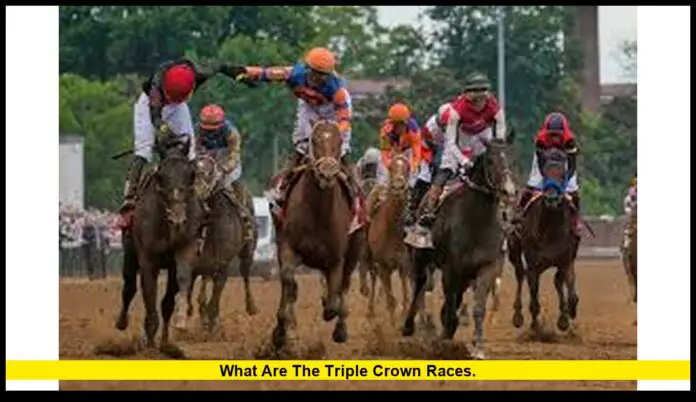
What are the triple crown races? As of June 2026, the Triple Crown remains the most celebrated achievement in American Thoroughbred racing, consisting of the Kentucky Derby, Preakness Stakes, and Belmont Stakes. The 2026 series has concluded with Kentucky Derby winner Golden Tempo capturing the Belmont Stakes after skipping the Preakness, while no horse earned the coveted Triple Crown title this year. The accomplishment remains one of the rarest feats in sports, with only 13 horses ever completing the sweep.
Horse racing has many prestigious events, but none carry the history, pressure, and national attention of the Triple Crown. Every spring, millions of fans follow the journey of elite three-year-old Thoroughbreds as they attempt to win three demanding races over a five-week span.
The Triple Crown tests speed, endurance, adaptability, and consistency. Winning even one race is a major achievement. Winning all three places a horse among the sport’s greatest legends.
Table of Contents
What Is the Triple Crown in Horse Racing?
The Triple Crown is a series of three Grade 1 races for three-year-old Thoroughbred horses in the United States. To win the Triple Crown, a horse must capture all three races in the same year.
The three races are:
| Race | Typical Date | Location | Distance |
|---|---|---|---|
| Kentucky Derby | First Saturday in May | Churchill Downs, Kentucky | 1¼ miles |
| Preakness Stakes | Third Saturday in May | Maryland | 1 3/16 miles |
| Belmont Stakes | Early June | New York | Traditionally 1½ miles |
The challenge comes from the short time between races and the different demands each track presents. Horses must recover quickly and perform at an elite level repeatedly against the best competition in their age group.
Only 13 horses in history have won all three races, highlighting the difficulty of the accomplishment.
The Kentucky Derby: The First Jewel
The Kentucky Derby is the opening race of the Triple Crown and is often called “The Run for the Roses.”
Held annually at Churchill Downs in Louisville, Kentucky, the Derby attracts the largest audience of any American horse race. Twenty horses typically compete in front of massive crowds and national television audiences.
The Derby is run at 1¼ miles and requires a combination of tactical speed, stamina, and racing luck. Because of the large field, traffic problems and difficult trips are common.
Winning the Kentucky Derby instantly places a horse in the national spotlight. Owners, trainers, and jockeys often spend years preparing for the opportunity.
In 2026, Golden Tempo emerged as the Kentucky Derby winner, setting up hopes for a potential Triple Crown run before connections decided to bypass the Preakness Stakes.
The Preakness Stakes: The Second Jewel
The Preakness Stakes serves as the middle leg of the Triple Crown.
Traditionally held two weeks after the Kentucky Derby, the race provides little recovery time for horses. This compressed schedule is one reason the Triple Crown is so difficult to win.
The Preakness is slightly shorter than the Derby at 1 3/16 miles. The race often rewards horses with tactical speed because of its distance and pace dynamics.
For decades, the Preakness has been associated with Pimlico Race Course in Baltimore. However, the 2026 edition was held at Laurel Park while renovations continued at Pimlico. Racing officials expect the event to return to Pimlico in 2027.
Many Derby winners see their Triple Crown hopes end in the Preakness because of fatigue, stronger competition, or strategic decisions by their connections.
In 2026, Golden Tempo skipped the Preakness entirely, ending any possibility of a Triple Crown sweep before the second race was run. Napoleon Solo won the Preakness Stakes.
The Belmont Stakes: The Final Jewel
The Belmont Stakes is known as “The Test of the Champion.”
Traditionally run at 1½ miles, it is the longest and often the most demanding race of the Triple Crown series. The Belmont challenges horses to demonstrate stamina rarely required elsewhere in American racing.
The race has produced some of the sport’s most memorable moments. It is where Triple Crown dreams are fulfilled or shattered.
Recent construction projects have temporarily altered the event. The Belmont Stakes was hosted at Saratoga Race Course from 2024 through 2026. Because of Saratoga’s configuration, the race distance was shortened to 1¼ miles during those years. The event is scheduled to return to a redeveloped Belmont Park in 2027.
The 2026 Belmont Stakes concluded the Triple Crown season with Golden Tempo defeating a talented field and earning a second Triple Crown race victory of the year.
Read More – What Time Is the Preakness 2026? Start Time, TV Schedule, Horses, and Everything Fans Need to Know
Why Is Winning the Triple Crown So Difficult?
Many sports championships are challenging, but the Triple Crown presents unique obstacles.
Several factors contribute to its difficulty:
Short Recovery Time
The Kentucky Derby and Preakness are separated by only two weeks. Horses must recover from a demanding race and quickly prepare for another elite competition.
Different Distances
Each race requires a different racing style.
A horse that excels in the Derby may struggle in the Preakness or Belmont because of changing pace scenarios and distances.
Elite Competition
The best three-year-old horses in North America target these races.
Even dominant Derby winners face fresh challengers entering later legs of the series.
Physical Demands
The Triple Crown occurs during a horse’s developmental stage. Young Thoroughbreds are still maturing physically and mentally.
These factors explain why Triple Crown winners remain so rare.
Triple Crown Winners Through History
Only 13 horses have completed the sweep.
The official Triple Crown winners are:
- Sir Barton (1919)
- Gallant Fox (1930)
- Omaha (1935)
- War Admiral (1937)
- Whirlaway (1941)
- Count Fleet (1943)
- Assault (1946)
- Citation (1948)
- Secretariat (1973)
- Seattle Slew (1977)
- Affirmed (1978)
- American Pharoah (2015)
- Justify (2018)
The long gap between Affirmed and American Pharoah highlighted how difficult the feat had become.
Justify’s 2018 victory remains the most recent Triple Crown triumph.
Secretariat and the Most Famous Triple Crown Victory
No discussion of the Triple Crown is complete without Secretariat.
The chestnut superstar captured the 1973 Triple Crown in historic fashion. His Belmont Stakes performance remains one of the greatest races ever run.
Secretariat won by an astonishing 31 lengths and set a world-record time for 1½ miles on dirt. More than five decades later, that record still stands.
His dominance transformed horse racing and created a benchmark that future champions continue to chase.
Recent Triple Crown History
Modern racing has seen numerous horses come close to winning the Triple Crown.
Several Derby and Preakness winners entered the Belmont with history within reach but fell short in the final race.
American Pharoah ended a 37-year drought in 2015.
Justify followed three years later in 2018.
Since then, no horse has completed the sweep.
The 2025 season also ended without a Triple Crown winner. Kentucky Derby champion Sovereignty skipped the Preakness before later winning the Belmont Stakes. A similar pattern occurred in 2026 when Golden Tempo bypassed the Preakness and later captured the Belmont.
Triple Crown Races in 2026
The 2026 Triple Crown season attracted significant attention from racing fans across the United States.
Key results included:
| Race | Winner |
| Kentucky Derby | Golden Tempo |
| Preakness Stakes | Napoleon Solo |
| Belmont Stakes | Golden Tempo |
Because Golden Tempo did not compete in the Preakness, the Triple Crown was unavailable after the first leg of the series. Despite that, the horse finished the season with victories in two of the three Triple Crown races.
The Belmont Stakes marked the final year of the race’s temporary stay at Saratoga Race Course. Beginning in 2027, the event is expected to return to the newly redeveloped Belmont Park.
How the Triple Crown Impacts Horse Racing
The Triple Crown serves as the centerpiece of American horse racing.
Its influence extends far beyond the three races themselves.
Benefits include:
- Increased television audiences
- Higher attendance at racetracks
- Greater public interest in Thoroughbred racing
- Increased breeding value for successful horses
- Expanded sponsorship and media coverage
A Triple Crown contender often becomes a national sports story, drawing attention from casual fans who may not follow racing throughout the year.
The series also provides a common benchmark across generations. Fans can compare modern stars with legends from decades past.
Read More – 2026 Belmont Stakes: Saratoga Prepares for One of Horse Racing’s Biggest Events
Why Fans Continue to Follow the Triple Crown
The appeal of the Triple Crown lies in its simplicity and drama.
Every year begins with possibility.
A horse wins the Kentucky Derby, and fans immediately start asking whether history could be made.
The Preakness increases the stakes. If the Derby winner captures the second jewel, anticipation grows nationwide.
By the time the Belmont arrives, the entire sports world is watching.
Even when no Triple Crown is on the line, the races still showcase the best young Thoroughbreds in the country competing on racing’s biggest stage.
That combination of history, tradition, and athletic excellence keeps the Triple Crown at the center of American horse racing year after year.
What are the triple crown races? They are the Kentucky Derby, Preakness Stakes, and Belmont Stakes—the three events that define greatness in American Thoroughbred racing. With the 2026 season now complete and no Triple Crown winner added to the record books, the pursuit of horse racing’s ultimate achievement will begin again next spring, giving fans another chance to witness history unfold.
What do you think is the greatest Triple Crown performance of all time? Share your thoughts and stay tuned for more horse racing updates.

