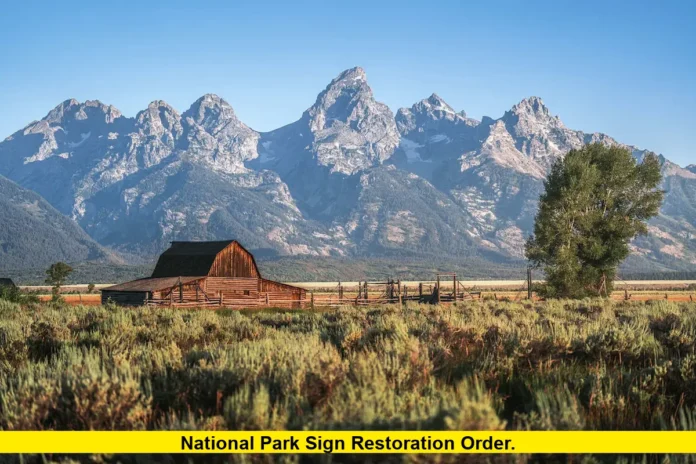
The national park sign restoration order has become one of the most significant legal developments involving U.S. national parks in 2026. A federal judge has ordered the Trump administration to restore historical and scientific information that was removed or altered at national parks, monuments, and historic sites across the country.
The ruling has reignited a national debate about how American history should be presented in public spaces, with supporters praising the decision as a victory for historical accuracy and critics arguing that federal agencies should have greater control over park messaging.
Table of Contents
What Is the National Park Sign Restoration Order?
The national park sign restoration order stems from a federal lawsuit challenging changes made under a Trump administration directive that sought to eliminate content considered critical of American history or institutions.
U.S. District Judge Angel Kelley issued a preliminary injunction requiring federal agencies to restore removed exhibits, signs, interpretive displays, and educational materials that addressed topics including:
- Slavery in American history
- Civil rights movements
- Indigenous and Native American history
- Climate change impacts
- Labor and social justice issues
The judge also ordered the administration to halt additional changes while the case proceeds through the courts.
Why Were National Park Signs Removed?
The controversy began after President Donald Trump signed an executive order titled “Restoring Truth and Sanity to American History” in 2025.
The order directed federal agencies, including the National Park Service, to review historical content displayed at national parks, monuments, and museums. The administration argued that some exhibits promoted divisive or partisan interpretations of American history.
Following the directive, numerous signs and displays were reportedly removed, modified, or flagged for review at national park sites throughout the United States.
Many of the affected exhibits discussed difficult chapters of American history, including slavery, racial discrimination, Indigenous displacement, and environmental challenges.
Judge’s Ruling Against the Changes
In her ruling, Judge Kelley stated that public history cannot be accurately presented by excluding the experiences and contributions of certain communities.
The court found that the plaintiffs were likely to succeed in their argument that the removals undermined the National Park Service’s mission to educate visitors and preserve historical truth.
The ruling requires federal officials to:
- Restore removed signs and exhibits
- Reinstall scientific and historical information
- Provide regular status reports to the court
- Pause additional removals while litigation continues
The administration has been given approximately 21 days to begin complying with the order.
Organizations Behind the Lawsuit
The lawsuit was brought by several preservation and historical organizations that argued the changes amounted to censorship.
Groups involved include:
- The National Parks Conservation Association
- The Association of National Park Rangers
- The American Association for State and Local History
The organizations argued that visitors deserve access to complete and accurate information about America’s past, including both achievements and failures.
Examples of Affected National Park Displays
Reports indicate that changes occurred at multiple national park and historic sites.
Examples include:
Slavery Exhibits
Interpretive displays discussing enslaved people at historic locations were removed or altered, prompting legal challenges and restoration orders.
Climate Change Information
Educational exhibits explaining the effects of climate change on national parks were reportedly taken down or revised.
Indigenous History
Some signs describing Native American history and the displacement of Indigenous communities were removed or targeted for review.
Civil Rights and Social History
Displays covering civil rights struggles and the experiences of marginalized groups were also affected by the policy changes.
Reaction to the Court Decision
The ruling has generated strong reactions from both supporters and opponents.
Supporters argue that national parks serve as educational resources and should present a complete account of American history, even when the subject matter is uncomfortable.
Critics of the decision contend that federal agencies should have authority to determine how historical information is displayed and whether certain exhibits align with government policies.
Meanwhile, historians, educators, and preservation advocates largely welcomed the ruling as a safeguard against political interference in historical interpretation.
What Happens Next?
The national park sign restoration order is currently a preliminary injunction rather than a final ruling.
The Trump administration may appeal the decision, and further court proceedings are expected in the coming months. However, unless a higher court intervenes, federal officials must move forward with restoring the affected materials.
The case is likely to remain a major legal and political issue as the United States approaches major historical commemorations and continues debating how its history should be represented in public institutions.
Why This Case Matters
The national park sign restoration order goes beyond individual exhibits or park signs. It raises broader questions about historical interpretation, public education, and the role of government in shaping national narratives.
For millions of visitors who rely on national parks to learn about America’s past, the outcome of this case could influence how future generations understand the country’s history, culture, and environmental legacy.
What do you think about the national park sign restoration order? Share your thoughts in the comments and stay tuned for the latest updates on this developing story.

