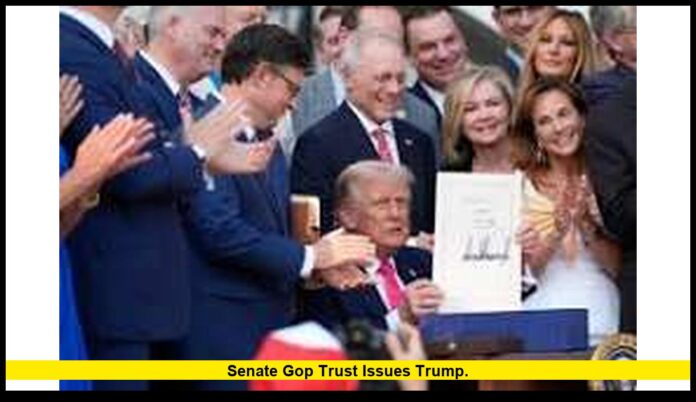
Senate GOP trust issues Trump have become one of the most closely watched political developments in Washington as Republican lawmakers and President Donald Trump navigate a series of disagreements ahead of the 2026 midterm elections. Recent disputes over voting legislation, national security policy, Senate procedures, and foreign affairs have exposed strains within a relationship that appeared solid only a year ago.
While Republicans continue to control key positions in Washington, divisions between the White House and Senate Republicans have become increasingly visible. Several senators who previously avoided public criticism of Trump have begun voicing concerns about his political strategy, legislative demands, and approach to governing. Those tensions are now influencing debates over major policy priorities and could play an important role in shaping the Republican Party’s future.
Table of Contents
Why Senate Republicans Are Showing Frustration
For much of Trump’s political career, Senate Republicans largely aligned themselves with his agenda. Many GOP lawmakers benefited from his popularity among Republican voters, and Trump-backed candidates continued to perform well in numerous primary contests.
However, recent events have highlighted a growing divide between the president and members of the Senate Republican conference.
Several issues have contributed to the friction:
- Disagreements over election legislation
- Conflicts involving national security policy
- Concerns about Senate procedure and governance
- Debates surrounding foreign policy decisions
- Differences over political strategy before the midterms
Republican senators increasingly face a difficult balancing act. They must maintain support from Trump-aligned voters while also protecting their own electoral prospects and legislative priorities.
The SAVE Act Dispute Becomes a Flashpoint
One of the biggest sources of tension involves Trump’s push for the SAVE America Act.
The legislation would require documentary proof of citizenship for participation in federal elections. Trump has made the proposal a central issue and has repeatedly urged Senate Republicans to support it.
The challenge for GOP leaders is that the bill faces significant obstacles in the Senate. Republican lawmakers acknowledge that the measure lacks enough support to advance under current Senate rules.
This reality has placed Senate leadership in a difficult position.
Trump has publicly urged Republican senators to find a path forward, while Senate leaders continue emphasizing the practical limits of what can be accomplished legislatively. The disagreement has become a symbol of broader frustrations inside the party.
Many senators support stronger election security measures in principle. Yet some have questioned whether tying other major legislation to the SAVE Act is politically wise or strategically effective.
The resulting standoff has delayed Senate business and intensified debate within Republican ranks.
Pressure on Senate Leadership
Senate Majority Leader John Thune has emerged as a central figure in the dispute.
As leader of the Republican Senate conference, Thune must manage relationships with both the White House and individual senators. His role has become increasingly challenging as Trump has pushed for more aggressive legislative action.
Republican senators frequently point to Senate rules and vote counts as practical constraints. Trump, meanwhile, has encouraged Senate leaders to pursue more ambitious approaches.
This difference in perspective has created visible friction.
Several Republican lawmakers have expressed concern that public disagreements could complicate efforts to maintain party unity before November’s elections.
Leadership also faces pressure from competing factions within the party. Some senators want closer alignment with Trump’s priorities, while others prefer a more cautious legislative strategy.
National Security Battles Deepen Divisions
Foreign policy has become another major source of disagreement.
Recent debates involving Iran policy have highlighted differences between Trump and several Republican senators. Some GOP lawmakers have criticized aspects of diplomatic agreements and questioned whether certain policy decisions align with long-term American interests.
The disagreements have been notable because they involve senators who traditionally supported Trump’s foreign policy initiatives.
National security debates often reveal deeper questions about executive authority, congressional oversight, and America’s role abroad. Those questions have become increasingly important within Republican circles.
Several senators have argued that Congress should maintain a stronger role in reviewing major international agreements and military decisions.
Others continue to support Trump’s broader approach while raising concerns about specific details.
The result is a more open and public debate than many observers expected from a Republican-controlled Washington.
Confirmation Battles Create New Frustrations
Personnel decisions have also contributed to the growing tension.
Senate Republicans have expressed frustration over disruptions involving confirmation proceedings and administration appointments.
These disputes matter because confirmations are among the Senate’s most important constitutional responsibilities.
When disagreements arise over nominees, scheduling, or confirmation strategy, they can slow the Senate’s work and increase political tensions.
Some Republican senators have suggested that unexpected changes to confirmation plans make it harder to manage the legislative calendar.
Others worry that public disputes over nominees create unnecessary distractions during a crucial election year.
Although confirmation fights are common in Washington, the recent disagreements have reinforced concerns about coordination between Senate Republicans and the White House.
Midterm Elections Raise the Stakes
The 2026 midterm elections loom over every major Republican decision.
Control of Congress remains a central objective for the GOP, and party leaders want to present a united front to voters.
At the same time, individual senators must consider the political realities of their own states.
Some Republicans represent strongly conservative states where close alignment with Trump remains politically advantageous.
Others come from more competitive states where independent voters may react differently to ongoing political battles.
This creates differing incentives within the party.
A strategy that helps Republicans in one state may create challenges in another.
As election season intensifies, senators are increasingly focused on issues that directly affect their reelection prospects and the party’s ability to maintain congressional majorities.
Trump’s Continued Influence on Republican Politics
Despite recent disagreements, Trump remains the most influential figure in Republican politics.
His endorsements continue to carry significant weight in primary elections.
Throughout the 2026 election cycle, Trump-backed candidates have achieved important victories in several contests. These results demonstrate that his influence among Republican voters remains substantial.
Because of that influence, most Senate Republicans continue to approach disagreements carefully.
Few lawmakers want to create the impression of direct opposition to the president.
Instead, many frame their concerns around strategy, procedure, or legislative realities rather than ideological differences.
This distinction is important.
The current tensions do not necessarily reflect a broad rejection of Trump within the Republican Party. Rather, they reveal disagreements about how best to advance shared political goals.
The Challenge of Governing Versus Campaigning
One recurring theme in the current dispute involves the difference between campaigning and governing.
Political messaging often rewards bold proposals and ambitious promises.
Legislative success, however, requires vote counting, coalition building, and procedural negotiations.
Many Senate Republicans argue that governing requires compromises that may not always satisfy every political objective.
Trump has frequently pushed for more aggressive action, emphasizing the importance of delivering on campaign promises.
These competing perspectives create friction whenever major legislation reaches the Senate.
Lawmakers must navigate constitutional requirements, Senate rules, and political realities.
The White House often focuses on broader policy goals and voter expectations.
Both sides ultimately seek Republican success, but they sometimes disagree on the path to achieve it.
How Voters Are Watching the Dispute
Republican voters are paying close attention to these developments.
Some grassroots activists support Trump’s calls for stronger action on election security, immigration, and other priorities.
Others worry that prolonged internal conflicts could distract from issues such as the economy, public safety, and national security.
Independent voters may also play an important role.
Many competitive Senate races will be decided by voters who do not consistently support one party.
Republican strategists understand that internal divisions can become campaign issues if they dominate headlines for too long.
As a result, party leaders continue working to prevent disagreements from evolving into a broader political crisis.
Historical Context for Republican Divisions
Political disagreements between presidents and members of their own party are not unusual.
American history includes numerous examples of presidents clashing with congressional allies over policy, appointments, and strategy.
What makes the current situation noteworthy is the visibility of the disputes.
Trump’s direct communication style ensures that disagreements often become public quickly.
Social media, television appearances, and campaign events can amplify even minor differences.
As a result, tensions that might have remained private in earlier eras now receive national attention.
That visibility contributes to the perception that Senate Republicans and the White House are experiencing a significant political rift.
Potential Impact on Republican Legislative Goals
The relationship between Senate Republicans and Trump will likely affect several major policy debates during the remainder of 2026.
Key areas include:
| Issue Area | Potential Impact |
|---|---|
| Election policy | Continued debate over voting legislation |
| National security | Ongoing disagreements over foreign policy |
| Confirmations | Possible delays and procedural conflicts |
| Senate rules | Disputes over legislative strategy |
| Midterm campaigns | Increased focus on party unity |
Republican leaders understand that legislative achievements could help strengthen their election message.
At the same time, unresolved disputes risk consuming political energy that might otherwise be directed toward policy goals.
The coming months will reveal whether the party can bridge these differences.
What Comes Next for Republicans
The future of the Republican Party remains closely tied to Trump’s leadership and influence.
Most Senate Republicans continue to support many of the president’s broader objectives. However, recent events demonstrate that support does not always translate into complete agreement.
As Congress debates major legislation and election campaigns intensify, lawmakers will face continued pressure to balance loyalty, governance, and political reality.
The relationship between Trump and Senate Republicans is likely to remain one of the defining political stories of 2026.
Whether these disagreements represent a temporary dispute or a longer-term shift in Republican politics will become clearer as the election season progresses.
For now, the debate surrounding senate gop trust issues trump reflects a party navigating the challenges of governing, campaigning, and maintaining unity during one of the most consequential political periods in recent years.
What do you think about the growing tensions between Senate Republicans and President Trump? Share your thoughts and stay updated as this story continues to develop.

