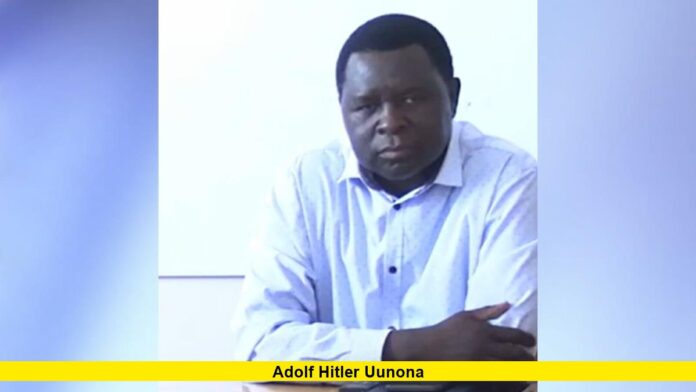
Adolf Hitler Uunona is again at the center of international attention as he seeks re-election on November 26, 2025, in the northern Namibian constituency of Ompundja. This repeated victory bid draws scrutiny not for his policies—but for the stark historical weight of his name.
Table of Contents
Who is Adolf Hitler Uunona
- Adolf Hitler Uunona, born in the 1960s, has served as regional councillor for Ompundja since 2004. He belongs to the ruling party South West Africa People’s Organization (SWAPO).
- Over his career, he won elections in 2004, 2010, 2015, and again in 2020 — when he secured approximately 85 % of the vote.
- Despite the global notoriety of his name, Uunona has consistently emphasized that his name reflects family history—not ideology. He states that his father likely did not understand who the Nazi leader was when choosing the name. He adds that when he was young, the name felt “normal,” and only later did he grasp the historical connotations.
2025 Re-election Bid: What’s Happening Now
- As Namibia heads to vote on November 26, 2025, Uunona is standing again as candidate for Ompundja. Early projections indicate he is likely to retain his seat.
- Local analysts note that many constituents appear focused on his record and service rather than the symbolic weight of his name. For them, his performance and longstanding presence as councillor matter more than external reactions.
- On the campaign trail and in public statements, Uunona has reiterated that he rejects any association with Nazi ideology and does not plan to change his legal name — it appears on all his official documents.
The Name — Legacy of Colonial History, Not Belief
- The presence of Germanic names such as “Adolf” in Namibia reflects a lingering imprint of its colonial past under German rule from 1884 to 1915. For many locals, such names lost the ideological meaning they carry elsewhere.
- Uunona’s case underscores how cultural and historical context shapes perception: a name that provokes shock internationally may be viewed as ordinary at home.
- The fact that he omits “Hitler” in everyday use and introduces himself simply as “Adolf Uunona” further reduces the symbolic load of the full name among his constituents.
What This Means in 2025
- If re-elected, Uunona will reaffirm that, for many voters in Ompundja, practical governance and local community ties outweigh global symbolism. His campaign underscores an essential truth: effective representation can transcend even the most controversial names.
- This situation also highlights broader tensions between global historical memory and local cultural context. In a former colony shaped by European influence, naming customs sometimes diverged sharply from Western historical consciousness.
- Uunona’s candidacy — and likely victory — invites reflection on how identity, memory, and public service intersect in post-colonial societies.
The 2025 vote may show that for many in Ompundja, the name Adolf Hitler Uunona carries little more weight than any other — and ultimately, service wins over symbolism.

