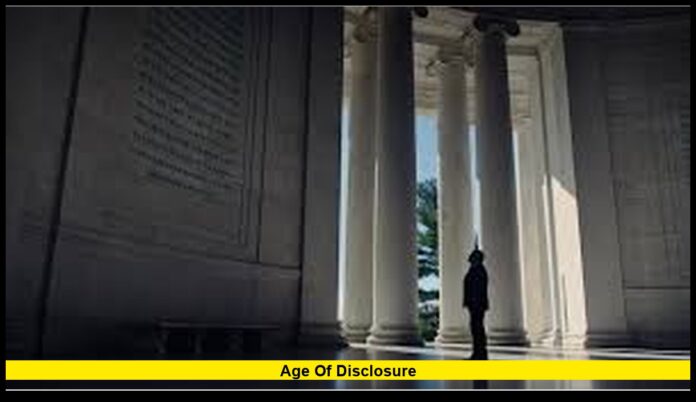
The term age of disclosure has surged into national headlines this month as the newly released documentary of the same name brings renewed attention to the decades-long debate over unidentified aerial phenomena (UAPs) and government secrecy in the United States. Released nationwide in November 2025, the film compiles testimony from dozens of former military officials, intelligence personnel, and government insiders who claim the world is entering a turning point in transparency about non-human intelligence and unidentified craft.
The release has sparked intense interest across the U.S. public, prompting discussions about truth, national security, scientific discovery, and the future of disclosure.
Table of Contents
A Landmark Release in the U.S. UFO Conversation
The Age of Disclosure documentary arrives at a moment when public interest in UAPs is already at its highest level in decades. Congressional hearings, whistleblower statements, and the Pentagon’s own UAP office have all contributed to a cultural shift where discussions once considered fringe now sit in mainstream American dialogue.
The film captures this shift and amplifies it with testimony from numerous high-ranking individuals who share their experiences with unidentified craft, unexplained encounters, and alleged long-term government programs designed to study non-human technology.
For many viewers, the film marks the most concentrated release of insider claims ever presented to the public in a single production.
What the Age of Disclosure Documentary Covers
The documentary covers roughly eighty years of alleged secrecy, beginning with post–World War II sightings and moving through claims of advanced craft retrieval, special access programs, and highly classified crash investigations. It is structured around several central themes:
1. Encounters by Trained Observers
The film highlights testimonies from former military pilots, radar operators, and intelligence officers who describe encounters with objects exhibiting flight characteristics beyond known human capabilities. These accounts include:
- Sudden acceleration without visible propulsion
- Sharp directional changes at high speed
- Near-silent movement
- Objects capable of traveling through air and water
Although these accounts have circulated for years, the documentary presents them collectively and in detail, creating a cohesive narrative for viewers.
2. Claims of Recovered Craft and Materials
Multiple officials in the film claim that the U.S. and other nations have retrieved non-human craft and materials over several decades. These claims are presented as part of a long-term international effort to reverse-engineer technology that appears far more advanced than anything publicly known.
The documentary asserts that global powers have operated in secrecy out of fear that public knowledge could disrupt geopolitical stability or reveal technological advantages.
3. Allegations of an 80-Year Cover-Up
One of the film’s boldest points is the claim that world governments have concealed evidence of non-human intelligence since the mid-20th century. Testimony alleges that secrecy was originally driven by national security concerns but expanded into a large network of compartmentalized programs with limited congressional oversight.
The documentary does not claim to provide physical proof. Instead, it compiles insider statements as the primary evidence for this alleged cover-up.
Why the Documentary Is Resonating With U.S. Audiences
American audiences are responding strongly to the documentary for several reasons:
Growing Distrust in Government Transparency
Public surveys have shown that many Americans feel the government releases only a fraction of what it knows regarding UAP incidents. The film taps directly into that sentiment.
Mainstream Coverage of UAP Sightings
In recent years, official videos, pilot reports, and government briefings have made the topic more credible in the eyes of the public. Viewers no longer see UAP discussions as fringe, making the documentary’s timing ideal.
National Security Context
The documentary presents UAP activity as a strategic concern, not just a scientific curiosity. Many viewers find the national security framing more compelling and urgent.
Scientific Curiosity
A growing number of Americans are open to the possibility that humanity is not alone. The documentary feeds that curiosity with structured testimony rather than vague claims.
A Closer Look at the Testimony Featured in Age of Disclosure
While the film does not reveal sensitive documents or classified evidence, it compiles firsthand accounts from individuals who held significant roles in the federal government, military, aviation, or intelligence.
Testimony featured includes:
- Former intelligence officials describing alleged briefings on non-human craft
- Military leaders recalling unidentified objects appearing over restricted airspace
- Defense industry personnel discussing advanced materials and programs designed to analyze them
- Elected officials expressing concern that Congress lacks full access to these programs
This combination of military, government, and political voices is a major reason the documentary has captured national attention.
Timeline of Events Presented in the Film
To help viewers understand the scale of alleged secrecy, the documentary outlines several key periods:
Late 1940s – Early Reports
Claims of unidentified craft following the post-war boom in aviation.
1950s – Nuclear-Site Incidents
Multiple sightings and radar returns near restricted airspace and nuclear facilities.
1980s–2000s – Technological Leap Era
Growing claims of retrieval programs operating under classified budgets.
2017–2023 – Public Awakening
Modern UAP videos released, congressional hearings begin, and public interest surges.
2024–2025 – Disclosure Pressure Increases
Whistleblowers, legislative proposals, and government reports raise public expectations.
The documentary positions 2025 as the moment when these decades of events converge into what it calls “the Age of Disclosure.”
Public Reaction Across the United States
Reactions to the documentary fall into several categories:
Supporters
These viewers believe the testimony confirms what they have suspected for years. Many argue that the consistency of statements across different branches of government adds credibility.
Skeptics
Skeptical viewers point out that testimony alone does not equal evidence. They ask for declassified documents, physical samples, and scientific validation before drawing conclusions.
Curious Middle Ground
The largest group includes Americans who are open to the possibility but want more information. For them, the film raises more questions than answers.
This mixed but engaged reaction underscores why the documentary has become a cultural flashpoint.
Implications for U.S. Policy and National Security
The documentary touches on important political questions:
1. Should Congress Oversee UAP Programs?
The film suggests that some UAP-related efforts operate with limited oversight, prompting discussions about government transparency.
2. How Should the U.S. Respond to Non-Human Technology Claims?
If future evidence supports the testimony, the U.S. may face decisions about disclosure, diplomacy, and scientific cooperation.
3. Does the Topic Deserve More Public Research Funding?
Advocates argue that technological progress could come from studying unexplained materials or aerospace behavior.
4. Could Disclosure Impact Global Stability?
The documentary briefly raises concerns about how rival nations may be involved in similar programs, making UAP information a strategic asset.
How the Documentary May Influence Cultural and Scientific Dialogue
The age of disclosure narrative is already reshaping how Americans talk about UAPs.
1. Popular Media
Movies, podcasts, and television shows are beginning to reflect more grounded, serious portrayals of UAP encounters.
2. Academic Research
Universities and research centers have expanded studies on aerial anomalies, atmospheric science, and space phenomena.
3. Public Curiosity
Americans across generations—from teens on social media to veterans with aviation backgrounds—are asking new questions about the possibility of non-human technology.
4. Scientific Openness
Researchers are increasingly willing to discuss unexplained data without fearing stigma, marking a significant cultural shift.
Why the Age of Disclosure Is Being Called a Turning Point
The documentary’s title reflects the belief that society may be entering a transitional era—one where secrecy gives way to transparency, where former insiders speak out publicly, and where government agencies face more pressure to declassify information.
Whether or not full disclosure will occur remains unknown. However, the documentary has undeniably intensified U.S. engagement with the topic and elevated the public conversation.
Final Thoughts
The age of disclosure documentary has captured America’s attention at a moment when public interest in UAPs is higher than ever. Through firsthand accounts, national security framing, and cultural relevance, the film has reshaped how many Americans think about government transparency and the possibility of non-human intelligence.
What do you think—are we really entering an age of disclosure, or is there still far more to uncover? Share your thoughts below and stay connected for the latest developments.

