If you’re wondering at what age can you collect Social Security, here’s the latest information — as of December 2025 — on when U.S. residents become eligible, how benefit levels vary by age, and what factors to consider when deciding when to claim.
Table of Contents
✅ Earliest Age — 62
You can begin receiving retirement benefits from the Social Security Administration as early as age 62. Many Americans choose to start benefits at this age — especially if they want income sooner or can’t wait.
However, claiming early comes with a trade-off: your monthly payments will be permanently reduced compared with what you’d receive at full retirement age.
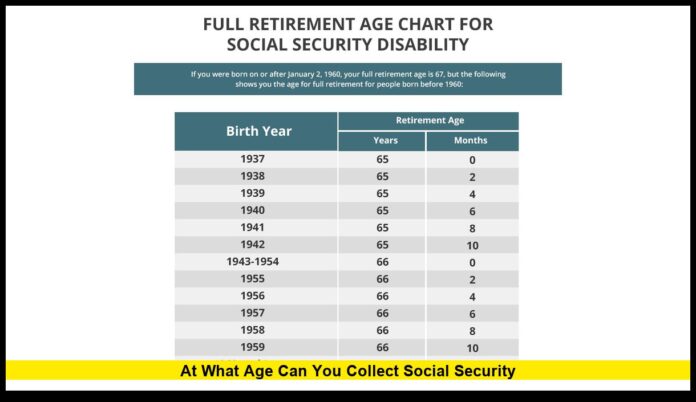
📅 Full Retirement Age (FRA) — 66 to 67 (depending on birth year)
The age at which you receive 100% of your benefit — known as the full retirement age — varies depending on when you were born:
| Year of Birth | Full Retirement Age (FRA) |
|---|---|
| 1937 or earlier | 65 years old |
| 1938 | 65 years, 2 months |
| 1939 | 65 years, 4 months |
| 1940 | 65 years, 6 months |
| 1941 | 65 years, 8 months |
| 1942 | 65 years, 10 months |
| 1943–1954 | 66 years |
| 1955 | 66 years, 2 months |
| 1956 | 66 years, 4 months |
| 1957 | 66 years, 6 months |
| 1958 | 66 years, 8 months |
| 1959 | 66 years, 10 months |
| 1960 or later | 67 years |
For individuals born in 1960 or later — most of today’s working-age Americans — the FRA is 67. At that age, you’re eligible for your full monthly benefit, based on your earnings history and primary insurance amount.
📉 What Happens If You Start Early or Delay
Starting at 62 (Earliest Age)
- Monthly benefits are permanently reduced. For many, that reduction may be about 30% compared with benefits at full retirement age.
- Benefits remain reduced — even if you live many more years.
Starting After FRA (Up to Age 70)
- If you wait beyond your full retirement age, your monthly benefit increases. For each full year you delay (until age 70), your benefit grows.
- Age 70 is widely considered the point at which you maximize monthly benefit under current law.
🧮 What It Means in Practice
Here’s a simplified example — assume your full retirement benefit (at FRA) would be $1,000/month:
- Claim at age 62 → your payment might be reduced to around $700/month.
- Claim at FRA (say 67) → you receive $1,000/month.
- Claim at age 70 → your payment might increase to about $1,240/month (or more, depending on PIA and credits for delay).
Because of these variations, when you choose to collect can make a big difference over your retirement years.
🔎 Recent Updates (2025)
- As of 2025, individuals born in 1959 reach their FRA at 66 years and 10 months.
- For those born in 1960 or later, FRA is 67 years.
- The longstanding rule — that benefits can begin at 62 — remains unchanged.
- Waiting until 70 still offers the highest monthly benefit under current law.
Because the FRA depends on birth year, many Americans nearing retirement should verify their exact benefit age using the SSA’s tools or an online calculator.
🧑💡 Who Should Claim Early — and Who Should Wait
You might choose to claim Social Security early if:
- You need income soon (for health expenses, debt, living costs).
- You’re in poor health or expect a shorter retirement period.
- You don’t have other retirement savings or income sources.
Waiting could be smarter if:
- You can continue working and don’t need the cash flow yet.
- You want higher monthly income for decades to come.
- You expect to live till or past average U.S. life expectancy.
Your decision should weigh your health, finances, savings, and retirement goals.
Making the call about at what age you can collect Social Security is one of the most important retirement decisions. Your birth year, financial needs, and health all matter. Many people at age 62 take benefits early, while those who can wait — often until full retirement age or even 70 — may get larger monthly checks that can comfortably support them for years to come.
Let me know if you’d like a breakdown of monthly benefit amounts by birth year — or a quick FAQ to help readers plan.

, full (66–67), or maximized (70).)