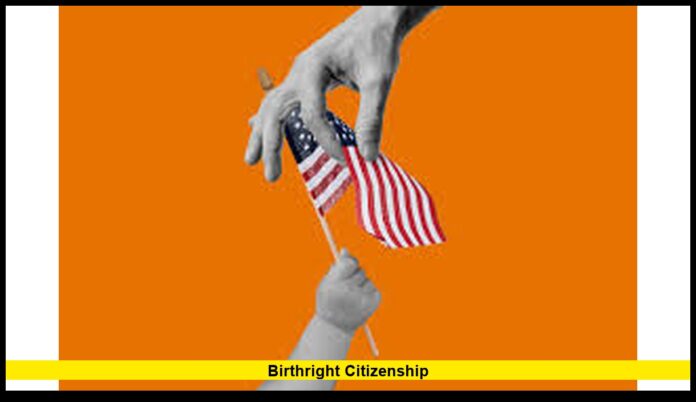
The debate over birthright citizenship has re-entered national focus, and the issue intensified on December 5, 2025, when the Supreme Court of the United States agreed to hear a case challenging a 2025 executive order issued by Donald Trump that aims to restrict who receives citizenship at birth.
Table of Contents
What Birthright Citizenship Means Today
Birthright citizenship is the long-standing principle that nearly everyone born in the United States automatically becomes a citizen. This standard is rooted in the Fourteenth Amendment and has been a central part of American identity for more than 150 years. It has only a few exceptions, such as children of foreign diplomats.
A landmark Supreme Court ruling in 1898 reaffirmed this guarantee, ensuring that people born on U.S. soil are citizens regardless of their parents’ immigration status. This framework has shaped national demographics, family rights, and civic participation for generations.
The 2025 Executive Order and Its Immediate Impact
The Order Itself
On January 20, 2025, the first day of the new administration, an executive order was signed titled “Protecting the Meaning and Value of American Citizenship.” It sought to narrow the definition of who receives citizenship at birth.
Under the order, a child born in the United States would only gain citizenship automatically if at least one parent were a U.S. citizen or a lawful permanent resident. Children born to undocumented immigrants or temporary visa holders would not receive citizenship under this policy. The order was written to apply to children born on or after February 19, 2025.
Legal Pushback and Court Responses
The order led to a wave of lawsuits filed by states, advocacy groups, and affected communities. A federal judge soon issued a nationwide preliminary injunction blocking its enforcement.
In June 2025, the Supreme Court reviewed a related case that did not directly address the legality of the order but examined whether lower courts could issue nationwide injunctions. The Court limited the use of such broad injunctions, creating uncertainty about enforcement in different jurisdictions.
To address this uncertainty, advocates filed a nationwide class-action suit. In July 2025, a federal judge granted class certification and once again blocked the order nationwide. As a result, the order remains unenforceable and cannot be applied anywhere in the United States at this time.
Current Status: December 2025
The Supreme Court has now agreed to take up the challenge to the executive order, placing birthright citizenship at the center of one of the most significant constitutional battles of the decade.
Oral arguments are expected in spring 2026, and a decision is likely by early summer. Until then, the existing nationwide injunction remains in place, and the traditional system of birthright citizenship continues uninterrupted.
Legal scholars largely agree that efforts to end birthright citizenship through executive action face major constitutional hurdles. The Fourteenth Amendment’s guarantee is explicit, and attempts to redefine it through reinterpretation raise serious legal concerns.
For now, every child born on U.S. soil continues to receive citizenship under current law, regardless of parental immigration status.
Why the Issue Matters
The future of birthright citizenship carries significant consequences for families, communities, and the nation.
Changes to this principle could affect hundreds of thousands of children born each year. It could create a new population of people born in the United States who are not citizens, which would be unprecedented in modern American history.
Such a shift would influence:
- Family stability
- Access to public services
- Government documentation systems
- Immigration patterns
- Demographic trends
The debate also touches on deep questions about American values, equality, and national identity.
What Comes Next
The upcoming Supreme Court decision will determine whether the executive order can be enforced or whether birthright citizenship remains protected under the Constitution.
A simplified overview of upcoming milestones is below:
| What Happens | Why It Matters | When |
|---|---|---|
| Supreme Court oral arguments | Could reshape citizenship law | Spring 2026 |
| Final ruling | May affirm or overturn long-standing precedent | By Summer 2026 |
| Policy response | Could affect families and immigration systems nationwide | Immediately afterward |
As the case moves forward, the nation faces a pivotal moment. The decision will determine whether the United States continues its historic approach to citizenship or enters a new and uncertain legal era.
Share your thoughts below on how this issue affects American families and what the Supreme Court’s decision could mean for the country.

