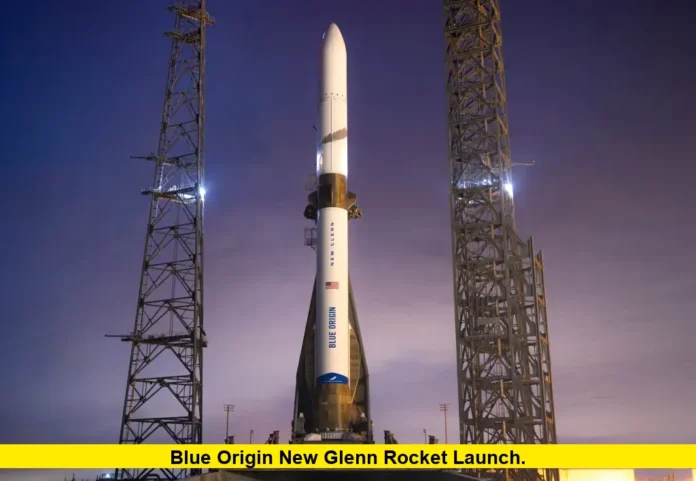
The Blue Origin New Glenn rocket launch achieved a key breakthrough on November 13, 2025, when the rocket successfully lifted off from Cape Canaveral and completed a first-stage booster landing, marking major progress in reusable heavy-lift space launches.
Mission Summary
The New Glenn rocket launched from Launch Complex 36 at Cape Canaveral Space Force Station in Florida at approximately 3:45 p.m. EST. The vehicle carried two twin spacecraft as part of NASA’s ESCAPADE mission, bound for Mars to study how the planet lost its atmosphere. Shortly after stage separation, the first stage returned and landed vertically on a barge in the Atlantic roughly 375 miles down‐range. The upper stage deployed the payload around 30–35 minutes into flight.
Why This Launch Matters
- This was only the second flight of the New Glenn vehicle and its first flight carrying a science payload destined for interplanetary travel.
- The first successful booster landing on the barge fulfills a key reusable-rocket objective for Blue Origin.
- With this success, Blue Origin strengthens its position in the heavy-lift launch market, offering an alternative to established providers.
- The ESCAPADE mission payloads mark a lower-cost, faster cadence scientific mission for NASA, enabled by this launch architecture.
Technical Highlights & Mission Profile
| Parameter | Detail |
|---|---|
| Rocket height | Approx. 321 ft (98 m) tall |
| Payload | Twin ESCAPADE spacecraft plus secondary communications experiment |
| Booster recovery zone | Atlantic Ocean barge “Jacklyn”, ~375 miles offshore |
| Orbit/Trajectory | After payload deployment, spacecraft will spend ~11 months in Earth-proximity before heading toward Mars for arrival in 2027 |
The rocket’s first stage performed deceleration burns using its BE-4 engines before executing the landing. On the upper-stage side, the dual spacecraft were deployed and entered a trajectory that will take them far beyond lunar distance before eventually transitioning toward Mars.
Lead-up & Challenges
Prior to the successful launch, the mission faced multiple delays:
- A scrub due to weather conditions at the launch site including cumulus-cloud rule violations.
- A solar-storm induced hold-down — elevated geomagnetic activity triggered a launch delay.
These hiccups underscore the many external factors that influence launch windows and mission readiness, especially for heavy-lift flights with high-stakes payloads.
Looking Ahead for Blue Origin & New Glenn
With the booster recuperated, Blue Origin now moves into a phase of booster refurbishment and reuse validation. Key upcoming goals will include:
- Demonstrating reliable turnaround of the first stage for subsequent flights.
- Qualifying New Glenn for national-security launches and long-duration commercial missions.
- Building out a manifest of heavy satellite and interplanetary customers to maximize vehicle utilization.
- Refining cost-competitiveness through reuse, which will be critical for market success in the U.S. launch sector.
What This Means for the U.S. Space Sector
The success of the New Glenn rocket launch has broader implications for the U.S. space industry:
- It brings more competition into the heavy-lift launch marketplace, which could reduce costs and spur innovation.
- It signals that private companies are increasingly capable of supporting NASA’s interplanetary science missions, not just crewed or Earth-orbit work.
- It helps diversify the U.S. launch base and reinforces domestic capability for large-payload and deep-space missions.
In Summary
The Blue Origin New Glenn rocket launch on November 13, 2025, marks a defining moment: a heavy-lift reusable rocket achieving booster landing after delivering an interplanetary science payload. By executing both launch and recovery, Blue Origin has demonstrated a significant engineering milestone. With its booster safely returned and spacecraft en route to Mars, the company enters a new chapter of orbital launch capability.
We’d love to hear your thoughts—please comment below and stay tuned for further updates on future flights, booster reuse cycles, and how New Glenn continues to reshape the U.S. launch landscape.

