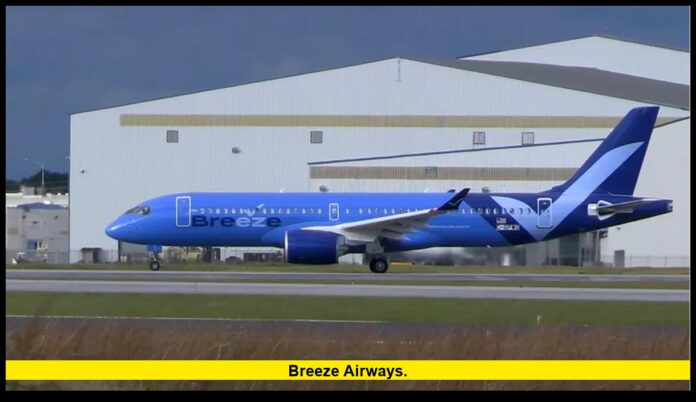
The low-cost carrier Breeze Airways has reached a major milestone this year, officially becoming a U.S. flag carrier and preparing to launch its first international routes in early 2026. This marks a turning point for the airline, which has quickly grown from a regional disruptor to a contender on the global stage.
Table of Contents
Breeze Airways Achieves Flag Carrier Certification
Breeze Airways has been granted U.S. flag carrier status, making it the first new airline in over a decade to receive this designation. This certification allows Breeze to operate international flights, opening the door for services beyond U.S. borders.
The approval follows years of domestic expansion, testing, and regulatory compliance. With the new status secured, Breeze can now shift its focus from strictly domestic routes to cross-border travel, beginning with leisure-focused destinations.
First International Flights Coming in 2026
Starting in January 2026, Breeze Airways will debut a series of seasonal international routes. These will initially connect U.S. travelers to Mexico and the Caribbean, destinations that align with the airline’s affordable leisure travel model.
Among the first routes to launch is New Orleans to Cancún, with fares starting at $99 one way. Other tropical destinations are expected to follow, all aimed at appealing to budget-conscious travelers seeking direct connections to vacation hotspots.
The international push will be supported by the opening of a new crew base at Raleigh-Durham International Airport (RDU), planned for early 2026. This base will house pilots and flight attendants dedicated to both domestic and international operations.
Domestic Growth Continues Steadily
Even as Breeze prepares for international service, its domestic expansion has not slowed. In mid-2025, the airline added new nonstop flights from Hartford, Connecticut (BDL) to Greensboro, North Carolina (GSO), strengthening its network in underserved regions.
Breeze now serves nearly 70 destinations across the United States, many of which are secondary airports often overlooked by larger airlines. By avoiding crowded hubs, Breeze continues to carve out a niche in the market with direct flights that save travelers time and hassle.
Fleet and Business Model
Breeze Airways operates a fleet made up primarily of Airbus A220-300 and Embraer 190/195 aircraft. These planes are well-suited for the airline’s mission of serving point-to-point routes and smaller markets.
Key features of the Breeze business model include:
- Underserved markets focus – targeting routes that lack nonstop service from larger carriers.
- Tiered fares – offering “Nice,” “Nicer,” and “Nicest” ticket classes, with varying levels of comfort and flexibility.
- Affordable premium seats – on Airbus A220s, first-class style seating is available at lower costs compared to legacy airlines.
- Point-to-point convenience – avoiding hub connections in favor of direct flights.
This model has resonated with travelers who value convenience and competitive pricing.
Recent Incidents and Challenges
Like any growing airline, Breeze has faced hurdles along the way.
- In August 2025, a cross-country flight had to divert after a disruptive passenger caused delays of several hours.
- Earlier this year, a Breeze Airbus A220 was involved in a ground collision at Charleston International Airport, leading to minor injuries and aircraft damage.
While these incidents created operational challenges, the airline continues to emphasize safety and resilience as it scales.
Competitive Advantages of Breeze Airways
Several strengths set Breeze apart in a competitive aviation market:
- Innovative network strategy – focusing on underserved city pairs.
- Lower operating costs – leveraging efficient aircraft and secondary airports.
- Rapid scalability – proven by its growth to nearly 70 destinations in just a few years.
- Customer appeal – blending budget-friendly options with a touch of premium service.
These advantages give Breeze a unique position as it enters the international market.
Potential Risks Moving Forward
As Breeze Airways expands, it faces several risks common to young airlines:
- Operational complexity – international flying brings new challenges such as customs and cross-border regulations.
- Economic sensitivity – low-cost airlines are vulnerable to fluctuations in fuel prices and consumer demand.
- Competitive retaliation – major airlines may attempt to undercut Breeze on new international routes.
How Breeze navigates these hurdles will determine the success of its international strategy.
What to Expect in 2026 and Beyond
Travelers and industry observers will be watching closely as Breeze makes the leap into international service. Key developments to monitor include:
- Performance of international routes – especially the Cancún flights from New Orleans.
- Growth of the RDU crew base – a sign of long-term expansion.
- Possible entry into Canada or Central America – future international markets under consideration.
- Fleet adjustments – further deliveries of A220 aircraft to support expansion.
- Partnership opportunities – potential codeshares with other carriers to expand reach.
Breeze’s next chapter could define its long-term place in the airline industry.
Breeze Airways Quick Facts
| Detail | Information |
|---|---|
| Founded | 2018 |
| First Flight | May 2021 |
| Current Destinations | Nearly 70 (domestic U.S.) |
| Fleet | Airbus A220-300, Embraer 190/195 |
| Business Model | Low-cost, point-to-point |
| New Status | Certified U.S. flag carrier (2025) |
| International Launch | January 2026 |
| First Route Abroad | New Orleans to Cancún |
| Crew Base Expansion | Raleigh-Durham International Airport |
Why Breeze Airways Matters in 2025
The transformation of Breeze from a small domestic disruptor to a certified flag carrier is one of the most significant developments in U.S. aviation this year. Its ability to blend affordability with convenience has already changed travel patterns in smaller markets.
Now, with international routes on the horizon, Breeze is poised to challenge traditional airlines in new ways. Success could establish it as a lasting player in both domestic and international markets.
Closing Thoughts
The rise of Breeze Airways is a reminder that innovation in aviation doesn’t always come from the biggest names. By focusing on underserved cities, offering flexible fares, and moving boldly into international service, Breeze is redefining what a low-cost carrier can achieve.
As its first international flights take off in 2026, all eyes will be on how Breeze delivers. Will it continue its rapid ascent or face turbulence in new skies? Share your thoughts below and stay tuned for what comes next.

