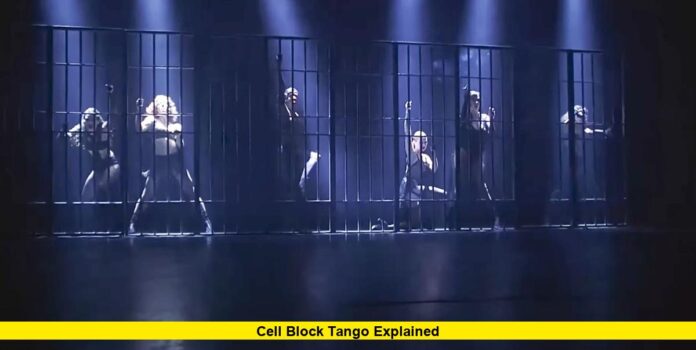
Step into the claustrophobic world of prison bars, jealousy, and vengeance — this is what “Cell Block Tango Explained” reveals about one of musical theatre’s most electrifying numbers. Since its debut in Chicago, the sequence “Cell Block Tango” has remained a provocative, unforgettable display of storytelling through music, dance, and psychological tension.
What is “Cell Block Tango”?
“Cell Block Tango” comes from the 1975 musical Chicago, with music by John Kander and lyrics by Fred Ebb. The number takes place in a jail cell at Cook County Women’s Annex, where six incarcerated women — each accused of murdering their significant others — recount the circumstances that led them to prison.
The song’s refrain “He had it coming” resonates over and over, a chilling chorus that frames each woman’s story as justified, no matter how extreme.
Meet the Six Women: Their Stories and Their Labels
Each of the six women in “Cell Block Tango” is introduced with a single word — a grim, memorable label that becomes shorthand for her story and fate. These labels are: Pop, Six, Squish, Uh-uh, Cicero, and Lipschitz.
- Pop — Liz: She shoots her husband after his relentless gum-popping annoys her, claiming her act was triggered by irrepressible irritation.
- Six — Annie: She reveals that her partner had secretly been married to six other women when she met him — leading to her poisoning his drink.
- Squish — June: Accused of stabbing her husband to death amid accusations of infidelity.
- Uh-uh — Hunyak: A Hungarian immigrant. She maintains she did not commit the crime she is accused of. Her story stands apart from the rest.
- Cicero — Velma Kelly: A vaudeville performer who confesses to killing both her husband and her sister after uncovering their affair during a performance tour in Cicero, Illinois.
- Lipschitz — Mona: She admits to murdering her partner after discovering his serial infidelity — apparently involving multiple women and at least one man.
Through these monologues, the audience hears different motivations — from betrayal to self-defense to plain anguish. But in each case, the convicted woman insists she only did what she had to.
Why This Number Hits So Hard
What makes “Cell Block Tango” more than just a murderers’ chorus is its seamless interplay of music, dance, stylized imagery, and psychological drama. In the 2002 film adaptation of Chicago, the number was reimagined with a “vaudeville meets nightmare” aesthetic — integrating tango rhythms, symbolic props, and imaginative choreography to turn the jail cell into a twisted stage of desire, regret, and rage.
The film version uses male partners and red scarves as symbolic representations of violence and death. The red scarf becomes a recurring motif — a dance prop, an emblem of guilt, and a metaphorical stain that cannot be washed away. For the one inmate who protests her innocence (Hunyak), a contrasting white scarf helps signal the ambiguous morality of the number.
As a result, “Cell Block Tango” transcends its plot role: it becomes a stylized comment on betrayal, revenge, gender dynamics, and societal hypocrisy — all through the lens of high-energy performance. It demands the audience decide whether to judge the women as criminals, victims, or both.
Legacy and Cultural Impact
Since its debut, “Cell Block Tango” has become a mainstay in the world of musical theatre. Its bold storytelling and theatricality make it a rite of passage for many performers.
Over the years, it has inspired countless reinterpretations — from parody versions to dance covers — and remains one of the most recognized numbers from Chicago’s songbook.
“Cell Block Tango Explained”: Why It Still Matters Today
Understanding “Cell Block Tango” offers more than insight into a famous song — it reveals how art can explore crime, guilt, justice, and vengeance in a way that outruns moral simplicity.
It’s a potent reminder that theatrical performance can blur the lines between empathy and horror, representing real human experiences in a heightened, stylized world where survival, anger and heartbreak dance together.
If you haven’t seen it — whether on stage or screen — pay attention to those labels: Pop. Six. Squish. Uh-uh. Cicero. Lipschitz. Let them sink in.
Let me know what you think. Feel free to chime in below — and stay tuned for more deep dives into musical theatre’s most unforgettable moments.

