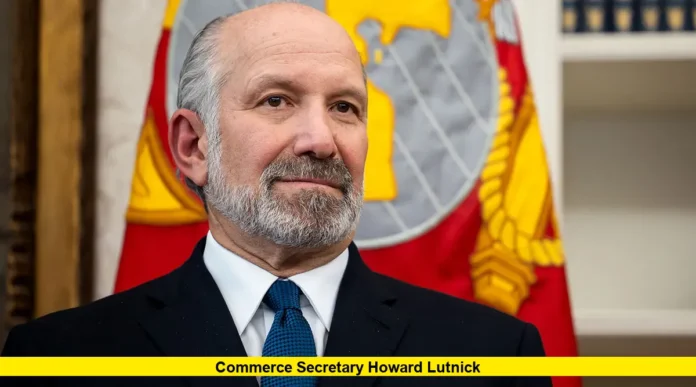
Commerce Secretary Howard Lutnick made a high-profile visit to Pennsylvania on Monday, June 8, 2026, celebrating a landmark moment for American steelmaking. Standing before roughly 100 U.S. Steel workers at the Edgar Thomson Plant in Braddock, Lutnick championed Nippon Steel’s massive commitment to revitalize the Mon Valley Works — a move that signals a new era for one of the most iconic industrial regions in the United States.
Table of Contents
Who Is Commerce Secretary Howard Lutnick?
Howard William Lutnick, born July 14, 1961, in Long Island, New York, serves as the 41st United States Secretary of Commerce. He assumed office on February 21, 2025, after being confirmed by the Senate following a Commerce, Science, and Transportation Committee hearing. Before his government role, Lutnick was widely known as the president and CEO of Cantor Fitzgerald, a position he held since 1990. Time magazine recognized him as one of the world’s 100 most influential people in 2025. Throughout his tenure, Lutnick has been a vocal advocate for tariffs and domestic manufacturing, and he emerged as a central figure in brokering the Nippon Steel–U.S. Steel deal.
Nippon Steel’s $2.5 Billion Pledge to Mon Valley Works
Nearly a year after U.S. Steel finalized its long-awaited sale to Japan-based Nippon Steel in a $15 billion acquisition, the company unveiled a sweeping investment plan for Mon Valley Works. U.S. Steel has pledged up to $2.5 billion in upgrades to the facility — a dramatic increase from the original $1 billion commitment Nippon Steel announced in 2024. The expanded figure reflects an “expanded scope of improvements” planned specifically for the Edgar Thomson plant.
The Mon Valley Works comprises three primary sites:
- Edgar Thomson Plant — Braddock, Pennsylvania
- Irvin Plant — West Mifflin, Pennsylvania
- Clairton Coke Works — Clairton, Pennsylvania
Together, these facilities produce up to 2.9 million net tons of steel per year and employ thousands of workers across the Pittsburgh region.
What the Investment Means for Pennsylvania
The economic ripple effects of the $2.5 billion investment are expected to be substantial. According to a report released by U.S. Steel on June 8, 2026, the investment is projected to generate $1.7 billion in economic impact across Pennsylvania, accounting for wages, construction costs, and related spending.
Key highlights from the report include:
- ~3,000 existing jobs preserved at Mon Valley Works
- ~3,200 indirect and induced jobs created over a three-year period
- A total of 6,381 jobs generated over the next three years
- Up to $58 million in state and local tax revenues over the same period
The investment forms part of a broader strategy by U.S. Steel and Nippon to invest $11 billion into U.S. domestic operations by 2028.
The Centerpiece: A Brand-New Hot Strip Mill at Edgar Thomson
The crown jewel of the Mon Valley investment is a brand-new Hot Strip Mill at the Edgar Thomson Plant in Braddock. The new facility will replace an 87-year-old hot strip mill currently operating at the nearby Irvin Plant in West Mifflin. The aging mill has long been a bottleneck in U.S. Steel’s production capability.
Once complete, the new mill will allow Mon Valley Works to produce:
- Low-cost exposed automotive steel — critical for American car manufacturing
- Line pipe steel and other high-strength steel products that the current facility cannot competitively produce
The upgrade is designed to improve yield, reduce energy consumption, and extend the operational life of the Mon Valley Works for decades to come.
Lutnick Delivers a Victory Lap in Braddock
Commerce Secretary Lutnick’s appearance at the Edgar Thomson Plant was nothing short of theatrical. Before taking the podium, he stepped back down to personally shake hands with every steelworker in the front row, clapping some on the back and exchanging warm greetings — a gesture that drew cheers from the crowd.
U.S. Steel President and CEO David Burritt introduced Lutnick by saying he had received “a master class in negotiation from this man” and that Lutnick had secured “the best deal in American steel.” Burritt added pointedly, “They said this day would never come, and yet here we are, recognizing the people that made it happen.”
Lutnick, in his remarks, credited President Trump as the driving force behind the deal’s success. “Because of President Trump, U.S. Steel is going to thrive,” he said, adding that Trump “has the back” of steelworkers and has prioritized domestic steel production.
The Golden Share: Federal Oversight Built Into the Deal
One of the most unusual and consequential aspects of the Nippon Steel–U.S. Steel agreement is the so-called “golden share” granted to the U.S. government. Commerce Secretary Lutnick first disclosed the details of this arrangement in a social media post, describing the deal as including “powerful terms that directly benefit and protect America, Pennsylvania, the great steelworkers of U.S. Steel and U.S. manufacturers.”
Under the golden share structure:
- President Trump holds the authority to name one of three independent corporate board directors and can veto the other two choices
- U.S. Steel cannot relocate its headquarters without federal approval
- The company cannot change its name without President Trump’s approval
- The deal mandates $11 billion in new investments by 2028
While presidents can typically influence corporate decisions only indirectly through agencies like the FTC, this arrangement gives the executive branch an unusually direct hand in U.S. Steel’s corporate governance — a reflection of how politically significant the deal has been since it was first proposed.
Nippon Steel’s Broader U.S. Ambitions
The Mon Valley commitment is just one piece of Nippon Steel’s aggressive U.S. investment strategy. The Japanese company — ranked as the third-largest steel producer in the world — has signaled its intent to grow U.S. Steel’s footprint significantly.
In addition to the $2.5 billion for Mon Valley Works, the company has announced plans to invest $3 billion into its Big River Steel site in Arkansas, a non-unionized facility that sits within the Southern automotive corridor stretching from South Carolina to Mississippi. As the American automotive industry continues to expand southward, U.S. Steel is positioning itself to serve the region’s growing demand for high-strength automotive steel.
CEO David Burritt captured the vision succinctly: “The Mon Valley Works is where the American steel industry was first forged, and this investment is proof that its best days are still ahead.”
A Long Road to This Moment
The Nippon Steel acquisition of U.S. Steel was one of the most contentious corporate deals in recent American history. The transaction faced fierce opposition from the United Steelworkers union, political resistance from both parties, and a high-profile national security review. Former President Biden had initially blocked the deal, citing concerns about foreign ownership of a strategic domestic asset.
The deal ultimately moved forward under the Trump administration, with Commerce Secretary Lutnick playing a pivotal negotiating role. Lutnick held meetings with rival bidders — including activist shareholder Ancora Holdings — before the Nippon deal was revived and ultimately completed. The golden share provision and the sweeping investment commitments were key terms that made the deal politically viable.
FAQ
Q: Why did Commerce Secretary Howard Lutnick visit Braddock, Pennsylvania on June 8, 2026? A: Lutnick visited the Edgar Thomson Plant to celebrate the one-year anniversary of U.S. Steel’s partnership with Nippon Steel and to tout the company’s new $2.5 billion investment commitment to Mon Valley Works.
Q: How much is Nippon Steel investing in Mon Valley Works? A: Nippon Steel, through U.S. Steel, has pledged up to $2.5 billion in upgrades to Mon Valley Works, up from an original $1 billion commitment announced in 2024.
Q: How many jobs will the Mon Valley investment create or preserve? A: The investment is expected to preserve approximately 3,000 existing jobs and generate a total of 6,381 jobs — including 3,200 indirect and induced positions — over the next three years.
Q: What is the centerpiece of the Mon Valley Works investment? A: The centerpiece is a brand-new Hot Strip Mill at the Edgar Thomson Plant in Braddock, replacing an 87-year-old mill at the Irvin Plant in West Mifflin.
Q: What is the “golden share” in the Nippon Steel–U.S. Steel deal? A: The golden share is a special government-held interest that gives the U.S. government — specifically the president — significant oversight over U.S. Steel’s corporate decisions, including board appointments, headquarters relocation, and name changes.
Q: What is Nippon Steel’s total U.S. investment commitment? A: Nippon Steel and U.S. Steel have committed to investing $11 billion into U.S. domestic operations by 2028, covering facilities in Pennsylvania, Arkansas, and elsewhere.
Q: Who is Howard Lutnick? A: Howard Lutnick is the 41st U.S. Secretary of Commerce, confirmed in February 2025 under President Trump. He was previously the CEO of Cantor Fitzgerald and was named one of Time magazine’s 100 most influential people in 2025.
What do you think about Commerce Secretary Howard Lutnick’s role in securing the Nippon Steel deal — is this the revival American steelworkers have been waiting for? Drop your thoughts in the comments below and stay updated as the Mon Valley transformation unfolds.

