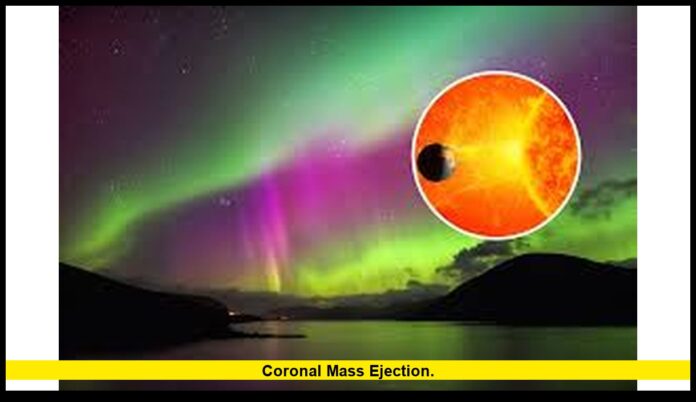
A coronal mass ejection continues to draw attention in May 2026 as solar activity remains elevated during the current solar cycle, prompting geomagnetic storm watches, aurora sightings, and close monitoring by NOAA space weather experts.
The Sun has stayed unusually active throughout early 2026. Multiple solar flares and CME events have already triggered radio blackouts, geomagnetic storm conditions, and vivid northern lights displays across parts of the United States. Recent activity has kept scientists, satellite operators, airlines, and power grid managers on alert as Earth experiences repeated bursts of charged solar particles.
NOAA’s Space Weather Prediction Center reported several geomagnetic disturbances in recent weeks, including G1 and G2 storm conditions connected to solar eruptions and fast-moving solar wind streams. Moderate radio blackouts were also observed after strong solar flare activity during May 2026.
Table of Contents
What Is a Coronal Mass Ejection?
A coronal mass ejection, often called a CME, is a massive eruption of plasma and magnetic fields from the Sun’s outer atmosphere. These eruptions can launch billions of tons of solar material into space at speeds reaching millions of miles per hour.
When a CME heads toward Earth, it can interact with the planet’s magnetic field and trigger geomagnetic storms. Those storms sometimes create visible auroras, but they can also interfere with technology systems.
CMEs vary greatly in strength and travel speed. Some move slowly and produce little effect. Others arrive rapidly and create severe disturbances in Earth’s magnetosphere.
Why Solar Activity Has Increased in 2026
Solar scientists have linked the recent increase in CME activity to the Sun’s current solar maximum phase. During solar maximum, the Sun’s magnetic field becomes more unstable, leading to more sunspots, solar flares, and coronal mass ejections.
The ongoing Solar Cycle 25 has become more active than many early forecasts predicted. Several X-class and M-class solar flares have erupted since the beginning of the year.
Recent tracking data showed:
| Solar Event | Recent Status |
|---|---|
| X-Class Solar Flares | Multiple events observed in 2026 |
| M-Class Solar Flares | Continued activity in May 2026 |
| Geomagnetic Storms | G1 to G4 conditions reported |
| Aurora Visibility | Expanded across northern U.S. |
| Radio Blackouts | Moderate disruptions recorded |
Space weather monitoring services also recorded strong flare activity during late April and early May.
Recent Coronal Mass Ejection Events in May 2026
Several recent solar eruptions have fueled public interest in space weather during May 2026.
One notable geomagnetic disturbance occurred after a CME and high-speed solar wind stream interacted with Earth’s magnetic field. NOAA issued geomagnetic storm watches while observers across northern states reported strong aurora displays.
Another event earlier this month surprised forecasters after geomagnetic conditions intensified more than expected. Scientists noted that Earth experienced a moderate G2 geomagnetic storm despite earlier projections suggesting weaker activity.
Solar observers also tracked powerful flare activity from active sunspot regions rotating into Earth-facing position. These regions increased the risk of additional Earth-directed CME events.
How CMEs Affect Earth
The effects of a coronal mass ejection depend largely on the eruption’s magnetic orientation and speed.
A strong CME can compress Earth’s magnetic field and inject enormous amounts of energy into the upper atmosphere. This process creates geomagnetic storms that may impact several technologies.
Possible effects include:
- GPS accuracy disruptions
- High-frequency radio interference
- Satellite communication interruptions
- Increased spacecraft drag
- Power grid fluctuations
- Expanded aurora visibility
Most CME events create little direct danger for the general public on the ground. However, severe geomagnetic storms can create challenges for modern infrastructure systems.
NOAA continues to monitor all significant solar eruptions around the clock.
Northern Lights Visibility Expands Across the U.S.
One of the most visible effects of recent CME activity has been the expansion of aurora sightings into parts of the continental United States.
During recent geomagnetic storms, northern lights displays became visible farther south than usual. Skywatchers in northern states reported strong aurora activity after CME impacts reached Earth.
States with recent aurora viewing opportunities included:
- Alaska
- Washington
- Montana
- Minnesota
- North Dakota
- Michigan
- Idaho
- Wisconsin
- New York
Clear skies and low light pollution improved viewing conditions for many observers.
Geomagnetic storms triggered by CMEs often create the brightest aurora events when solar particles strongly interact with Earth’s magnetic field.
NOAA’s Current Space Weather Monitoring
NOAA’s Space Weather Prediction Center remains the primary U.S. agency monitoring solar activity and issuing alerts.
The agency tracks:
- Solar flares
- Coronal mass ejections
- Geomagnetic storms
- Radiation storms
- Radio blackout risks
NOAA uses several spacecraft and solar observation systems to analyze activity from the Sun in real time.
Current forecasts continue to indicate periodic geomagnetic disturbances as solar activity remains elevated through 2026. Recent NOAA bulletins also highlighted ongoing moderate radio blackout conditions linked to solar flare activity.
Understanding Geomagnetic Storm Levels
NOAA classifies geomagnetic storms using a G-scale ranging from G1 to G5.
G1 – Minor
- Weak power grid fluctuations possible
- Minor satellite impacts
- Aurora visible at high latitudes
G2 – Moderate
- Increased spacecraft charging risk
- Radio signal disruptions
- Aurora visible farther south
G3 – Strong
- Voltage correction issues on power systems
- Navigation problems possible
- Wider aurora visibility
G4 – Severe
- Potential widespread voltage control issues
- Satellite disruptions increase
- Significant radio communication problems
G5 – Extreme
- Rare and potentially dangerous
- Major grid disturbances possible
- Widespread communication impacts
Recent events during 2026 have reached G4 severity during some solar storm periods.
Can a Coronal Mass Ejection Damage the Internet?
Interest in severe solar storms has increased because modern society depends heavily on satellite systems and communication infrastructure.
Scientists continue studying how a powerful CME could affect internet connectivity, especially undersea communication cables and satellite networks.
Most recent solar storms have caused manageable disruptions rather than catastrophic failures. Still, experts acknowledge that an extreme geomagnetic event could create serious infrastructure challenges.
Space weather specialists continue improving forecasting systems to reduce risks for power grids, aviation systems, and communication networks.
Airlines and Space Missions Monitor CME Threats
Airlines operating polar routes pay close attention to space weather alerts because solar storms can interfere with radio communication and navigation systems.
Space agencies also monitor CME activity closely before launches and during crewed missions.
Earlier in 2026, a powerful solar flare triggered radio blackout concerns during preparations connected to NASA’s Artemis 2 mission timeline. Scientists tracked the associated CME closely due to possible Earth impacts.
Astronaut safety becomes increasingly important during periods of strong solar radiation and geomagnetic activity.
Read More – Aurora Borealis Forecast
How Scientists Detect a Coronal Mass Ejection
Researchers use multiple satellites and solar telescopes to detect CMEs shortly after eruptions occur on the Sun.
Key monitoring systems include:
- Solar Dynamics Observatory
- GOES satellites
- DSCOVR spacecraft
- ACE spacecraft
- NOAA space weather sensors
These instruments help scientists estimate:
- CME speed
- CME direction
- Arrival timing
- Magnetic field orientation
Forecast accuracy improves as the CME approaches Earth and real-time solar wind measurements become available.
Why Magnetic Orientation Matters
Not every CME produces strong geomagnetic storms after reaching Earth.
Scientists explain that a CME’s magnetic field orientation plays a major role in determining its impact strength.
A southward magnetic orientation allows stronger interaction with Earth’s magnetic field. That interaction increases geomagnetic storm intensity and raises the chances of aurora development.
Forecasters often cannot confirm the full magnetic orientation until shortly before impact. This uncertainty explains why some storms become stronger or weaker than expected.
The Strongest Solar Storms in Modern History
Several historic geomagnetic storms continue to shape modern space weather research.
Major past events include:
| Event | Year | Impact |
|---|---|---|
| Carrington Event | 1859 | Telegraph failures worldwide |
| Quebec Blackout Storm | 1989 | Power grid collapse in Canada |
| Halloween Storms | 2003 | Satellite and aviation disruptions |
| May Solar Storms | 2024 | Strongest storm in two decades |
Researchers studying the massive 2024 geomagnetic storm concluded that multiple interacting CMEs contributed to its extreme intensity.
Could More CMEs Arrive Soon?
Solar forecasters expect elevated solar activity to continue throughout much of 2026 because the Sun remains near solar maximum.
Active sunspot regions rotating across the Earth-facing side of the Sun may continue generating solar flares and CME eruptions.
Recent observations showed several magnetically complex sunspot groups capable of producing additional strong solar events.
Scientists continue monitoring conditions daily for signs of Earth-directed solar eruptions.
How Americans Can Track Space Weather
People interested in solar activity can monitor official space weather forecasts through NOAA’s Space Weather Prediction Center.
Popular tracking tools include:
- Aurora forecast maps
- Geomagnetic storm alerts
- Solar flare trackers
- Real-time satellite data
- Space weather dashboards
These systems help photographers, astronomers, airlines, emergency managers, and utility companies prepare for changing solar conditions.
Read More – Northern Lights Aurora Borealis Forecast
Public Interest in Coronal Mass Ejection Events Keeps Growing
Interest in space weather has surged during the current solar cycle. Social media platforms, astronomy communities, and weather forums continue sharing aurora photos and solar updates after each major geomagnetic storm.
The combination of vivid northern lights, viral sky images, and concerns about technology disruptions has made coronal mass ejection events one of the most talked-about science stories of 2026.
Researchers expect public attention to remain high as solar maximum conditions continue generating powerful eruptions from the Sun.
As solar activity evolves through 2026, readers can expect more updates on geomagnetic storms, aurora sightings, and the latest coronal mass ejection developments across the United States.

