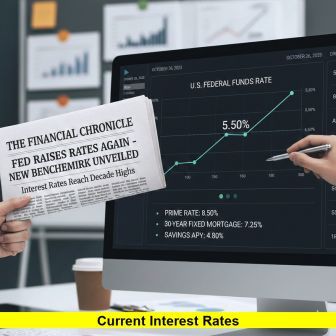
The latest update on current interest rates shows that the effective federal funds rate is around 3.88%, marking the short-term borrowing cost for banks. At the same time, the average U.S. 30-year fixed mortgage rate stands at approximately 6.26% in mid-November 2025 and about 6.33% as of late November.
Why these figures matter
The federal funds rate—what banks charge each other overnight—is a key benchmark. When it sits near 3.88%, that signals a certain level of monetary policy stance affecting broader lending.
Meanwhile, the average long-term mortgage rate at about 6.26% to 6.33% reflects how much homebuyers can expect to pay for financing across the U.S. housing market.
How did we get here?
After a period of higher short-term rates, policymakers held the federal funds rate steady near this level. The rate has remained around 3.88% in recent days.
Mortgage rates, conversely, have hovered above 6% for some time. While they’re below peaks seen earlier this year, they remain elevated compared to the ultra-low rates of the pandemic era. For example, the average 30-year fixed rate was about 6.26% as of November 20, 2025, according to federal data.
Snapshot of key rates
- Federal funds (effective): ~3.88%
- 30-year fixed mortgage average: ~6.26% (mid-Nov) → ~6.33% (late Nov)
- Deposit and savings rates: Many national rate caps show savings/money-market products capped around 3.86%-4.61%.
What this means for borrowers and savers
For homebuyers: A 30-year fixed rate of around 6.3% means higher monthly payments compared to the low-rate environment of recent years. It becomes especially important to factor in the rate when budgeting for home purchase or refinance decisions.
For those refinancing: If your current rate is significantly higher than today’s average, it may make sense to explore refinancing—provided the closing costs and remaining term justify the move.
For savers: Even though short-term bank rates aren’t skyrocketing, seeing deposit rate caps around 3.86%-4.61% suggests some room for better yields than in the deeply low-rate years.
For overall borrowing: Costs for auto loans, personal loans, and other credit are influenced by both the short-term policy rate and the longer-term borrowing environment. Because lenders consider their cost of funds plus risk, shifts in benchmarks tend to ripple through slowly.
What to keep an eye on next
- Inflation: If inflation remains sticky, the Fed may hold off on cuts or even raise rates.
- Labor market: Weakening employment data could prompt rate cuts and lower yields.
- Treasury yields: Movements in the 10-year Treasury note influence long-term loan rates, including mortgages.
- Fed communications: Any indications of future policy changes can drive rate expectations and market reactions.
Bottom line
Current interest rates reflect a steady short-term policy environment with the federal funds rate near 3.88%, and long-term borrowing (such as mortgages) still elevated above 6%. For both borrowers and savers in the U.S., understanding these dynamics is essential.
We’d love to hear your experiences—feel free to comment on how these rates are affecting your financial decisions or plans.

