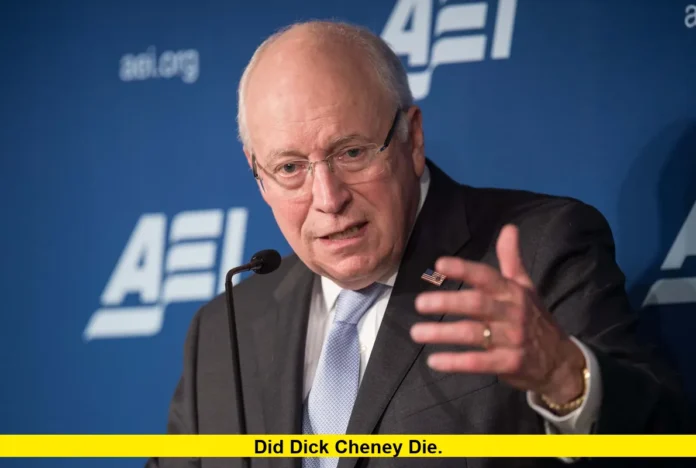
Did Dick Cheney die? Yes — former U.S. Vice President Dick Cheney passed away on November 3, 2025, at the age of 84. His family confirmed that he died from complications caused by pneumonia, alongside long-term cardiac and vascular conditions. Cheney passed peacefully at home, surrounded by his wife, Lynne Cheney, and his two daughters, Liz and Mary. His death marks the end of a remarkable, often controversial political career that shaped the direction of American policy for over four decades.
Table of Contents
Early Life: From Wyoming Roots to Washington’s Power Corridors
Richard Bruce Cheney, known to history as Dick Cheney, was born on January 30, 1941, in Lincoln, Nebraska. He spent most of his youth in Casper, Wyoming — a place he always called home. Growing up in small-town America gave him a deep respect for hard work and perseverance, traits that carried him through every stage of his life.
Cheney earned both his bachelor’s and master’s degrees in political science from the University of Wyoming. He later began doctoral studies at the University of Wisconsin–Madison, though he left before completing his dissertation to pursue public service. That decision set the stage for one of the most consequential political careers in modern American history.
Cheney’s Early Political Rise
Cheney’s government career began during the Nixon administration, where he quickly proved himself as a capable strategist. By the mid-1970s, he was serving as White House Chief of Staff under President Gerald Ford — at just 34 years old, making him one of the youngest ever to hold the position.
In 1978, Cheney won election to the U.S. House of Representatives from Wyoming, serving six terms. During that time, he built a reputation as a reliable conservative and a strong supporter of limited government and national defense. Colleagues admired his calm, analytical approach to policy, though even then, his style was notably firm and direct.
Leadership as Secretary of Defense
Cheney’s influence on U.S. military policy began long before his vice presidency. In 1989, he was appointed Secretary of Defense under President George H. W. Bush. During his tenure, he oversaw Operation Desert Storm — the U.S.-led coalition that liberated Kuwait from Iraqi occupation in 1991.
His measured handling of the Gulf War earned him bipartisan respect and praise for precision and restraint. This success boosted his standing as one of the Republican Party’s leading foreign policy voices throughout the 1990s.
Vice President Under George W. Bush (2001–2009)
When George W. Bush selected Dick Cheney as his running mate in 2000, many saw the decision as a move to add foreign policy gravitas to the ticket. Once elected, Cheney quickly became one of the most influential vice presidents in American history.
Following the tragic events of September 11, 2001, Cheney became central to shaping U.S. national security policy. His firm belief in a strong executive branch and decisive military action defined much of the Bush administration’s response to terrorism.
Under his guidance, the U.S. launched wars in Afghanistan and Iraq. Cheney’s leadership during this era transformed the vice presidency — a role traditionally symbolic — into one of unmatched influence. Supporters called him steady and unflinching; critics labeled him secretive and overly powerful.
A Career Defined by Controversy
Dick Cheney’s legacy cannot be separated from controversy. His role in shaping U.S. foreign policy after 9/11 made him one of the most debated figures in modern politics. He supported enhanced interrogation methods and broad surveillance programs, which sparked national and global criticism.
He also strongly defended the Iraq invasion — a decision later criticized after weapons of mass destruction were never found. Cheney remained unapologetic about his choices, saying he prioritized American security above all else.
Despite the criticism, many conservatives admired his consistency and resolve. Even after leaving office, he stood by his principles, often speaking candidly about his decisions and their impact on the world.
Health Challenges Through the Years
Cheney’s long struggle with heart disease was well known to the public. His first heart attack came at just 37 years old, followed by several more in later decades. He underwent numerous surgeries, including bypass operations, angioplasties, and finally, a heart transplant in 2012.
These challenges never stopped him from working. Even while battling serious illness, Cheney remained active in politics, think tanks, and public commentary. His health story became one of resilience and determination — a reflection of his relentless nature both in and out of office.
By late 2025, his health had declined significantly. Complications from pneumonia, combined with his existing heart condition, ultimately led to his passing at home in Wyoming.
Family, Personal Life, and Beliefs
Cheney was married to Lynne Cheney for over six decades. Together, they raised two daughters — Liz and Mary — and shared a deep commitment to family and faith. Lynne, an author and historian, often described her husband as disciplined, pragmatic, and deeply patriotic.
Liz Cheney, following in her father’s political footsteps, became a U.S. Representative from Wyoming and a high-profile figure in Republican politics. Mary Cheney, who is openly gay, has also played an active role in advocacy and public discourse. The Cheney family, while politically united in their values of service, has often been described as thoughtful, private, and close-knit.
Public Reaction to His Death
News of Cheney’s passing drew swift responses from political figures across the spectrum. Supporters remembered him as a patriot who made tough decisions in the face of immense pressure. Many Republicans praised his strength, intellect, and commitment to national security.
Democratic leaders offered condolences while acknowledging his significant — if controversial — impact on U.S. policy. Political commentators across television and social media reflected on how Cheney changed the role of vice president and redefined power dynamics within the White House.
For historians, his death represents the end of an era defined by strong executive authority, rapid global change, and deeply divisive decisions that continue to shape world affairs today.
Why So Many Asked, “Did Dick Cheney Die?”
For years, rumors about Cheney’s death circulated online due to his health struggles and relative privacy after leaving office. Several false reports surfaced throughout the 2010s and 2020s, often spreading rapidly on social media before being debunked.
However, as of November 3, 2025, the news of his death has been confirmed as accurate and official. This time, there is no speculation — the family’s statement and verified reports confirm that the former vice president has passed away.
A Legacy That Will Be Studied for Generations
Few vice presidents have influenced the United States as profoundly as Dick Cheney. His leadership style, decisiveness, and command of policy reshaped how the office operates. He was a master strategist — analytical, deliberate, and unyielding when it came to what he saw as protecting America’s interests.
Critics will always associate him with controversial decisions, especially regarding the Iraq War and civil liberties. Supporters, on the other hand, will remember him as a steady hand during one of the nation’s darkest periods.
In the end, Cheney’s story is not one of simple heroism or villainy, but of complexity — a reflection of how difficult leadership can be during times of crisis. His influence will be discussed in classrooms, political debates, and history books for decades to come.
The Final Chapter of a Defining Political Life
With his death, Dick Cheney leaves behind not just a political legacy but also a family deeply rooted in public service. His story — from a small-town Wyoming boy to one of the most powerful vice presidents in history — captures both the promise and the controversy of American democracy.
Love him or hate him, Cheney’s impact is undeniable. His policies, decisions, and worldview shaped a generation of politics and global strategy. As the nation reflects on his life, one thing is certain: Dick Cheney’s name will remain a part of American history for generations.
Yes, Dick Cheney has died — but his influence lives on in the fabric of U.S. governance, foreign policy, and political thought.
How do you remember Dick Cheney’s impact on America? Share your thoughts and reflections below — your perspective matters in understanding this pivotal moment in history.

