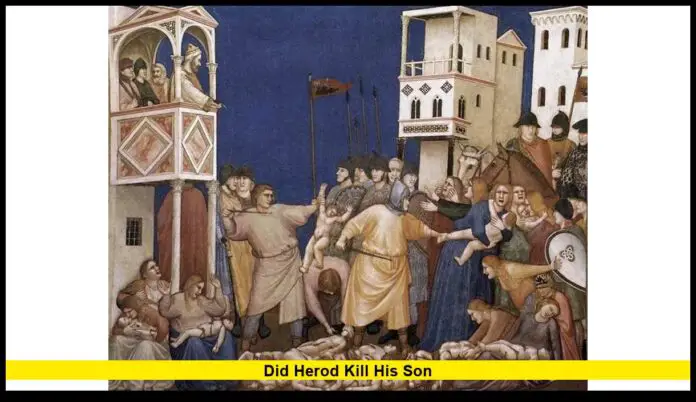
The question “Did Herod kill his son?” continues to intrigue historians and Bible readers alike. The simple answer is yes — King Herod the Great did kill several of his own sons. Historical records, especially from the first-century historian Flavius Josephus, confirm that Herod ordered the execution of at least three of his children, driven by jealousy, fear, and political paranoia.
As of December 2025, historians still regard these killings as among the most disturbing episodes in ancient royal history. Herod’s story is one of ambition, brilliance, and extreme cruelty — a ruler whose legacy remains divided between monumental achievements and brutal acts of violence against his own family.
Table of Contents
Who Was King Herod the Great?
King Herod the Great ruled Judea from 37 BCE to 4 BCE, under the authority of the Roman Empire. He was appointed “King of the Jews” by the Roman Senate, and his reign is remembered for major architectural projects — including the grand rebuilding of the Second Temple in Jerusalem — as well as his political cunning.
But behind his success as a builder and administrator was a man consumed by fear. Herod’s throne depended heavily on Roman approval and his ability to control local unrest. Suspicious of anyone who might threaten his power, he turned against many around him — including his own blood relatives.
Herod’s Family: Power, Politics, and Betrayal
Herod’s family life was complicated and volatile. He had at least ten wives and many children, which created endless rivalries and conspiracies within his household.
The most famous of his wives was Mariamne I, a Hasmonean princess whose family once ruled Judea before Herod rose to power. Her royal heritage made her children — Alexander and Aristobulus — strong contenders for the throne. Herod’s deep love for Mariamne eventually turned into suspicion, fueled by rumors and court intrigue.
In time, Herod began to see even his own sons as threats to his rule.
The Sons Herod Ordered to Be Killed
Historical evidence confirms that Herod executed at least three of his sons:
Alexander and Aristobulus IV
Alexander and Aristobulus were the sons of Mariamne I. Their royal bloodline through their mother made them popular among the Jewish elite — something Herod found dangerous.
By 7 BCE, Herod accused the two of plotting against him. Despite their protests and a lack of evidence, both were executed in the city of Sebaste (Samaria).
Josephus described this moment as one of the most tragic in Herod’s life — the act of a father who valued power more than family.
Antipater III
Herod’s eldest son, Antipater, initially appeared to be his father’s favorite. But as Herod aged, Antipater’s ambition grew. Rumors spread that he was secretly scheming to speed up his inheritance.
Herod, already known for his paranoia, was convinced that Antipater wanted to kill him. In 4 BCE, just days before his own death, Herod ordered Antipater’s execution in Jericho.
The timing was grimly symbolic — a father dying only days after killing the son who was supposed to succeed him.
Why Did Herod Kill His Sons?
Herod’s motive was rooted in fear, power, and mistrust. Despite his intelligence and political skill, he suffered from deep insecurity.
He was not born into Judean royalty. His father was an Idumean (Edomite), a group converted to Judaism, which made Herod an outsider to many Jews who saw him as a Roman puppet rather than a true king.
As a result, Herod constantly feared rebellion. His sons, especially those with royal Hasmonean blood from their mother’s side, represented everything he feared most — legitimacy and potential rivals.
Over time, advisors and courtiers manipulated his suspicions, convincing him that his sons plotted treason. Instead of verifying their claims, Herod’s temper and paranoia led him to acts of deadly cruelty.
A Kingdom Consumed by Suspicion
By the final decade of his life, Herod’s palace had become a place of intrigue, betrayal, and bloodshed.
His paranoia didn’t stop with his sons. He also executed his wife Mariamne I, her mother Alexandra, and several other relatives. Even his sister Salome played a role in stirring tension, feeding Herod’s fears of conspiracy.
The Roman Emperor Augustus famously joked, “It’s better to be Herod’s pig than his son.” The dark humor of the remark reflected a grim truth — while Herod, as a Jew, would never eat pork, he had no hesitation about executing his children.
What Ancient Historians Say
Most of what we know about Herod’s family tragedies comes from Flavius Josephus, a Jewish historian writing in the first century CE. In his works The Jewish War and Antiquities of the Jews, Josephus described Herod’s volatile temper and his obsession with power.
Josephus depicted Herod as both brilliant and brutal — a man capable of monumental achievements but destroyed by his inability to trust anyone, even his sons.
Modern historians largely support Josephus’s account, pointing out that Herod’s actions fit a pattern seen in other monarchs who ruled through fear rather than loyalty.
Archaeological Findings and Modern Research
Archaeological discoveries continue to bring Herod’s world to life. Excavations at Herodium, his fortress-palace in the Judean desert, have uncovered luxurious structures, mosaics, and artifacts that reveal his wealth and obsession with immortality.
Although no direct archaeological evidence connects to the killings of his sons, everything found reinforces Josephus’s portrayal of Herod as a man of extremes — both visionary and violent.
Scholars studying Herod’s final years also suggest he suffered from severe illness, possibly chronic kidney disease or gangrene, which may have worsened his paranoia.
Still, historians agree that his actions were deliberate and politically motivated — not merely the result of madness.
The Aftermath of Herod’s Death
When Herod died in 4 BCE, his kingdom was left fractured and unstable. Rome divided his territory among his surviving sons:
- Archelaus ruled Judea, Samaria, and Idumea.
- Herod Antipas governed Galilee and Perea.
- Philip received territories northeast of the Jordan.
But Herod’s legacy of mistrust haunted his descendants. None of his sons could match his power or political skill, and within a generation, Rome had absorbed Judea completely.
Herod’s fear of losing control had, ironically, ensured that his dynasty would never last.
Herod in Religious and Cultural Memory
In the Christian tradition, Herod is most infamous for the Massacre of the Innocents — the killing of male infants in Bethlehem after the birth of Jesus, as described in the Gospel of Matthew.
While historians debate the historicity of that specific event, Herod’s well-documented murders of his own sons make the biblical account consistent with his known character.
Across history, Herod’s name has become synonymous with cruelty, insecurity, and abuse of power. Yet his story also serves as a cautionary tale — a reminder of how fear and ambition can destroy even the most powerful of rulers.
Modern Reflections on Herod’s Legacy
Today, historians view Herod the Great as a complex figure. He was a political genius who stabilized Judea under Roman rule and left behind enduring architectural wonders like Caesarea Maritima and the Temple Mount.
But his personal life remains a study in tragedy. The question “Did Herod kill his son?” is not just about history — it’s a reflection on the timeless struggle between ambition and morality.
Herod’s legacy reminds us that greatness built on fear is fragile, and that the quest for power without compassion often ends in self-destruction.
Yes, Herod did kill his sons — an undeniable historical fact that continues to define his legacy. His reign shows how paranoia can turn a powerful ruler into his own worst enemy. What are your thoughts on Herod’s actions and their impact on history? Share your perspective below!

