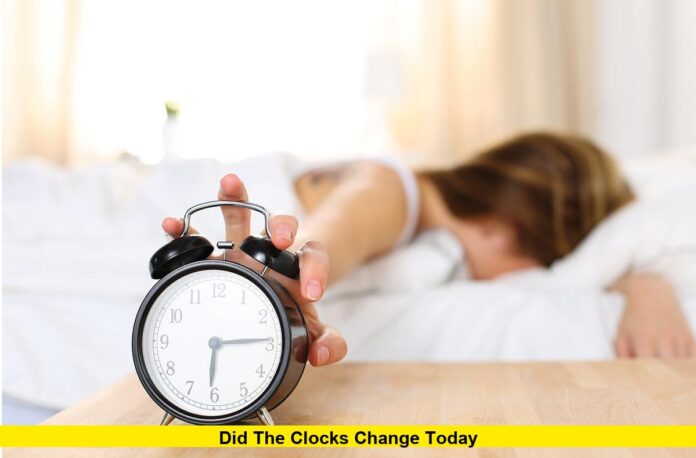
It Happened This Morning
If you woke up today feeling like something was off, you were right. Daylight saving time for 2026 started early this Sunday morning, meaning most Americans lost an hour of sleep overnight when the clocks sprang forward. So yes — did the clocks change today? Absolutely. And if you forgot to set yours ahead, now is the time to fix that.
When local standard time reached 2:00 a.m. on Sunday, March 8, 2026, clocks moved forward one hour to 3:00 a.m. That lost hour means sunrise and sunset are both arriving about an hour later than yesterday — which also means longer, brighter evenings are finally on the way.
Already feeling the impact of the time change? Drop a comment below and let others know how you’re coping with the lost hour.
Why Do Clocks Change in the First Place?
The ritual of changing the clocks twice a year has roots stretching back more than a century. The practice of springing forward in the U.S. began during World War I as a way to conserve fuel and redirect energy resources toward the war effort. By moving the clocks ahead an hour, the thinking was that people would use less artificial lighting in the evening, saving electricity at a critical time.
The system has been updated and revised several times since then. Today, most Americans spring forward on the second Sunday in March at 2:00 a.m. and fall back on the first Sunday of November at 2:00 a.m. — a schedule locked in by federal law more than a decade ago. By shifting clocks forward an hour, daylight saving time effectively moves an hour of daylight from the morning to the evening. That trade-off is exactly what makes the whole debate so complicated. Some people love the extra evening light, while others resent losing that quiet morning hour.
Which States Don’t Change Their Clocks?
Not everyone in the country is resetting their phones and wall clocks this morning. Hawaii does not observe daylight saving time and stays on standard time year-round. Because of its location near the equator, the state sees relatively little variation in daylight hours between seasons, making the practice largely unnecessary.
Most of Arizona is in the same boat, opting out of the time change entirely. Several U.S. territories — including Puerto Rico, Guam, the U.S. Virgin Islands, American Samoa, and the Northern Mariana Islands — also remain on standard time throughout the year. The Navajo Nation, which spans parts of Arizona, Utah, and New Mexico, does observe daylight saving time, making it a notable exception within a non-observing state.
For people in those regions, today is just another Sunday. For the rest of the country, it is an annual exercise in mild sleep disruption.
What the Time Change Does to Your Body
The lost hour is not just an inconvenience — it carries real health consequences that doctors and researchers have studied for years. Darker mornings and lighter evenings can disrupt the body’s internal clock and cause sleep trouble that lingers for days or even weeks after the change.
The risks extend well beyond simple tiredness. Research over the years has pointed to a noticeable increase in heart attacks, strokes, and traffic accidents in the days immediately following the spring time change. The human body does not adapt to losing an hour of sleep as quickly as the calendar moves, and that gap shows up in emergency rooms and on highways in the days that follow.
Health professionals recommend giving yourself a few days to adjust, sticking to a consistent sleep schedule, getting morning sunlight to help reset your internal clock, and resisting the urge to drown the fatigue in caffeine.
Where Does the Debate Stand in 2026?
The pushback against changing the clocks twice a year is louder than ever. Polls consistently show that a strong majority of Americans — roughly two-thirds — would prefer to eliminate the practice entirely and settle on one permanent time. The disagreement is not really about whether to stop changing the clocks. It is about which time to keep permanently: standard time or daylight saving time.
Lawmakers at both the state and federal levels have been pushing for a fix. Dozens of states have passed resolutions or legislation in recent years favoring permanent daylight saving time, but those laws are contingent on federal approval that has not yet arrived. A federal bill — the Sunshine Protection Act — passed the U.S. Senate unanimously back in 2022 but stalled in the House and never became law. Similar proposals have been reintroduced in 2026, with some calling for a compromise that would shift clocks forward a permanent half-hour, splitting the difference between the two options.
Despite all the political energy behind eliminating the practice, the twice-yearly clock change remains in place. States can legally opt out of daylight saving time entirely — as Hawaii and most of Arizona have done — but they cannot unilaterally adopt permanent daylight saving time without Congress acting first. That federal bottleneck has kept the status quo intact even as frustration continues to build.
When Will the Clocks Change Again?
For anyone already counting down to getting that hour back, the wait ends on the first Sunday of November. This year, clocks will fall back to standard time at 2:00 a.m. on November 1, 2026. Daylight saving time will be in effect for the next 238 days — meaning longer evenings, more outdoor time after work, and a welcome stretch of light before winter settles back in.
In the meantime, make sure every clock in your home is set correctly. Your smartphone and most smart devices updated automatically overnight, but manual clocks — on your microwave, your car dashboard, and your walls — still need a human hand.
Do you think it’s finally time to stop changing the clocks for good, or would you miss those long summer evenings? Share your take in the comments — this debate is only getting louder.

