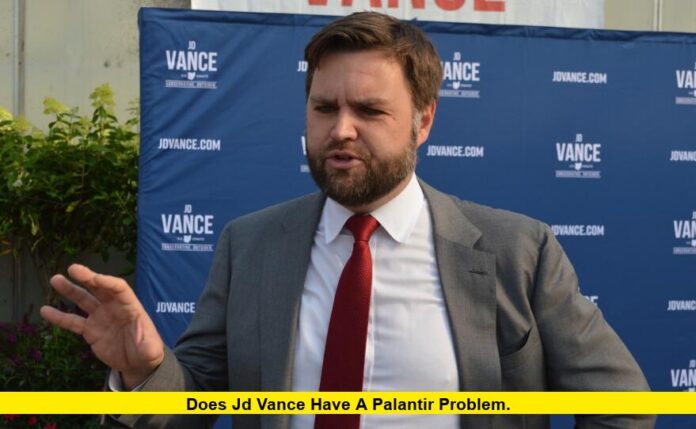
Vice President J.D. Vance is now facing growing scrutiny over his relationship with Palantir Technologies, and the question “Does JD Vance have a Palantir problem?” is increasingly being asked across conservative and tech-policy circles.
In recent days, reports have emerged that Vance’s longstanding connections to Palantir and its co-founder Peter Thiel are drawing concern within his political coalition—even among voices that strongly supported his rise. The firm’s expanding role in federal government contracts and data systems has become a flashpoint, raising questions about Vance’s positioning as a populist conservative allied with anti-elite, anti-big-tech sentiment.
Table of Contents
Background: Why this matters
- Peter Thiel helped launch Vance’s early professional career and backed his political ascent financially.
- Palantir’s footprint in federal contracting and government-data analytics has grown significantly; that growth has triggered concerns among civil-liberties advocates and some conservative technologists alike.
- Vance’s public identity is rooted in an “outsider” posture—criticising entrenched elites and Big Tech power—but his associations appear to bridge him to a major tech investor and a company with deep ties to government data systems.
What’s going on now?
- Multiple conservative commentators and activists are voicing unease that Vance may be straying too close to Silicon Valley interests and surveillance-adjacent technologies.
- Internally in the Republican coalition, there’s mounting friction: supporters who prioritise tech-accountability and privacy fears feel the Vance-Palantir link undermines his populist message.
- On the defense side, Palantir’s growing access to federal data systems and contracts is adding fuel. This heightens risk that Vance’s relationship to the company will be leveraged by adversaries or become a credibility issue with sceptical voters.
Key Areas of Concern
1. Messaging Clash
Vance has repeatedly criticised “elite” tech power and promised to curb Big-Tech influence. Yet his alignment with Thiel and Palantir appears to contradict that stance.
2. Surveillance & Data Governance
Palantir’s government work—ranging from federal contract expansions to analytics platforms—raises questions about how data and privacy are managed. Vance’s ties prompt the question: will his loyalties align with the public interests he campaigns on, or with the tech-industry network that helped elevate him?
3. Political Risk
For a figure who built his profile as a challenger of the status quo, being too closely associated with a powerful tech firm could erode trust among his base. It may provide ammunition to opposition or disaffected allies who view Palantir as emblematic of the very elite power structures Vance claims to oppose.
Timeline: Highlights
- Early career: Vance worked in Thiel-backed ventures and benefitted from Thiel’s financial support during his rise.
- 2022: Thiel’s networks significantly backed Vance’s Senate campaign.
- 2025: As Vance assumed the vice presidency, Palantir’s role in federal contracting and data consolidation moved into sharper view—and conservative critics flagged the overlap with Vance’s tech ties.
What Is Vance Saying?
Vance has acknowledged Palantir only as a private company that may offer useful services—but one that must be regulated and held accountable. He continues to position himself as a reformer of tech and elite power, rather than a beneficiary. Nonetheless, some critics argue his language and affiliations haven’t fully addressed the deeper concerns raised by his alignment with Palantir’s ecosystem.
Why the Question “Does JD Vance Have a Palantir Problem?” Matters
- Credibility Risk: If voters believe Vance is part of the very tech-elite networks he criticises, his credibility could suffer.
- Policy Implications: Given his role in shaping tech and government policy, his associations raise questions about conflicts of interest or the balance of public vs private influence.
- Coalition Dynamics: The populist, anti-elite centre of his coalition may withdraw support if the Palantir link looks like establishment capture.
- Opposition Narrative: Political opponents may frame the relationship as a betrayal of his stated values, weakening his broader appeal.
Where This Could Go From Here
- Vance may be asked to disclose more fully his links to Thiel, Palantir, and tech-industry donors to clarify for his base.
- His tech-policy agenda could get re-examined in light of Palantir’s contract expansions and data-system roles in government.
- If the issue deepens, it could create a wedge inside his coalition between pro-tech donors and privacy-focused conservatives.
- The way he handles this scrutiny will shape whether the question becomes a passing hiccup or an enduring challenge to his leadership and brand.
In short: yes, it appears that Vance does have a Palantir problem—at least in terms of optics, internal coalition friction, and potential conflict with his anti-elite narrative. Whether this becomes a full‐blown political liability will depend on how transparently and forcefully he addresses the issue.
What do you think — will Vance navigate this challenge smoothly, or will this become a major headache for his political brand? Let me know your thoughts below.

