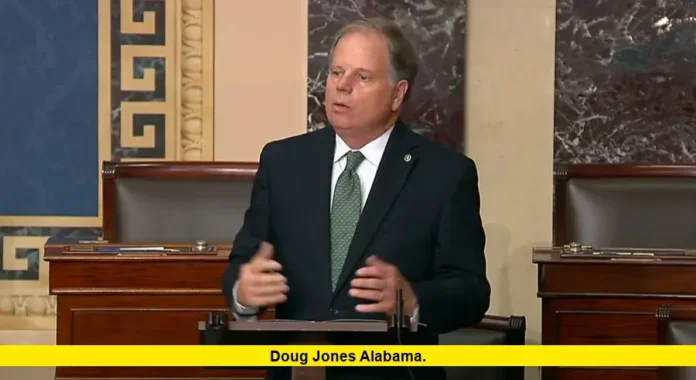
Former U.S. Senator Doug Jones Alabama officially launched his gubernatorial campaign Friday night in Birmingham, setting the stage for what promises to be one of the most watched political contests of 2026. Speaking before thousands of enthusiastic supporters at The Theodore, Jones laid out an ambitious agenda aimed at addressing healthcare, education, and economic challenges facing families across the state.
The campaign kickoff took place on the eighth anniversary of Jones’s stunning 2017 Senate victory over Roy Moore, a moment that briefly turned national attention to Alabama politics. Now, Jones is attempting to recapture that historic energy as he seeks to become the first Democratic governor of Alabama since Don Siegelman in 1998.
A Rematch Years in the Making
Jones’s entry into the gubernatorial race sets up an expected rematch with Republican Senator Tommy Tuberville, who defeated him by 20 percentage points in the 2020 Senate race. Tuberville, a former Auburn University football coach, announced in May that he would forgo reelection to the Senate and instead run for governor as current Republican Governor Kay Ivey faces term limits.
The contrast between the two candidates could not be starker. Jones, a civil rights lawyer who served as U.S. Attorney for the Northern District of Alabama from 1997 to 2001, brings decades of public service experience. His most notable accomplishment came when he successfully prosecuted two former Ku Klux Klansmen for the 1963 Birmingham church bombing that killed four African American girls.
Tuberville, on the other hand, entered politics with no previous governmental experience beyond his decades-long coaching career. Jones did not shy away from highlighting this difference during his campaign launch.
“Alabama’s not a stadium,” Jones declared to loud cheers. “It is not a sporting event. Our lives, our communities, our jobs, our wages, our kids’ education, our healthcare, our doctors, our nurses—none of this is a game.”
Sharp Criticism and Policy Vision
Throughout his speech, Doug Jones Alabama took repeated shots at his likely opponent, questioning both Tuberville’s record and his commitment to the state. Jones raised questions about Tuberville’s residency, noting that the senator maintains a beach house in Florida while claiming Auburn as his home.
“He doesn’t even live in Alabama, and if he does, then prove me wrong,” Jones said, echoing concerns raised by the Alabama Democratic Party, which has announced plans to challenge Tuberville’s candidacy based on residency requirements.
Jones also criticized Tuberville’s five years in the Senate as a period that has “embarrassed the state,” pointing to what he characterized as a lack of meaningful accomplishments and unwavering support for policies that Jones believes harm ordinary Alabamians.
The former senator reserved particular criticism for President Donald Trump’s economic policies, which he said “only benefit tech bros and millionaires.” Jones specifically mentioned Trump’s tariff policies as harmful to farmers while noting that Tuberville remains one of Trump’s strongest supporters in Congress.
Policy Platform Focused on Kitchen Table Issues
Jones used his campaign launch to outline specific policy proposals he would pursue as governor. His agenda includes several items that have long been debated in Alabama politics but have faced resistance from the Republican-controlled legislature.
First among his priorities is establishing a state lottery. Jones argued that Alabama is losing millions of dollars that flow across state borders to Georgia, Florida, Tennessee, and Mississippi, money that could instead fund education and infrastructure within the state.
“Instead of watching literally millions of dollars bleeding across our borders where that money could be staying home working for you,” Jones said, making the economic case for the lottery proposal.
Second, Jones pledged to fight for Medicaid expansion under the Affordable Care Act, something Alabama has resisted despite significant federal funding being available. Jones emphasized that families are struggling with healthcare costs and that expanding Medicaid would provide relief to thousands of Alabamians currently without coverage.
Jones also criticized the state’s decision to use federal pandemic relief funds for construction of a $1.2 billion prison facility that has exceeded its initial budget. He argued these funds could have been better spent addressing more pressing needs.
Additionally, Jones promised to work toward establishing early voting in Alabama and making it easier for citizens to cast ballots. “We are going to be investing in ways to make it easier to vote, not harder,” he declared.
The Electoral Math Challenge
Despite the enthusiasm at his campaign launch, Jones faces steep odds in Alabama’s deeply conservative political landscape. The state has not elected a Democratic governor in 27 years, and recent statewide elections have shown a consistent pattern of overwhelming Republican victories.
In 2020, Tuberville held Jones to approximately 40 percent of the vote, a figure that has become something of a ceiling for Democratic candidates in recent Alabama statewide races. Roughly two-thirds of Alabama voters cast straight-ticket ballots in the 2024 elections, with the vast majority voting Republican.
Political observers have noted the uphill battle Jones faces. Retired political science professor Jess Brown bluntly assessed Jones’s chances, stating that despite being a talented and intelligent individual, Jones faces significant challenges given his 2020 loss as a well-funded incumbent.
Tuberville’s campaign has also projected confidence, with spokesperson Mallory Blount Jaspers dismissing Jones’s candidacy by noting that Tuberville has spent months building coalitions, securing endorsements from key players in Alabama politics, and shattering fundraising records. She also reminded voters that Tuberville defeated Jones handily in their previous contest.
Reasons for Optimism
Despite the daunting electoral landscape, Jones and his supporters point to several factors that could work in their favor. The former senator acknowledged being the underdog but said his decision to run stemmed partly from a desire to ensure Tuberville doesn’t coast into office unchallenged.
Jones cited recent Democratic victories in other Southern states, including Georgia and Mississippi, as evidence that political change is possible even in traditionally conservative regions. He also suggested that the current political environment might benefit his campaign.
Economic uncertainty, rising healthcare costs, and concerns about education funding could motivate voters to consider alternatives to the status quo. Jones noted that President Trump’s net favorability rating in Alabama stood at just 4.9 percent according to recent polling, a surprisingly modest number in a state Trump won by 30 percentage points in 2024.
The former senator also highlighted that Democrats will likely vote for him with more enthusiasm than Republicans will for Tuberville, particularly if Tuberville’s campaign continues what Jones characterized as comically arrogant statements treating his election as inevitable.
Strong Democratic Support
Jones received praise from prominent Alabama Democrats, including U.S. Representative Terri Sewell, one of only two Democrats in the state’s congressional delegation. Sewell told reporters that Jones “has beaten the Republican machine before, and he cannot be counted out.”
She described Jones as a terrific senator and well-respected legislator, attorney, and skilled fundraiser who possesses the intelligence, connections, and determination necessary to challenge Tuberville effectively.
The campaign kickoff featured Alabama musician Jason Isbell, who introduced Jones and spoke about their friendship. “When people tell him politicians don’t care about people, he tells them about Jones,” capturing the personal connection many supporters feel with the candidate.
Democratic voters at the rally expressed relief and excitement about Jones’s return to the political arena. Supporters like Angela Hornbuckle welcomed having what she called “somebody sensible getting in the race,” noting that Jones had already proven himself capable by winning a Senate seat.
Fundraising and Resources
One area where Jones has demonstrated strength is fundraising. In his 2017 Senate race, he raised $25.7 million, and his 2020 reelection effort brought in $31 million. This ability to attract national attention and donations could prove crucial in a race where resources will matter significantly.
However, Jones will not be the sitting senator this time around—Tuberville holds that position. The Republican has already raised $8.1 million for his gubernatorial campaign, demonstrating his own fundraising prowess.
Primary Competition
Before facing Tuberville in a general election, Jones must first secure the Democratic nomination. Two other Democrats have entered the race: Will Boyd and Chad Martin. While Jones is widely expected to win the Democratic primary, he has stated he plans to run an aggressive primary campaign.
Jones emphasized that voters should compare his record of service to Alabama across various sectors—including veterans, historically Black colleges and universities, civil rights, and agriculture—against his opponents’ records. He believes that when voters examine these records, they will choose to nominate someone with the best chance of winning in November.
There is also concern among Democrats about potential Republican crossover voting in the primary, particularly if the GOP contest becomes noncompetitive. Alabama allows open primaries, meaning voters can choose to participate in either party’s primary regardless of registration.
The Path Forward
Jones served in the U.S. Senate from 2018 to 2021, a tenure marked by several legislative accomplishments. Bills he championed that became law included a measure to permanently fund historically Black colleges and universities and legislation requiring public release of documents related to unsolved civil rights cases.
After leaving Congress, Jones remained active in Democratic politics. He served as a guide for Supreme Court nominee Ketanji Brown Jackson during her confirmation process, which concluded successfully in April 2022. He has also worked as a political commentator for CNN and held fellowships at Georgetown University’s Institute of Politics and Public Service and the University of Chicago’s Institute of Politics.
More recently, Jones launched a political radio show on Sirius XM called “The Cloakroom with Senator Doug Jones,” where he has interviewed prominent political figures and discussed current events.
His decision to enter the gubernatorial race represents a return to Alabama electoral politics after several years focused on national issues and commentary. Jones made his intentions clear in late November when he filed paperwork and announced what he called “the worst-kept secret in the state of Alabama.”
The official campaign launch on December 12 marked the beginning of what promises to be an intense battle for Alabama’s highest office. Both major party candidates will face primary elections in May before the general election in November 2026.
What’s at Stake
Jones framed his campaign as fundamentally about improving the lives of ordinary Alabamians who he says are struggling with everyday challenges. In interviews, he emphasized that families are having difficulty with healthcare costs, energy bills, and simply making ends meet.
“People are struggling. They are hurting,” Jones said, articulating the core message of his campaign.
He argued that Alabama deserves a governor who will fight for citizens rather than treating the position as what he called “a rest stop on the way to the Florida beach,” another jab at Tuberville’s residency situation.
Jones’s campaign represents more than just his personal political ambitions. For Alabama Democrats, his candidacy offers something the party has lacked in recent years: a credible, well-known candidate with proven ability to compete statewide. Win or lose, political analysts suggest Jones gives Democrats an opportunity for growth and a chance to add what one observer called “purple hues” to Alabama’s deep red political landscape.
The 2026 gubernatorial race will test whether Alabama voters are ready for a political shift or whether the state’s conservative trajectory will continue unchanged. Jones is betting that his message of competent leadership, policy solutions to real problems, and commitment to serving all Alabamians can overcome partisan divisions and Republican dominance.
As the campaign progresses through the coming months, both candidates will work to mobilize their respective bases while competing for persuadable voters in the middle. The outcome will help determine not just who leads Alabama for the next four years, but also whether Democrats can remain competitive in Deep South politics.
What happens in Alabama could reshape Southern politics for years to come—will you be watching this historic race unfold?

