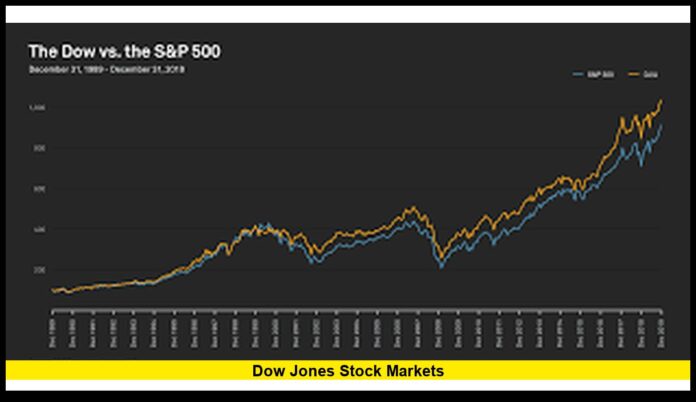
The dow jones stock markets have entered historic territory after the Dow Jones Industrial Average closed above the 50,000 mark for the first time ever. The milestone signals strong momentum for U.S. blue-chip stocks, but it also comes at a time when investors are bracing for fresh economic data, corporate earnings updates, and potential shifts in Federal Reserve policy.
Wall Street is celebrating the record, yet traders remain alert. Markets are reacting not only to the psychological impact of crossing a major threshold, but also to real-time developments in inflation trends, labor market strength, and sector rotation.
Table of Contents
A Historic Moment for the Dow
The Dow Jones Industrial Average surged past 50,000 following a powerful rally that pushed the index more than 1,200 points higher in a single session. This breakthrough marks one of the most significant milestones in the index’s 128-year history.
The Dow tracks 30 major U.S. companies spanning industries such as finance, healthcare, consumer goods, and industrial manufacturing. Its climb above 50,000 reflects broad-based gains across several sectors, particularly financial institutions and industrial leaders.
Round-number milestones often carry emotional weight in financial markets. For many investors, crossing 50,000 represents more than a numeric achievement — it reinforces confidence in the durability of corporate America and the resilience of the U.S. economy.
Early Pullback Highlights Market Sensitivity
Shortly after the record close, the Dow dipped below 50,000 during early-week trading. While the decline was modest compared to the previous rally, it served as a reminder that volatility remains part of the landscape.
Some pharmaceutical and industrial stocks weighed on the index, prompting short-term profit-taking among traders. After such a sharp upward move, many investors chose to rebalance portfolios and lock in gains.
These fluctuations underscore a key reality: markets rarely move in a straight line. Even as long-term trends remain positive, short-term pullbacks can emerge quickly when investors reassess valuations.
Broader Market Performance: S&P 500 and Nasdaq
While the Dow reached its milestone, other major indices displayed mixed but generally resilient performance.
The S&P 500 continued to hover near record highs, supported by steady gains across multiple sectors. The Nasdaq Composite showed relative strength in technology-driven segments, particularly companies tied to artificial intelligence and semiconductor development.
However, growth stocks have faced intermittent pressure. Investors are weighing high valuations against future earnings potential. This dynamic has led to uneven trading patterns within the tech sector.
Despite occasional dips, overall market sentiment remains constructive. Strong corporate earnings and stable economic indicators have helped maintain upward momentum.
Sector Rotation Drives Market Leadership
One of the defining trends shaping Wall Street right now is sector rotation. Investors have shifted capital between industries in response to evolving economic expectations.
Financial stocks have benefited from steady lending activity and healthy balance sheets. Industrial companies have gained traction amid infrastructure investment and steady corporate spending. Healthcare and consumer staples have provided defensive stability during periods of uncertainty.
Meanwhile, high-growth technology stocks have experienced selective consolidation after strong rallies. Rather than abandoning the sector, investors appear to be reallocating funds strategically.
This rotation reflects disciplined portfolio management rather than widespread concern. It signals that investors are seeking balance as they navigate record-high valuations.
Inflation and Jobs Data in Focus
Upcoming economic data releases remain central to the market’s next move. Traders are closely watching the delayed January jobs report and the latest Consumer Price Index figures.
Employment data offers insight into labor market health. Strong job growth can reinforce confidence in consumer spending and economic expansion. At the same time, persistent wage growth could influence inflation expectations.
Inflation readings will likely play an even larger role in shaping investor sentiment. If price pressures continue to ease, markets may interpret it as supportive of potential interest rate adjustments later in the year.
On the other hand, stubborn inflation could prompt caution and spark renewed volatility.
Federal Reserve Policy Remains a Key Variable
The Federal Reserve continues to influence the direction of U.S. equities. Markets respond swiftly to any indication of shifts in interest rate policy.
Investors are carefully analyzing comments from central bank officials for clues about the path forward. Rate expectations directly impact stock valuations, particularly for growth-oriented sectors that are sensitive to borrowing costs.
Lower rate expectations typically support higher equity valuations. Conversely, signs of tighter monetary policy can temper enthusiasm.
For now, the market appears to be balancing optimism about economic resilience with caution about inflation risks.
Corporate Earnings Provide Fundamental Support
Recent corporate earnings have helped underpin the Dow’s historic climb. Several major companies reported results that exceeded expectations, demonstrating strong revenue growth and effective cost management.
Profit margins have remained stable across many industries. Companies have navigated supply chain challenges and pricing pressures with relative success.
Forward guidance from executives suggests confidence in business conditions, although some firms remain cautious about global economic uncertainties.
As earnings season progresses, investors will continue to focus on revenue growth, margin trends, and capital expenditure plans.
Psychological Impact of 50,000
Crossing 50,000 is not only a statistical milestone — it influences investor psychology.
Such levels often attract increased trading activity. Momentum investors may see the milestone as confirmation of continued upward potential. Meanwhile, value-focused investors may pause to assess whether valuations justify further gains.
Historically, major index milestones have sometimes led to short-term consolidation before markets resume longer-term trends.
The Dow’s movement around 50,000 illustrates how psychology and fundamentals interact in financial markets.
Global Influences on U.S. Equities
International developments also shape domestic trading conditions.
Recent strength in overseas markets provided a boost to U.S. futures before domestic volatility emerged. Global economic growth, currency fluctuations, and geopolitical events all affect multinational corporations within the Dow.
Energy prices and supply chain stability remain important considerations for investors assessing future earnings.
Despite global uncertainties, U.S. equities continue to attract investment flows due to relative stability and strong corporate governance.
Investor Sentiment and Market Outlook
Investor sentiment remains cautiously optimistic. The historic surge has boosted confidence, but many traders are approaching new highs with discipline.
Portfolio managers are diversifying holdings and focusing on quality companies with strong balance sheets. Defensive sectors remain attractive as hedges against unexpected volatility.
The dow jones stock markets now face a pivotal period. Upcoming economic reports and corporate updates will likely determine whether the rally extends further or enters a consolidation phase.
Long-Term Perspective
While short-term fluctuations dominate headlines, long-term investors often focus on broader trends.
The Dow’s steady ascent over decades reflects the enduring strength of leading U.S. companies. Milestones like 50,000 highlight how markets evolve alongside innovation, productivity growth, and economic expansion.
Periods of volatility are part of that journey. Investors who maintain diversified portfolios and stay informed often navigate such periods more effectively.
Key Takeaways for U.S. Investors
- The Dow Jones Industrial Average has closed above 50,000 for the first time.
- Short-term volatility followed the milestone surge.
- Sector rotation continues to shape leadership across industries.
- Inflation and employment data will influence near-term market direction.
- Federal Reserve policy remains central to investor decision-making.
Wall Street stands at a notable crossroads. Record highs inspire confidence, but economic data will determine whether the next leg of the rally gains traction.
Do you believe the Dow will continue climbing from here, or are we due for a pause? Share your perspective and stay connected for the latest market updates.

