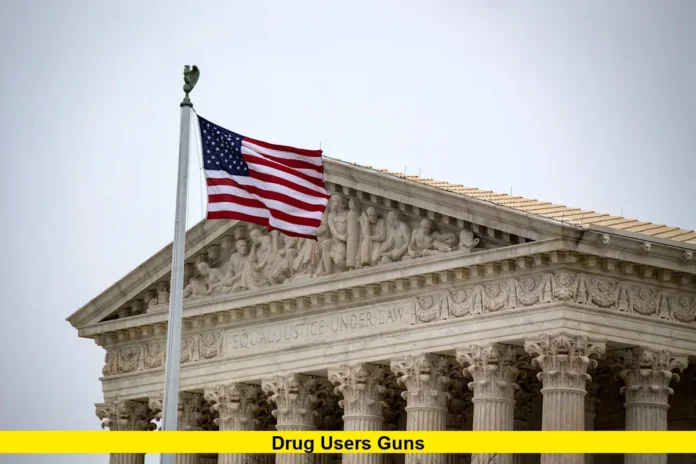
The debate surrounding drug users guns has taken center stage again as the U.S. Supreme Court prepares to hear a case that could reshape the boundaries of the Second Amendment. At stake is a federal law that forbids anyone classified as an “unlawful user of or addicted to a controlled substance” from owning or possessing a firearm.
This issue goes far beyond one man’s criminal case. It touches on questions of personal liberty, evolving attitudes toward drug use, and the reach of government authority over citizens’ constitutional rights. The Court’s decision could redefine how America views the intersection of gun rights and substance use — potentially changing the law for millions of people.
Table of Contents
Background: The Law at the Heart of the Dispute
The federal statute under scrutiny — 18 U.S.C. §922(g)(3) — was introduced as part of the Gun Control Act of 1968. It makes it illegal for anyone who is “an unlawful user of or addicted to any controlled substance” to possess or receive a firearm.
At the time of its creation, the law reflected the social attitudes of the era, when drug use was seen as incompatible with responsible firearm ownership. Lawmakers believed that anyone using controlled substances posed a heightened risk of violence or impaired judgment, and therefore, should not have access to guns.
But America in 2025 is not the same as America in 1968. Cannabis is now legal in some form in more than 30 states, and public opinion about drugs and addiction has shifted dramatically. The once-clear definition of “unlawful user” has become blurred, leaving courts to interpret how this decades-old statute applies in a modern, more nuanced society.
The Case That Sparked National Attention
The case now before the Supreme Court, United States v. Hemani, involves a Texas man named Ali Danial Hemani, who was charged with violating §922(g)(3). Authorities discovered a firearm in his possession, along with small amounts of marijuana and cocaine. Hemani admitted to using the substances but argued that his drug use should not automatically strip him of his constitutional right to bear arms.
The lower courts agreed — at least in part. The Fifth Circuit Court of Appeals ruled that the statute was unconstitutional as applied to Hemani, finding that the government failed to show any historical precedent for disarming people simply because they used drugs. The court emphasized that, under the Supreme Court’s 2022 Bruen decision, any gun restriction must align with America’s “historical tradition of firearm regulation.”
This ruling struck a nerve in Washington. The Department of Justice (DOJ) immediately appealed the case, arguing that allowing drug users to possess guns would pose serious public safety risks. On October 20, 2025, the Supreme Court agreed to hear the case — setting the stage for one of the most consequential Second Amendment battles in recent memory.
Why This Case Matters So Much
This case isn’t just about Hemani or even about drug users alone. It’s about the constitutional framework that determines who can be denied a fundamental right. The Supreme Court’s eventual ruling could ripple across multiple areas of law.
Here’s why the decision carries enormous weight:
- It could redefine “dangerousness.” Historically, restrictions on gun ownership were applied to people considered dangerous — such as violent felons or those with severe mental illness. The Court must now decide whether habitual drug use fits that same category.
- It tests the limits of the Bruen standard. The 2022 Bruen decision reshaped how courts evaluate gun restrictions, demanding that any modern regulation be consistent with historical analogs. If the Court sides with Hemani, it could signal a stricter application of that standard.
- It affects marijuana users nationwide. Millions of Americans use marijuana legally under state law but remain “unlawful users” under federal law. As a result, they are barred from purchasing or possessing firearms. This case could change that landscape completely.
- It may influence other disqualification laws. Beyond drugs, federal law also restricts gun ownership for people with certain mental health conditions or past misdemeanor convictions. If §922(g)(3) falls, similar laws could face renewed scrutiny.
Government’s Argument: Public Safety Comes First
The Department of Justice defends the drug-user firearm ban as a necessary safety measure. It argues that individuals who use controlled substances — particularly habitually — are more likely to act irrationally or violently. The government points to historical analogues, such as 18th- and 19th-century laws disarming “habitual drunkards,” claiming that these precedents support modern restrictions on drug users.
Officials also stress that the ban isn’t about punishing people for drug use but about preventing impairment-related violence. They argue that firearms and addictive substances form a dangerous combination, one that historically has led to accidents, domestic violence, and impulsive acts of aggression.
In short, the DOJ’s position is simple: if you’re not legally allowed to drive or operate heavy machinery while under the influence, you shouldn’t be allowed to handle a firearm either.
The Counterargument: Rights Don’t Disappear Because of Behavior
Opponents of the law see it differently. They argue that the Constitution doesn’t condition fundamental rights on personal habits. They believe the ban unfairly punishes individuals for private behavior that may not endanger anyone.
Their central point: there’s no historical or legal precedent for disarming people based solely on drug use. Founding-era laws restricted gun ownership for those who were actively intoxicated while carrying weapons, not for individuals who used substances at other times.
Critics of §922(g)(3) also highlight inconsistencies in its application. For example, someone who drinks heavily but is not “addicted” faces no federal prohibition, while someone who occasionally smokes marijuana — even legally under state law — could face criminal charges for possessing a gun.
They see this not only as illogical but also as discriminatory, especially against individuals in states that have legalized cannabis.
The Marijuana Factor: A Legal Gray Zone
This case has gained even more attention because of its potential impact on marijuana users. As of 2025, cannabis remains illegal under federal law, despite being legal in most states for medical or recreational use.
Under current federal rules, anyone who uses marijuana — even if it’s prescribed for medical reasons — is considered an “unlawful user” and cannot legally purchase a firearm. When buying a gun, individuals must fill out a federal background check form that specifically asks about marijuana use. Lying on that form is a felony.
This conflict between state and federal law has created a confusing and controversial situation. Millions of Americans who follow state laws are technically breaking federal ones. The Supreme Court’s ruling could finally bring clarity to this long-standing contradiction.
A Political and Cultural Flashpoint
The drug users guns debate has also become a political talking point. Gun rights advocates argue that the government is overreaching, using outdated laws to restrict personal freedoms. Gun control supporters, meanwhile, warn that relaxing these laws could make it easier for unstable individuals to gain access to weapons.
Adding to the controversy, this same statute — §922(g)(3) — was cited in the Hunter Biden case, when the president’s son was accused of lying on a federal form about his past drug use to purchase a gun. That case reignited national discussions about equal treatment under the law and how substance use should intersect with gun ownership.
While the Hemani case is unrelated, its outcome could indirectly influence how such charges are viewed in the future.
What Happens Next
The Supreme Court will likely hear oral arguments in early 2026, with a decision expected by the summer. The ruling could come down to how the justices interpret the historical tradition test from Bruen and whether they believe modern concerns about drug use justify limitations on a constitutional right.
Possible outcomes include:
- Upholding the law: The Court may decide that Congress has the authority to restrict firearms for those considered impaired or dangerous, reaffirming the existing standard.
- Striking down the law: The justices could find that §922(g)(3) is unconstitutional, potentially expanding gun rights and invalidating thousands of similar cases.
- A narrow ruling: The Court could rule that the law is unconstitutional only in specific situations, such as when no evidence shows drug use affected a person’s firearm possession.
Whatever the outcome, the decision will almost certainly influence future cases related to gun ownership, addiction, and personal responsibility.
Public Reaction and Broader Implications
The case has already sparked passionate debate across social media and legal circles. Gun-rights supporters see it as a chance to correct an overreach of government power, while public safety advocates warn it could lead to more guns in the hands of those struggling with substance abuse.
Legal scholars suggest the ruling could also impact how courts interpret other parts of federal gun law — potentially calling into question bans based on mental health records, domestic violence restraining orders, or even nonviolent felonies.
In essence, this case may help answer one of the most profound constitutional questions of the modern era: To what extent can the government limit a right that is explicitly guaranteed in the Constitution?
The Road Ahead
As the Supreme Court prepares to hear the case, both sides are gearing up for an intense legal showdown. The outcome will shape the national conversation about how the law should balance individual freedom with public safety.
One thing is certain — the Court’s decision will not just determine the fate of Ali Hemani. It will decide whether the U.S. government can continue to disarm individuals based on their private behavior, and how far the Second Amendment truly extends in 21st-century America.
In the months ahead, all eyes will be on the Supreme Court as it takes up this defining question. What are your thoughts on the issue of drug users and gun rights? Do you believe the law should stand, or is it time for change? Share your views below and stay informed as this historic case unfolds.

