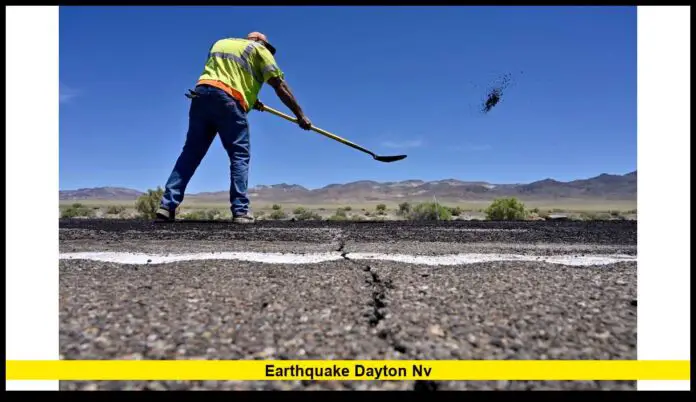
The earthquake Dayton NV event early Thursday morning, December 4, 2025, was felt by residents across Lyon County and nearby Carson City. The U.S. Geological Survey (USGS) confirmed that a magnitude 3.8 earthquake struck near Dayton, Nevada, at 6:27 a.m. Pacific Time, causing light shaking but no reported damage or injuries.
This minor quake is part of Nevada’s ongoing seismic activity, reminding residents that the Silver State remains one of the most earthquake-prone regions in the country.
Table of Contents
Earthquake Details: Time, Location, and Magnitude
USGS data shows that the earthquake occurred approximately 5 miles northeast of Dayton, with a depth of 9.4 kilometers (5.8 miles). The relatively shallow depth made the shaking noticeable across western Nevada, though not strong enough to cause structural damage.
Earthquake Summary
| Detail | Information |
|---|---|
| Date | Thursday, December 4, 2025 |
| Time (Pacific) | 6:27 a.m. PT |
| Magnitude | 3.8 |
| Depth | 9.4 km (5.8 miles) |
| Epicenter | 5 miles NE of Dayton, Nevada |
| Nearest Cities | Dayton, Carson City, Silver Springs |
| Felt Reports | Over 800 submitted to USGS “Did You Feel It?” system |
Residents in Dayton, Carson City, Silver Springs, and Fernley described brief shaking lasting two to three seconds. Some reported hearing a deep rumble before the tremor hit.
Shaking Felt Across Multiple Counties
Reports from the USGS “Did You Feel It?” program show that residents as far west as Reno and as far south as Minden felt mild vibrations. Most reports categorized the shaking as Intensity III–IV, meaning it was noticeable indoors but not strong enough to cause any movement of heavy objects.
Dayton resident Lisa Hernandez, who lives near State Route 50, described the event as “a quick, sharp jolt that made the windows rattle.” Another resident said their pet reacted seconds before the quake—a common observation during seismic activity.
Local emergency dispatchers confirmed receiving several calls from residents checking if the shaking was related to construction or mining activity. Once USGS confirmed the event as an earthquake, officials reassured the public that no significant damage had been reported.
No Injuries or Damage Reported
As of midday Thursday, there have been no reports of injuries, gas leaks, or power outages linked to the earthquake. Crews from the Lyon County Office of Emergency Management and Nevada Department of Transportation (NDOT) conducted inspections of nearby bridges, schools, and roads.
All structures, including the Dayton Valley Road Bridge, were cleared as safe. NDOT confirmed that U.S. Highway 50 remains fully open and that traffic was not affected.
The Carson City Fire Department also checked for potential disruptions to utilities and confirmed that power, water, and gas services continue to operate normally.
Aftershocks Recorded but Minimal
The Nevada Seismological Laboratory at the University of Nevada, Reno (UNR) confirmed at least two small aftershocks in the same area Thursday morning. The strongest was measured at magnitude 2.1, occurring about 30 minutes after the initial tremor.
Seismologists describe the Dayton event as typical for western Nevada, where small-to-moderate quakes are part of the region’s natural seismic activity. The area sits near several active fault lines associated with the Walker Lane Seismic Belt, a major geological zone running along the eastern Sierra Nevada.
This belt accommodates a portion of the movement between the Pacific and North American tectonic plates—making it one of the most seismically active regions in the continental United States.
Why Western Nevada Experiences Frequent Quakes
Nevada ranks third nationwide for earthquake frequency, behind California and Alaska. The Dayton area, located between the Carson Range and the Virginia Range, lies in a network of small faults capable of producing regular seismic activity.
These faults release pressure from the ongoing tectonic stretching of the Basin and Range Province, which shapes Nevada’s mountainous terrain. While most of these earthquakes are small, historical records show that the region is capable of producing larger ones.
Notable Past Nevada Earthquakes:
- 1915 Pleasant Valley Earthquake: Magnitude 7.1 – One of Nevada’s strongest on record.
- 1954 Dixie Valley–Fairview Peak Sequence: Magnitudes 6.6 and 7.1 – Major fault ruptures in central Nevada.
- 2020 Monte Cristo Range Earthquake: Magnitude 6.5 – Felt widely across western Nevada, including Dayton and Reno.
Geologists emphasize that small earthquakes like Thursday’s help relieve tectonic stress gradually, potentially reducing the risk of a larger event in the near term.
Local Officials Emphasize Preparedness
While Thursday’s quake caused no harm, local and state agencies used it as an opportunity to remind residents about earthquake safety.
Lyon County Emergency Management Director Chris Martin stated that the tremor serves as “a good reminder for families to review their emergency plans.” He added that Nevada’s active fault system makes preparedness critical even when earthquakes are minor.
The Nevada Division of Emergency Management (NDEM) also urged households to check emergency kits and secure heavy furniture to prevent injuries during future events.
Earthquake Safety Tips
- During an earthquake: Drop to the ground, take cover under sturdy furniture, and hold on until the shaking stops.
- After an earthquake: Check for gas leaks, structural damage, and fallen power lines before re-entering buildings.
- Always: Keep at least 72 hours’ worth of emergency supplies, including water, food, and first aid materials.
Nevada participates each October in the Great Nevada ShakeOut, a statewide drill that teaches earthquake preparedness to residents and schools.
Scientific Monitoring and Data Analysis
The Nevada Seismological Laboratory (NSL) and USGS continue to monitor seismic activity in the Dayton area. Dozens of sensors across Lyon County recorded detailed data from Thursday’s tremor, which will be used to study local fault behavior.
NSL scientists noted that the event likely originated from a small, unmapped fault system connected to the Carson Lineament Zone, which has produced similar minor earthquakes in recent years.
While the region’s faults are not as well known as California’s San Andreas Fault, they remain active and capable of producing moderate shaking. The NSL emphasizes that ongoing seismic monitoring helps improve understanding of Nevada’s geological systems and enhances early-warning capabilities.
Community Reaction and Public Communication
In the hours following the quake, local residents took to social media to share their experiences. Many posted that they initially thought the shaking was caused by heavy trucks or nearby industrial work. Within minutes, the USGS confirmed the event, calming speculation.
Emergency management agencies used local radio and social media platforms to reassure the public and remind residents that mild quakes are common in the area.
Teachers at Dayton Intermediate School reported that students noticed the vibration but remained calm. “It was over before we could even start a drill,” one teacher said.
Businesses across downtown Dayton operated normally Thursday, with most owners describing the event as “just another Nevada shake.”
Infrastructure and Utility Check
Engineers with NV Energy and Southwest Gas inspected infrastructure in the region as a precaution. Both companies confirmed no service interruptions or leaks.
Water facilities in Lyon County also remained stable, and there were no reported issues with public safety systems, including emergency dispatch centers and cellular networks.
NDOT crews will continue to inspect bridges and key roadways throughout the day, though no structural concerns have been identified.
A Reminder of Nevada’s Resilient Communities
The earthquake Dayton NV incident reinforces how prepared and resilient Nevada communities have become in handling minor seismic events. Residents, emergency managers, and scientists all responded swiftly, demonstrating coordination and calm communication.
As Nevada continues to grow in population, ongoing investments in monitoring technology and preparedness programs ensure that the state remains ready for future seismic activity—no matter the scale.
Even though Thursday’s earthquake caused no damage, it serves as a timely reminder that awareness and preparation are the best defenses in an earthquake-prone region like Nevada.

