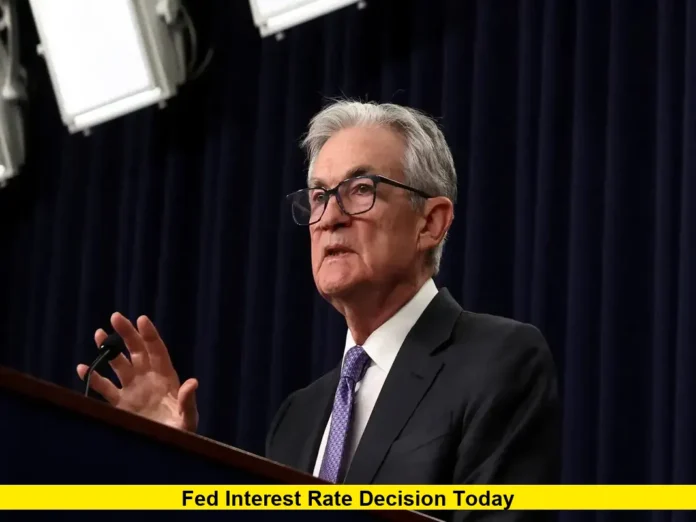
In a highly anticipated announcement, the fed interest rate decision today concluded with the Federal Reserve keeping its benchmark interest rate unchanged, sustaining the target range that was set after a series of reductions in 2025. This development draws attention from households, investors, and businesses alike as the central bank signals its cautious approach to guiding the U.S. economy through continuing inflation pressures and evolving labor market dynamics.
The move provides a moment of clarity on the Fed’s policy direction at the outset of 2026. It offers stability in borrowing conditions while underscoring ongoing concerns about price pressures and employment trends. For anyone tracking the pulse of the American financial system, this decision has important implications for credit markets, savings, and economic confidence.
Table of Contents
Fed Holds Steady After Prior Rate Cuts
At its first monetary policy meeting of the year, the Federal Open Market Committee voted to leave the federal funds rate in the range of 3.50 percent to 3.75 percent. This marks a pause following three consecutive quarter-point rate cuts in the latter part of 2025. Federal Reserve officials emphasized that recent data suggest the economy is expanding at a healthy clip, but inflation remains elevated above the Fed’s long-term objective and deserves careful monitoring.
The vote was not unanimous. Two of the committee’s governors preferred an additional rate cut at this meeting, reflecting differing views within the institution about the pace of easing monetary policy. The majority’s decision reflects a desire to balance support for economic growth while ensuring that inflation does not reaccelerate.
Officials noted that uncertainty about the economic outlook remains elevated, and they will continue to assess incoming data on prices, employment, and financial conditions as they consider future adjustments.
What This Means for Consumer Loans and Borrowing Costs
For consumers, the central bank’s decision to hold rates steady translates into ongoing stability in short-term borrowing costs. While the federal funds rate does not directly set consumer loan rates, it influences the broader interest rate environment that determines rates on mortgages, credit cards, auto loans, and other forms of credit.
Mortgage rates, for example, are sensitive to changes in monetary policy expectations. A stable policy outlook can help prevent sudden swings in fixed mortgage pricing and offer predictability for prospective home buyers. Variable-rate loans and credit products will similarly see less fluctuation when the benchmark rate remains in place.
Lenders, meanwhile, will gauge the implications of this pause when setting their pricing, balancing competitive pressures with the costs of capital.
Inflation Still a Central Focus
One of the dominant themes behind the Fed’s decision is inflation. Despite notable progress from elevated levels seen in recent years, overall price growth remains above the central bank’s long-term goal. The Fed has consistently noted that inflation should move closer to its 2 percent objective before policymakers feel confident adjusting rates lower.
Certain areas of the economy, such as housing and services, continue to experience upward price pressure, contributing to the central bank’s cautious policy stance. Data on core inflation, which excludes volatile food and energy prices, also remain elevated relative to historical norms. Federal Reserve leaders have indicated that they want to see sustained signs of inflation easing before embarking on a new cycle of rate cuts.
Consumer expectations about future inflation and wage growth will also play into how the Fed views its mandate going forward.
Labor Market Conditions and Growth Trends
The jobs market remains a critical piece of the economic puzzle. Recent labor data show that job gains have slowed compared with earlier stages of the recovery, but unemployment remains relatively low by historical standards. Wage growth has also moderated, which may help ease some inflationary pressures over time.
Overall economic activity, including consumer spending and business investment, continues to show resilience. Some sectors have registered stronger output, contributing to stable economic expansion. However, the Fed is watching for signs that employment momentum could weaken further, which could influence future policy discussions.
By balancing inflation trends with labor market performance, the central bank aims to fulfill its dual mission of promoting price stability and maximum sustainable employment.
Market Reactions Following the Announcement
Financial markets generally anticipated the Fed’s decision, and the initial market response was relatively muted. Major U.S. stock indexes closed the day with mixed results, as investors digested the implications of steady interest rates for equities and fixed-income assets.
Bond markets saw only modest movement in yields, reflecting confidence that the Fed’s pause will continue into upcoming months unless new economic data suggest otherwise. Gold prices experienced upward movement, often interpreted as a hedge against inflation or economic uncertainty.
Market analysts now are focusing on upcoming economic indicators, especially inflation readings and employment reports, which could shape expectations for future policy adjustments.
Political and Institutional Pressure Surrounding Monetary Policy
The backdrop to this policy decision includes heightened political scrutiny of the Federal Reserve and its leaders. Public debate over monetary policy has intensified, with political figures pressing for deeper rate cuts to stimulate economic activity. At the same time, central bank leaders have reiterated their independence in setting policy based on economic considerations rather than political pressure.
Questions about leadership succession at the central bank have also emerged, as terms for key officials approach expiration later in the year. These developments have injected an additional layer of attention to the Fed’s decision-making process.
Despite external pressures, policymakers have maintained that their decisions are driven by economic data and their assessment of the risks to inflation and employment.
What to Expect in Coming Months
Looking forward, the Federal Reserve is expected to continue monitoring a broad set of economic indicators before adjusting rates again. Key metrics that policymakers will watch include:
- Monthly inflation data, including broader and core price measures.
- Employment reports that reflect changes in hiring, layoffs, and wage trends.
- Consumer spending patterns, which influence overall growth.
- Financial market conditions that could signal changes in credit availability or investor sentiment.
Economists and investors alike will pay close attention to these figures as they attempt to forecast when the next rate move might occur. Consensus expectations at present suggest possible rate cuts later in the year, particularly if inflation shows stronger signs of moving toward target levels and economic headwinds emerge.
Longer-Term Implications for the Economy
For households and firms, the Fed’s steady approach offers clarity in financial planning. Stable interest rates help consumers make informed decisions about borrowing and saving, and they provide businesses with a predictable cost of capital for investment decisions.
While inflation remains a concern, the central bank’s measured stance suggests that policymakers are confident enough in economic momentum to pause rather than shift policy abruptly. This could foster an environment where long-term financial decisions are made with greater confidence.
However, should conditions deteriorate or inflation reaccelerate, the Fed has indicated it would not hesitate to adjust its policy stance accordingly.
How Individuals Can Navigate the Current Rate Environment
In this environment, individuals might consider several practical steps:
- Review loan and mortgage options to understand how current rates impact monthly payments.
- Evaluate savings and investment strategies in light of stable interest rates and market expectations.
- Monitor upcoming economic reports that may signal shifts in policy direction.
By staying informed about financial developments and economic trends, consumers and businesses can better position themselves for changes that may arise later in 2026.
Conclusion
The Federal Reserve’s choice to maintain interest rates at existing levels reflects a careful evaluation of inflation, job market dynamics, and economic growth indicators. While policymakers see progress in some areas, they are not yet ready to embark on a new cycle of rate reductions. This stance provides clarity in the near term while underscoring the importance of upcoming economic data in shaping future policy decisions.
The central bank’s approach today conveys a commitment to steering the economy toward balanced growth without overreacting to short-term fluctuations.

