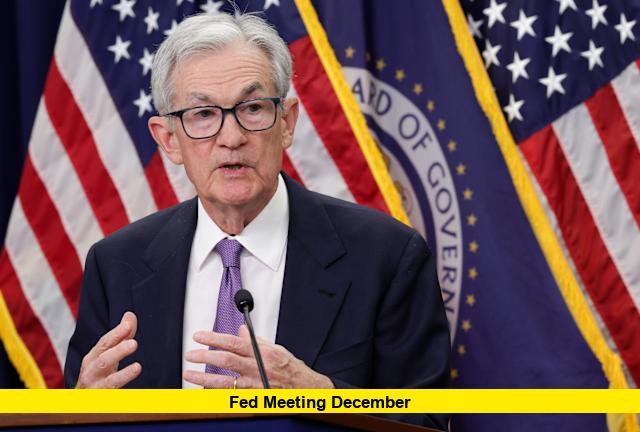
The Federal Reserve’s December 2025 gathering — the crucial “fed meeting December” — is drawing intense attention as investors, businesses, and consumers alike prepare for what could be the central bank’s third straight interest-rate reduction this year. With stakes high and uncertainty in the air, many are watching to see not only whether rates will come down, but also how the Fed signals its future path.
Table of Contents
What’s happening now: timing and expectations
The Fed’s policy-setting arm will meet December 9–10, 2025. Markets overwhelmingly expect a rate cut — the odds stand at roughly 87%.
A simple cut seems likely. But the critical question: will the Fed also signal a pause after December? Many analysts believe that could be its path forward.
Why the Fed may cut: jobs, inflation, mixed data
Labor market softness
Behind market expectations is concern over a cooling labor market. Recent private-sector reports show layoffs and job cuts — a marked slowdown from earlier strength. With official government data delayed following a government shutdown, the Fed has less clarity.
Policymakers worry unemployment could worsen, making it harder to justify holding rates high.
Inflation still above target — but persistent uncertainty
Inflation remains above the Fed’s 2% target, a core concern for rate-setters. At the same time, sluggish economic activity and weak consumer demand put pressure on growth.
In other words, the Fed is caught between wanting to support a fragile labor market and a need to keep inflation in check.
How the December meeting could play out
A likely 25-point cut — but not a blank check
Most major financial institutions now anticipate a 25-basis-point cut, bringing the federal funds rate down to a target of roughly 3.50%–3.75%.
Still, the decision is expected to be far from unanimous. The committee remains sharply divided, reflecting competing priorities: some members fear higher rates will suffocate growth, while others worry further cuts could fuel stubborn inflation.
A “hawkish cut”: easing now, but readiness to pause
If the cut comes, it’s likely to be what many call a “hawkish cut” — that is, a reduction in rates paired with language that signals caution about further easing.
Markets will look closely at the accompanying statement, and perhaps more importantly, at comments from the Fed chair during the post-meeting press conference — especially his view on inflation, labor market trends, and whether the Fed will hold off from immediate further cuts.
Policymakers may also publish updated economic projections and their “dot plot,” offering a clearer window into their expectations for 2026.
What this means for consumers, borrowers, and markets
Mortgage and loan rates: a mixed picture
Many homeowners and prospective buyers hope that a rate cut will lower mortgage interest rates and make refinancing or home purchases more affordable.
Still, a Fed rate cut doesn’t automatically translate into cheaper mortgages — other factors, like demand for Treasury bonds (which influence mortgage rates), often play a bigger role.
For now, lenders may stay cautious until they see how the market responds to the Fed’s decision and the tone of its forward guidance.
Financial markets on edge
Markets have grown jittery leading up to the decision. In recent days, stock indexes flickered and Treasury yields climbed to multi-month highs, reflecting investor uncertainty.
If the Fed’s commentary tilts hawkish even as rates drop, markets could react sharply — particularly in interest-rate-sensitive assets like housing, tech, and financial stocks.
Bond markets and investor behavior shifting
Ahead of the meeting, many bond investors have already shifted their focus from long-duration Treasuries to mid-maturity bonds. This reflects expectation for only modest further rate cuts in 2026 — a more cautious, deliberate pace of easing.
If the Fed signals a pause after the December cut, this repositioning is likely to remain in place in the near term.
Why this December meeting matters more than most
It caps the 2025 monetary policy cycle
This is the final FOMC meeting of the year, and it could define how the Fed enters 2026. Markets, businesses, and borrowers want clarity — will the Fed continue cutting, or shift to “data-dependent,” meeting-by-meeting decisions?
The decisions and tone set now may ripple through every corner of the economy: from borrowing costs and the housing market to corporate investment and consumer spending.
Unusual uncertainty inside the Fed
What adds weight to this meeting is the degree of division among policymakers. Recent communications suggest that some view inflation as still too high for comfort, while others fear that holding rates too long will stifle the labor market.
With economic data clouded by delays from the government shutdown, the Fed must choose a path based on imperfect information, making each decision far more consequential.
Potential turning point for 2026 rate policy
If the Fed cuts rates now but signals caution toward additional easing, December could mark the end of rapid rate reductions. Instead, the central bank may move to a more reactive, data-driven posture next year — reacting to inflation and employment reports as they come.
That would leave markets — and everyone from homebuyers to business investors — on watch, waiting for new signals instead of looking ahead to guaranteed rate drops.
What to watch when the Fed announces
When the rate decision publishes at 2:00 p.m. ET on December 10, the critical aspects will include:
- The size of the rate move — a 25-basis-point cut is expected, but any variance will be heavily scrutinized.
- The forward-looking language — does the Fed hint at more cuts, or push back?
- Updated economic projections and the dot plot — these will indicate where the Fed sees rates going next year.
- Comments from the Fed chair — especially on inflation risks, labor-market health, and geopolitical/economic uncertainty.
Markets will digest all of this in real time, meaning volatility is likely to spike — especially in equities, bonds, and mortgage markets.
Bottom line: January 2026 may be a game-changer
All signs point to a 25-point rate cut this week — the third in a row. But the real story is what comes next. If the Fed signals a pause, we could be entering a period of rate stability, where every subsequent move depends tightly on new data.
For borrowers, homeowners, and investors, that could mean waiting longer for lower rates or market calm. For businesses and markets, it could signal a shift toward caution after months of aggressive easing.
Expect the Fed’s decisions this week to cast a long shadow into 2026.
Stay tuned for the official announcement and share your thoughts below — this could shape the financial landscape for months to come.

