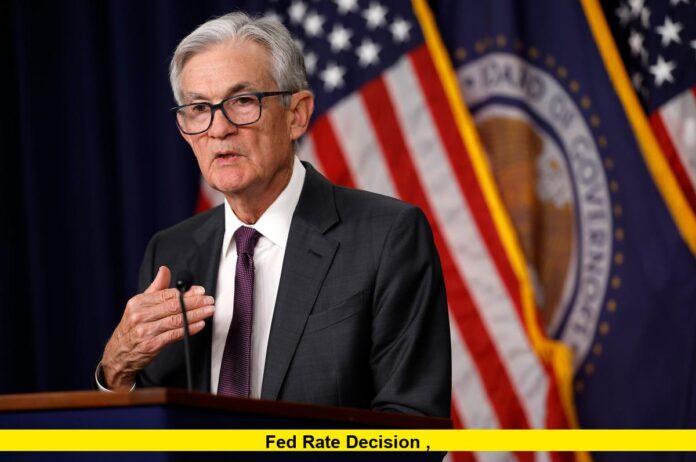
The Federal Reserve is set to announce its highly anticipated fed rate decision today, and financial markets across the United States are bracing for what is widely expected to be a third consecutive interest-rate cut. The central bank is preparing this move at a moment when the labor market is softening, borrowing costs remain historically high for many households, and the economy shows signs of slowing as the year draws to a close.
With the Federal Open Market Committee meeting concluding this afternoon, Americans are closely watching how the coming decision could influence mortgages, credit cards, business financing, and investment trends heading into 2026.
Table of Contents
A Major Decision Day for the U.S. Economy
Current expectations point to a 0.25% cut, which would bring the federal funds rate down to a target range of 3.50% to 3.75%. If confirmed, this marks the sixth cut since late 2024 and cements the Fed’s turn toward more supportive monetary policy as economic momentum continues to cool.
Investors, analysts, and business owners anticipate not only the rate adjustment itself but also the Fed’s guidance for the year ahead. With inflation still above the long-term target and employment growth slipping, officials face a delicate balancing act: stimulating the slowing economy without encouraging a renewed surge in prices.
The tone of today’s press conference and the release of fresh economic projections could play an equally important role as the rate cut itself.
Why the Fed Is Poised to Cut Rates Again
A Cooling Labor Market
Recent data shows a noticeable slowdown in hiring across multiple sectors. Private employers shed tens of thousands of jobs last month, and wage growth has moderated. These trends suggest businesses remain cautious and are reducing labor needs in response to uncertain demand.
This cooling backdrop increases pressure on policymakers to ease borrowing conditions, support employment, and stabilize business investment.
Disrupted Economic Data After Government Shutdown
A recent federal government shutdown caused delays in the collection and publication of several key reports. Without timely figures on consumer spending, inflation, and hiring, the central bank must work with partial information. Historically, when faced with data gaps, the Fed chooses caution — and caution usually leans toward accommodation rather than tightening.
Inflation Remains Elevated
Despite the series of rate cuts over the past year, inflation has not yet returned to the 2% target. Prices for essentials such as food, housing, and transportation remain stubbornly high. Even so, inflation has cooled enough from last year’s peak to give the Fed confidence that another rate reduction will not immediately reignite price pressures.
Still, this careful backdrop is also why many officials plan what is being described as a “hawkish cut” — a rate reduction paired with messaging that further cuts are not guaranteed.
Policy Pressure and Internal Debate
Internal divisions within the Federal Reserve have become more visible. Some policymakers have argued that the inflation battle is not complete and that cutting too aggressively could cause a reversal of recent progress. Others warn that holding rates higher for longer could trigger a more significant downturn.
This split makes today’s vote one of the most uncertain and consequential in recent years.
What a Rate Cut Means for Everyday Americans
Borrowing Costs Could Gradually Decrease
A cut to the federal funds rate does not immediately lower all consumer borrowing rates, but it typically sets off a chain reaction. Over time, Americans may see:
- Slightly lower mortgage rates
- Reduced credit card APRs
- More attractive auto loan terms
- Better financing options for small businesses
However, the impact can be uneven. Mortgage rates, for example, depend heavily on long-term bond yields, which do not always move in sync with the Fed’s decisions.
Savings Yields May Slip
A cut often leads to lower interest paid on savings accounts, money-market accounts, and certificates of deposit. Americans who rely on interest income, particularly retirees, may find yields less appealing in the months ahead.
Stock Market Reaction Could Swing
Financial markets have been volatile ahead of today’s announcement. If the Fed confirms expectations and signals openness to further support, stocks may rally — especially in sectors sensitive to borrowing costs, such as construction, manufacturing, and technology.
On the other hand, a more conservative tone or a divided vote could spark market hesitation.
The Growing Divide Inside the Fed
One of the biggest storylines heading into today’s announcement is the deep internal split among policymakers. Some voting members appear strongly committed to maintaining pressure on inflation, while others insist the risk of economic slowdown is too severe to ignore.
The result may be a narrow vote — a rarity for the historically unified Federal Reserve.
This divide matters because it hints at how policymakers might approach next year. A fractured committee could mean:
- More cautious adjustments
- Greater uncertainty in financial markets
- Less predictability for households planning major purchases
- Slower reductions in borrowing costs
Americans looking for relief from high interest expenses should pay close attention not just to today’s number, but to the tone and language the Fed uses to describe its outlook.
What to Watch in the 2026 Projections
Every December, the Fed releases fresh economic projections outlining expectations for inflation, GDP growth, unemployment, and interest rates for the coming years. These projections often move markets just as dramatically as the rate announcement.
Today’s outlook is expected to include:
- A moderate slowdown in growth
- Continued but slower progress on inflation
- A gradual easing of the federal funds rate in 2026
- A policy path shaped by uncertainty more than confidence
If the Fed signals limited room for additional cuts, Americans may not see major relief in mortgage rates or credit borrowing costs until later next year.
Could the Fed Hold Rates Instead of Cutting?
While expectations overwhelmingly lean toward a cut, several factors could still lead policymakers to pause:
- Incomplete economic data
- Concern about how markets may overreact
- Worry that inflation could reignite
- A desire to maintain flexibility into early 2026
Given the central bank’s priority of restoring stability, any sign that inflation could stall its downward momentum might weigh heavily on today’s discussion. Even so, recent labor and spending patterns strongly favor a cut.
How Americans Can Prepare for What Comes Next
Regardless of today’s decision, the coming months will bring both opportunities and challenges:
Homebuyers & Homeowners
Mortgage rates may ease slightly, but major drops are unlikely without further cuts. Those considering refinancing should monitor long-term bond yields closely.
Borrowers with Credit Card Debt
Any reduction in APRs will help, but card rates remain historically high. Paying down balances remains one of the best financial defenses.
Small Business Owners
Lower rates could support hiring, expansion, and inventory management — all crucial as consumer demand slows.
Investors
Market volatility is likely to continue as traders react to both the rate change and the Fed’s outlook for next year.
As 2026 approaches, the economic narrative will hinge on whether inflation continues falling and whether hiring stabilizes. That trajectory will shape every policy move the central bank makes.
How do you think today’s rate cut will affect your finances or business? Share your thoughts below and stay connected for the latest updates.

