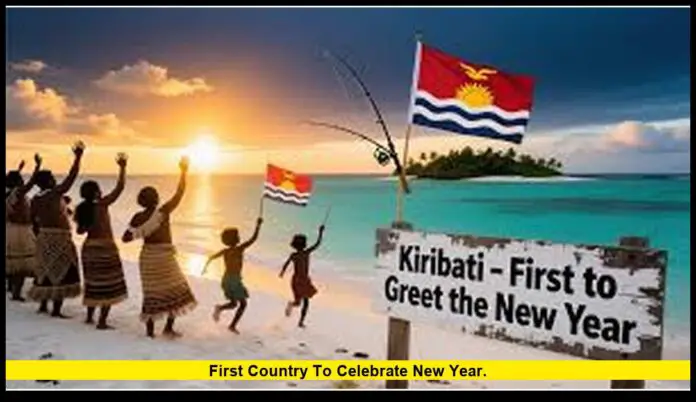
First country to celebrate New Year is a distinction held by the Pacific island nation of Kiribati as the world officially transitions into a new calendar year today. This status is based on globally recognized time zones and remains unchanged under current international timekeeping standards.
Every year, as people in the United States prepare for New Year’s Eve celebrations, the New Year has already arrived in one place on Earth. That moment occurs long before the ball drops in New York City or fireworks light up the West Coast. Understanding where and why the New Year begins first offers a clear view into how time zones, geography, and national decisions shape the global calendar.
Table of Contents
The Confirmed Answer as of Today
As of today, Kiribati is the first country to celebrate the New Year.
The celebration begins on Kiritimati (Christmas Island), which is part of Kiribati’s Line Islands. This region observes UTC+14, the earliest time zone anywhere in the world.
When the clock strikes midnight in Kiritimati, January 1 has officially begun—even though most countries are still hours, and sometimes an entire day, away from entering the new year.
This timing is permanent, official, and universally recognized.
Where Kiribati Is Located
Kiribati is located in the central Pacific Ocean and is made up of 33 coral atolls and reef islands. These islands are spread across a massive area of ocean, covering more than three million square miles.
The country is divided into three main island groups:
- Gilbert Islands
- Phoenix Islands
- Line Islands
The Line Islands sit farthest east, which places them closest to the beginning of each calendar day.
Because of this geographic spread, Kiribati once faced challenges with different parts of the country living on different calendar days.
Why Kiribati Changed the Calendar Line
In 1995, Kiribati made a nationally significant decision.
The government shifted the International Date Line eastward so that all islands would share the same calendar date. Before this change, some islands were nearly a full day behind others, creating confusion for governance, education, and communication.
After the adjustment:
- All islands shared the same date
- National operations became simpler
- Trade and administration improved
An additional result of this decision was global recognition as the first country to welcome the New Year.
Understanding UTC+14
The world measures time using Coordinated Universal Time (UTC).
Each time zone is expressed as an offset from UTC. Positive numbers indicate locations ahead of UTC, while negative numbers indicate locations behind it.
Key time zone facts
- UTC+14 is the earliest official time zone
- No country operates ahead of UTC+14
- The last places to celebrate New Year observe UTC−12
This creates a total time difference of 26 hours between the first and last New Year celebrations worldwide.
Kiribati’s Line Islands operate at UTC+14, placing them permanently at the front of the global calendar.
Global Comparison of New Year Timing
To understand how early Kiribati celebrates, it helps to compare it with other regions.
| Location | Time Zone | New Year Timing |
|---|---|---|
| Kiritimati, Kiribati | UTC+14 | First |
| Tonga | UTC+13 | One hour later |
| Samoa | UTC+13 | Shortly after |
| New Zealand | UTC+13 (DST) | Later |
| Australia (East Coast) | UTC+11 | Several hours later |
| U.S. East Coast | UTC−5 | 19 hours later |
| U.S. West Coast | UTC−8 | 22 hours later |
| Baker Island (U.S.) | UTC−12 | Last |
This explains why Americans often see images of New Year celebrations while still living in the previous year.
How New Year Is Celebrated in Kiritimati
Unlike major global cities, Kiritimati’s New Year celebrations are quiet and community-focused.
The island has a small population, and traditions emphasize togetherness rather than spectacle.
Typical New Year activities include
- Church services and prayer gatherings
- Community singing and music
- Shared meals with family and neighbors
- Midnight blessings
- Modest fireworks in some locations
The focus remains on reflection, gratitude, and welcoming the year with peace.
Does Tourism Play a Role?
Being the first country to celebrate the New Year has created niche tourism interest.
Some travelers plan visits specifically to:
- Experience the earliest New Year celebration
- See the first sunrise of January 1
- Mark milestone birthdays or anniversaries
However, Kiribati remains a low-tourism destination. Infrastructure is limited, and access requires careful planning.
The country has not turned its New Year status into a commercial event.
How Social Media Changed Global Awareness
In the past, only international broadcasters paid attention to Kiribati’s New Year.
Today, social media has changed that completely.
Within minutes of midnight:
- Photos appear online
- Short videos circulate globally
- The New Year trend begins hours before U.S. celebrations
For American audiences scrolling on December 31, the New Year can already feel underway somewhere else in the world.
Why Australia and New Zealand Are Often Confused as First
Many people assume Australia or New Zealand celebrates first.
This misconception exists because:
- They are major economies
- Their celebrations are widely televised
- Fireworks are large and visually striking
In reality:
- New Zealand celebrates after Kiribati
- Australia celebrates even later
Kiribati’s celebrations are smaller, but its timing is earlier.
Is Kiribati Always the First Country?
Yes.
As of today, Kiribati remains the first country to celebrate the New Year.
Time zones are regulated by national law and international standards. Kiribati’s UTC+14 designation has not changed, and there are no confirmed plans to revise it.
This position has remained stable for decades.
The Last Places to Celebrate New Year
Just as Kiribati is first, some places are always last.
The final New Year celebrations occur on:
- Baker Island (U.S. territory)
- Howland Island (U.S. territory)
These locations observe UTC−12 and are uninhabited.
This means the global New Year celebration stretches across more than a full day.
Why Time Zones Rarely Change
Changing time zones is complex.
It requires:
- Government legislation
- International coordination
- Economic justification
Kiribati has no incentive to change its current alignment. The system works efficiently for the country and provides international consistency.
Why This Topic Trends Every December
Search interest in the first country to celebrate New Year spikes sharply each December.
For U.S. readers, the topic reflects:
- Global curiosity
- Cultural awareness
- Anticipation of the year ahead
It also serves as a reminder that while the calendar changes everywhere, it does not change at the same moment.
What This Means for Americans
When Kiribati enters January 1:
- The U.S. East Coast is still on December 31 morning
- The West Coast is often still on December 30 night
This time gap explains why global headlines may announce the New Year long before Americans begin their celebrations.
Looking Ahead to Future Years
As long as global timekeeping rules remain unchanged, Kiribati will continue to welcome the New Year before any other country. Its position at UTC+14 secures its place at the very start of each new calendar year, a role that remains firm and recognized by international timekeeping authorities. In the years ahead, this timing is expected to stay the same because no major changes to the International Date Line or global time zone agreements have been confirmed. Nations occasionally consider time zone adjustments for economic or social reasons, but there are currently no official plans from Kiribati or neighboring Pacific states to alter this arrangement.
That first midnight is quiet, meaningful, and firmly established—arriving long before fireworks light up Times Square or celebrations begin across the United States. In fact, when Kiribati’s clocks strike midnight and welcome January 1, much of the world is still hours away from beginning their New Year festivities. This early celebration continues to draw curiosity and attention worldwide, from travelers planning special trips to social media users sharing the first photos and videos of the year. As global interest grows in real-time cultural moments, Kiribati’s position on the world clock remains a fascinating and unchanging starting point for the new year, setting the tone long before other celebrations follow.
Final Thoughts
What truly determines the first country to celebrate New Year isn’t a nation’s size, wealth, or global prominence—it is the clock and where that clock sits on Earth’s timeline. Time zones are fixed by geography and international agreements, and in today’s global New Year celebrations, time remains the ultimate deciding factor. Kiribati’s unique position near the International Date Line, specifically in the UTC+14 time zone, places it farther ahead on the global clock than any other inhabited place. This means its residents step into January 1 earlier than anyone else on the planet—hours before most of the world begins its festivities, including major New Year celebrations in places like New Zealand, Australia, Europe, and the United States.
Each year as the world counts down, Kiribati’s strategic placement in the earliest official time zone gives it a permanent edge over other countries. This year is no exception: when Kiribati reached midnight and entered 2026, nations across the Pacific and beyond were still in the final hours of 2025. The effect of this timing increases global attention each December, as individuals and media around the world mark Kiribati’s New Year celebrations long before celebrations begin elsewhere. This reality highlights how time itself—not national influence—defines who welcomes the New Year first, a fact reinforced every December 31 as Kiribati leads the world into January 1.
What do you find most interesting about how the New Year begins around the world? Share your thoughts and stay tuned for more global updates.

