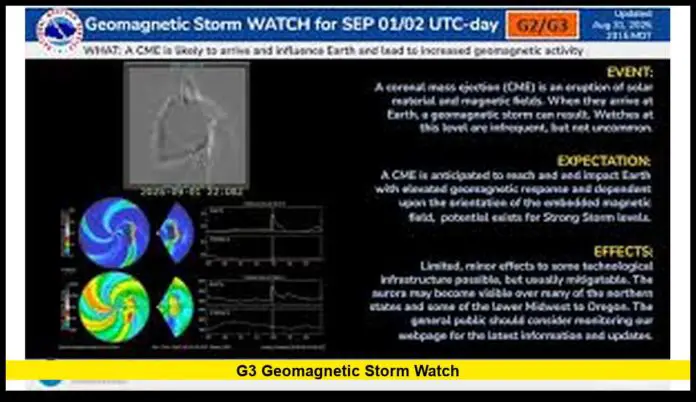
A G3 geomagnetic storm watch is now in effect after a powerful M8.1 solar flare produced a full-halo coronal mass ejection (CME) expected to reach Earth on December 9. Forecasts show elevated geomagnetic activity with the highest storm level projected on December 9, making this one of the most closely watched space weather events of the month.
Forecasters note a period of minor G1 disturbances on December 8, a strong G3 peak on December 9, and a return to G1 levels on December 10. A watch signals that conditions exist for strong geomagnetic storming capable of influencing several Earth-based and satellite technologies.
The watch was issued following detailed analysis of the solar flare and the trajectory of the CME. The M8.1 flare, which erupted on December 6, launched a full-halo CME directed toward Earth. Models project its arrival early to midday on December 9, raising the likelihood of strong geomagnetic effects throughout the day.
Timeline Overview
- Dec. 6: M8.1 solar flare detected, launching a full-halo CME.
- Dec. 7: G3 geomagnetic storm watch issued and forecasts updated.
- Dec. 8–10: Expected impact window, with G3 peak on Dec. 9.
Potential Impacts for the United States
A G3 storm is labeled “Strong,” meaning systems may experience noticeable disruptions. Most daily activities will continue normally, yet certain sectors may encounter challenges:
- Power grids: Voltage irregularities and transformer stress may occur in long-distance transmission systems. Utilities typically activate protective measures during predicted strong storm intervals.
- Satellites and GPS: Increased atmospheric drag can shift satellite orbits, and GPS accuracy may temporarily degrade.
- Radio communications: High-frequency radio used in aviation, maritime operations, and emergency communications may experience interference or short-term blackouts.
- Pipelines: Induced currents can contribute to increased corrosion rates unless proper safeguards are active.
- Auroras: Strong storming enhances aurora visibility, potentially reaching northern and central U.S. states.
Who Should Prepare Now
- Power grid operators may adjust system loads and monitor transformer performance.
- Satellite operators might schedule short-term orbit corrections or adjust mission timelines.
- Aviation and maritime sectors using HF radio should prepare backup communication strategies.
- Amateur radio users and photographers can prepare equipment and monitor sky conditions for aurora visibility.
How Forecasters Determined the Watch
The watch is based on solar imaging, coronagraph data, and model simulations that assess CME speed, density, direction, and magnetic properties. A full-halo CME indicates Earth-directed material, and model runs continue to refine expected arrival timing. The strongest disturbances often depend on the magnetic orientation of the incoming CME once it interacts with Earth’s magnetosphere.
Practical Guidance for U.S. Residents
- Expect occasional GPS disruptions: Travelers should avoid relying solely on satellite navigation during peak storm hours.
- Prepare backup communication tools: HF users should verify alternate systems and ensure adequate power supply.
- Protect sensitive electronics: Surge protectors and backups for essential data are recommended.
- Aurora viewing: Choose dark, open areas away from city lights. Weather and cloud cover will influence visibility.
What Experts Will Monitor Next
As the CME approaches, forecasters will analyze changes in solar wind speed, magnetic field orientation, and any additional solar activity. The magnetic orientation (Bz) is the most important variable. A prolonged southward Bz increases the likelihood of stronger geomagnetic disturbances. Updates to the watch or potential warnings will reflect incoming real-time measurements.
Quick Reference: G3 Storm Details
- Classification: Strong
- Common effects: Grid fluctuations, GPS inaccuracies, HF interference, increased satellite drag, enhanced aurora visibility
- Peak window: December 9, with diminished activity on December 8 and December 10
Communities, industries, and skywatchers across the United States should stay alert as this geomagnetic event approaches. Preparation is simple, and awareness helps reduce the impact of temporary disturbances. With models pointing to a defined peak time, many sectors are already reviewing and adapting operational plans.
Share your sky photos or local observations below, and check back for updates as this G3 geomagnetic storm watch continues to develop.

