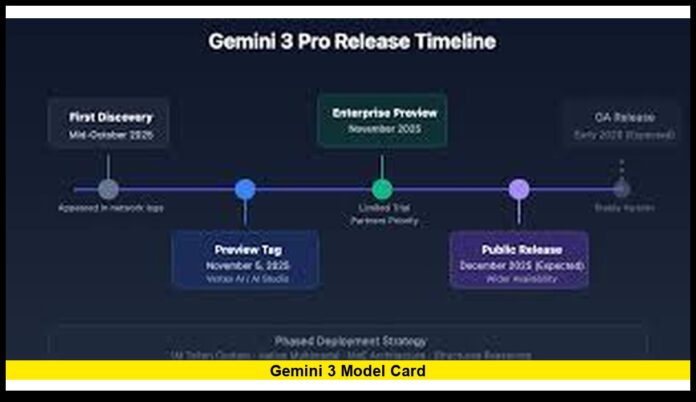
The Gemini 3 model card is now publicly available, giving U.S. readers, developers, and businesses a clear and factual overview of Google’s latest flagship multimodal AI model. Published in November 2025, the model card outlines the architecture, capabilities, limitations, performance benchmarks, and transparency standards for Gemini 3 Pro, confirming its role as Google’s most advanced model to date.
Table of Contents
A Clear Look at the Gemini 3 Model Card
The newly released model card provides verified and detailed information about how Gemini 3 Pro was developed, what data it uses, how it performs across tasks, and where its limitations exist. This document helps users understand the model without speculation or outdated information.
The card confirms that Gemini 3 Pro is built as a sparse mixture-of-experts transformer, designed from the ground up for native multimodal reasoning. It processes text, images, audio, and video inputs directly within the same architecture. This structural shift marks the latest step in Google’s multimodal evolution.
Key Technical Details
The Gemini 3 model card outlines several core specifications:
Architecture & Design
- Sparse mixture-of-experts (MoE) transformer.
- Native support for text, images, audio, and video.
- Improved safety filtering and dataset curation processes.
Input and Output Capabilities
- Accepts multimodal inputs in a single prompt.
- Supports context windows up to 1 million tokens.
- Can generate up to 64,000 tokens in a single output.
- Designed for long-range reasoning and extended document workflows.
Pre-Training Data and Processing
The model card explains that Gemini 3 Pro uses a broad set of data sources across text, images, audio, and video. Data is licensed, permission-based, publicly available, or user-contributed through Google’s services.
Processing steps listed in the card include:
- Deduplication
- Filtering for safety and quality
- Format normalization
- Removal of sensitive and harmful content
Performance Benchmarks
Gemini 3 Pro’s benchmark results are among the most transparent Google has released to date. The model card lists performance across reasoning, multimodal processing, coding-related tasks, and long-context understanding.
Some of the standout metrics include:
- Strong reasoning performance on complex exam-style benchmarks.
- High accuracy on multimodal video and image understanding tasks.
- Significant improvements over the Gemini 2.5 family across nearly every tested category.
These numbers highlight how Gemini 3 Pro is designed not just for chat but for sophisticated reasoning and multimodal workflows.
Limitations and Safety Notes
One of the strengths of the Gemini 3 model card is its acknowledgment of limitations. These include:
- Occasional hallucination or generation of incorrect facts.
- Sensitivity to harmful or biased content in training data.
- Potential inconsistencies when handling ambiguous prompts.
- Variation in performance depending on the modality involved.
The card also details mitigation techniques such as model-level safety filters, dataset exclusion processes, and human-in-the-loop testing.
Distribution and Access
The model card confirms that Gemini 3 Pro is being rolled out through:
- Google’s Gemini mobile app
- Google Workspace integrations
- Vertex AI for enterprise and developer use
- API access for third-party platforms
Availability may vary by region and product tier, but U.S. users now have broad access through Google’s AI platforms.
Why the Gemini 3 Model Card Matters
The release of the Gemini 3 model card is significant for several reasons:
Greater Transparency
Google is offering detailed, verifiable information about:
- Model architecture
- Dataset composition
- Safety mechanisms
- Benchmark performance
This transparency helps organizations make informed decisions.
Enterprise Use Cases
With its extended context window and multimodal flexibility, Gemini 3 Pro supports:
- Document analysis at scale
- Video and image-based workflows
- Large-codebase reasoning
- Enterprise-grade AI assistants
Improved Accuracy for Reporting and Research
Writers, researchers, and developers no longer need to rely on vague descriptions of Gemini’s capabilities. The model card provides exact metrics and clear descriptions.
Impact on U.S. Developers and Businesses
For American businesses evaluating AI integrations, the Gemini 3 model card offers a technical reference point that outlines what the model can—and cannot—do. This includes performance expectations, safety boundaries, and compatibility with existing Google Cloud products.
Developers can build services with:
- More confidence
- Better transparency
- Clearer understanding of data safety measures
- Accurate insight into multimodal capabilities
This makes the Gemini 3 release cycle one of the most developer-friendly yet.
Conclusion
The Gemini 3 model card offers a complete and factual overview of one of the most advanced multimodal AI models available today. Its transparency, benchmark data, and detailed breakdown of capabilities give U.S. users a reliable foundation for understanding how the model works and where it fits into the fast-moving world of artificial intelligence.
Feel free to share your thoughts below or explore what part of the model card interests you most.

