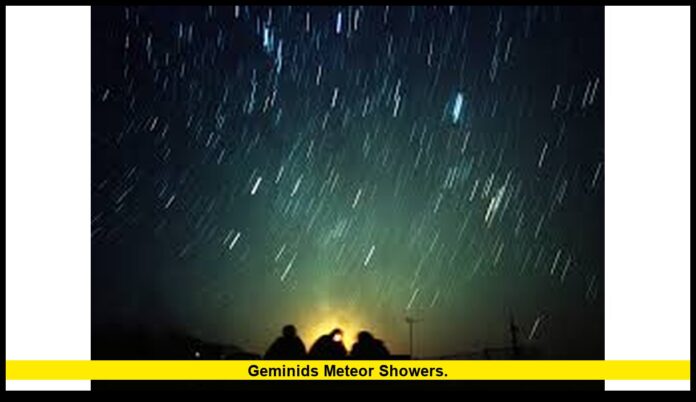
geminids meteor showers peak overnight from Saturday, December 13 into early Sunday, December 14, 2025, delivering one of the strongest annual sky shows for U.S. stargazers. Under dark skies, many viewers can spot steady bursts of “shooting stars,” with the highest activity typically building after midnight and into the pre-dawn hours.
The Geminids are known for frequent, bright meteors and occasional vivid colors. They can appear anywhere across the sky, even though they seem to trace back to the constellation Gemini.
Table of Contents
When the Geminids peak in 2025
The peak is expected late December 13 through the early morning of December 14, 2025. In the U.S., that generally means your best window is late evening through pre-dawn, with the most consistent action usually after midnight as Gemini climbs higher.
If you can only watch for a short time, plan on the darkest part of the night before dawn. If you have flexibility, start earlier to catch the ramp-up, then stay out as long as comfort allows.
How many meteors you might see
At peak, the Geminids are famous for producing high counts under ideal conditions. In a truly dark location, the rate can approach around 100+ meteors per hour at times, but real-world numbers vary widely based on light pollution, cloud cover, and how much sky you can see.
City lights can cut your count dramatically. A person watching from a suburb might see a fraction of what a watcher sees from a rural, wide-open viewpoint.
Moonlight in 2025 and why it matters
In 2025, the Moon is not expected to be a major spoiler on peak night, with relatively modest illumination compared with years when a bright Moon washes out fainter meteors. Even so, moonlight can still reduce the number of dim streaks you’ll notice.
For best results, position yourself so the Moon (if visible during your viewing time) is blocked by a building, hill, or trees—without blocking too much of the sky you want to watch.
What makes the Geminids different
Most major meteor showers come from dusty comet debris. The Geminids are linked to an object called 3200 Phaethon, often described as asteroid-like. Earth crosses the stream of debris left along its orbit, and those tiny particles hit our atmosphere at tremendous speed, burning up in brief streaks of light.
Geminid meteors have a reputation for being bright and “punchy,” which is one reason they remain a favorite even for casual observers.
Best times to watch by clock, not jargon
You don’t need exact astronomical timing to have a great viewing session. Use this simple rule of thumb for the U.S.:
- Good: Late evening (around 9–11 p.m. local time) as activity begins to pick up
- Better: Midnight to 2 a.m. as the radiant climbs and meteor counts increase
- Best: 2 a.m. to pre-dawn when Gemini is high and your sky is darkest (especially away from city lights)
If you can watch only once this season, choose the late-night to pre-dawn hours around the Dec. 13–14 peak.
Where to look in the sky
No telescope, binoculars, or special gear is required—in fact, wide-open naked-eye viewing is best.
The meteors will seem to radiate from Gemini, near the bright star Castor. But don’t stare only at Gemini. Meteors can appear anywhere, and many experienced skywatchers prefer looking 30–60 degrees away from the radiant to catch longer, more dramatic streaks.
A helpful sky cue this year: Jupiter is prominent in the evening sky, and Gemini is in that same general region of the sky as the night progresses. Use bright objects like Jupiter as an anchor, then keep your gaze wide.
How to pick a viewing spot in the U.S.
Your location matters as much as the peak timing.
- Escape light pollution: Drive 20–60 minutes away from heavy city glow if you can. Rural roads, parks, and open fields can make a huge difference.
- Find a wide horizon: An open area with a big slice of sky beats a pretty overlook blocked by trees.
- Safety first: Choose a legal, accessible spot where you can park safely and stay warm without trespassing.
If you’re staying in town, go to the darkest place available—large parks, waterfronts, or areas with fewer streetlights—and keep direct lights out of your eyes.
What to bring for comfort (and better results)
Meteor watching is mostly about staying outside long enough for your eyes and patience to pay off.
- A reclining lawn chair or blanket (neck strain is real)
- Warm layers, hat, gloves, and thicker socks (nights can feel colder than you expect)
- A thermos of something warm
- A red-light flashlight (or a phone set to a dim red filter)
- Snacks and water
Give your eyes at least 20 minutes to adjust to the dark. Avoid checking bright phone screens, which can reset your night vision fast.
Photography tips that stay simple and realistic
You can photograph Geminid meteors with a modern phone in some cases, but cameras still have an edge. If you’re using a camera:
- Use a tripod
- Point at a wide section of sky
- Use long exposures and keep shooting continuously
- Expect many frames with no meteors—this is normal
For phones, use a stable mount and a night mode or long-exposure setting if available. Either way, the best strategy is volume: more time shooting equals better odds.
What else is happening in the sky around the peak
Mid-December skies often include bright winter stars rising earlier each night. Even if meteor counts come in lower than hoped at your location, you can still enjoy a classic winter sky scene—especially once your eyes adapt and you start noticing faint stars that city lighting usually hides.
How to tell a meteor from a satellite or plane
- Meteor: quick streak, usually under a second or two, sometimes with a flare
- Satellite: steady, slow-moving point of light crossing the sky
- Plane: blinking lights, often with a consistent path and sometimes sound
If you see a brief flash that vanishes instantly, that’s the signature meteor moment you’re out there for.
If you miss the peak night
The Geminids are active across much of December, with the strongest activity centered on the peak. If weather or schedule ruins your Dec. 13–14 plans, you can still watch on nearby nights, though counts usually drop from the maximum.
The key remains the same: pick a dark place, watch after midnight, and give it time.
As long as skies are clear, the best plan is simple: step outside, get comfortable, and look up.

