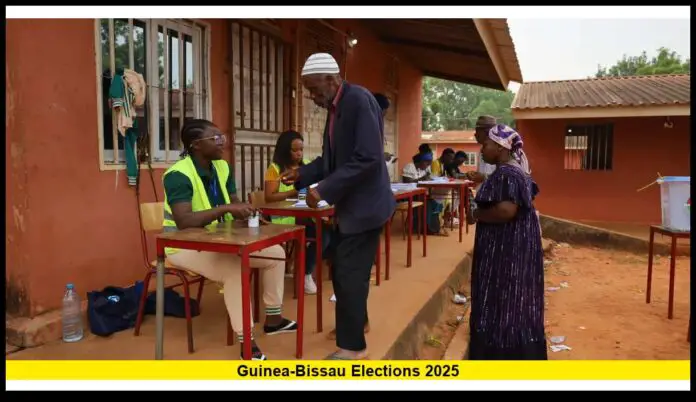
As Guinea-Bissau elections 2025 approach, the small West African nation is once again at the center of regional political attention. Scheduled for late 2025, the elections will determine the country’s next president and potentially reshape its political landscape after years of instability, leadership disputes, and efforts toward democratic reform.
With voters preparing to head to the polls, both domestic and international observers are watching closely to see whether this election will mark a step forward for one of Africa’s most politically volatile states.
Table of Contents
Background: A Nation Defined by Political Turbulence
Guinea-Bissau, a coastal country with a population of just over two million, has faced decades of political upheaval since gaining independence from Portugal in 1973. The nation has endured multiple coups, contested elections, and short-lived governments — a cycle that has prevented consistent governance and long-term development.
The 2025 elections come amid growing public frustration with corruption, unemployment, and a struggling economy heavily reliant on cashew exports. The nation’s voters are eager for a leadership that can bring lasting stability, rebuild institutions, and restore confidence in the democratic process.
The Current Political Climate
As of November 2025, Guinea-Bissau’s political scene remains highly polarized. President Umaro Sissoco Embaló, who came to power in 2020, continues to face criticism from opposition parties and civil society groups who accuse his administration of overstepping executive authority.
Embaló dissolved parliament in 2022 after months of political deadlock, leading to tensions between the executive and legislative branches. Although a new government was formed in 2023, lingering mistrust between political factions has fueled public concern ahead of the upcoming election.
International observers, including the Economic Community of West African States (ECOWAS) and the African Union, have called for calm and transparency in the lead-up to the vote.
Key Political Parties and Players
The 2025 elections are expected to feature a mix of veteran politicians and newer voices seeking to challenge the traditional power blocs that have long dominated Guinea-Bissau’s politics.
Major political players include:
- PAIGC (African Party for the Independence of Guinea and Cape Verde): The historic party that led the country to independence, still influential in parliament and the opposition.
- PRS (Party for Social Renewal): A major rival of the PAIGC, with strong regional support, particularly in the north.
- Madem-G15 (Movement for Democratic Alternation): The ruling party led by President Embaló’s allies, currently controlling much of the government structure.
Independent candidates and smaller parties have also signaled interest in contesting the presidency, with many promising reforms aimed at tackling corruption and improving economic management.
Election Timeline and Process
The National Election Commission has confirmed that the presidential and parliamentary elections are scheduled for late 2025, with voter registration campaigns already underway across all regions.
To ensure fairness, the Commission has introduced digital registration systems and expanded polling stations to rural communities. International organizations have offered technical support to help maintain transparency throughout the voting and counting processes.
Guinea-Bissau’s electoral framework allows for a two-round presidential election if no candidate secures a majority in the first round. This system often leads to runoff elections, which have historically been tense and closely contested.
Security Concerns and International Involvement
Security remains one of the biggest challenges heading into the 2025 vote. Guinea-Bissau’s history of military intervention in politics continues to cast a shadow over the democratic process.
ECOWAS peacekeeping forces have maintained a limited presence in the country since 2022 to ensure political stability and to deter military interference during the electoral period. The United Nations and the European Union have both expressed support for ongoing peacekeeping and mediation efforts.
Domestically, the government has pledged to protect polling stations and prevent voter intimidation. The police and military have also been instructed to remain neutral throughout the process.
Economic Stakes in the Election
The outcome of the 2025 election carries major economic implications. Guinea-Bissau’s economy has long depended on agriculture, particularly cashew nuts, which account for more than 80% of export revenues. However, fluctuating global prices, limited industrialization, and a lack of infrastructure have left the economy vulnerable.
Candidates are under pressure to propose concrete solutions for diversification — especially in fisheries, tourism, and renewable energy — sectors that could attract foreign investment and reduce reliance on agriculture.
Financial experts and regional analysts say that sustained political stability after the election could unlock significant international aid and trade opportunities, helping to modernize Guinea-Bissau’s struggling economy.
Public Sentiment and Youth Engagement
A growing number of young voters are expected to participate in the 2025 elections. Over 60% of Guinea-Bissau’s population is under 25, and many young people have become increasingly vocal about unemployment, poor education, and lack of opportunity.
Social media platforms like Facebook and WhatsApp have become central tools for political discussion, voter mobilization, and campaign messaging. Youth-led organizations have launched awareness drives encouraging first-time voters to register and demand accountability from leaders.
Analysts believe that this energized youth participation could be a turning point in shaping the nation’s political future.
The Role of the International Community
Guinea-Bissau’s allies and regional partners are taking a close interest in the 2025 elections. ECOWAS, the African Union, and the United Nations have deployed observation missions to ensure the process remains transparent and credible.
The United States and European Union have also provided financial and logistical assistance to strengthen the electoral infrastructure. Both have urged all candidates to respect the rule of law and accept the final results peacefully.
For Guinea-Bissau, international legitimacy is crucial — especially as the country seeks to attract investment and reestablish stronger diplomatic ties in the wake of past instability.
Challenges Ahead
Despite widespread optimism, several obstacles could affect the integrity and outcome of the elections:
- Persistent corruption and lack of oversight within political institutions.
- Limited media freedom, particularly for independent outlets covering political affairs.
- Weak infrastructure in rural areas, complicating voter access.
- Economic pressure on the population, which can influence voting patterns.
Observers have emphasized the need for continued civic education and nonpartisan oversight to ensure that every vote counts.
What’s at Stake
For Guinea-Bissau, the 2025 elections represent more than a political contest — they symbolize a potential shift toward lasting democracy and stability after decades of turmoil.
If conducted fairly, the vote could mark a turning point that strengthens institutions, improves governance, and rebuilds global confidence in the nation’s future. But if tensions escalate or results are disputed, Guinea-Bissau risks repeating the cycle of uncertainty that has hindered progress for generations.
The world will be watching closely as Guinea-Bissau heads to the polls in 2025. Will this election finally bring the stability its people have long hoped for? Share your thoughts in the comments and stay tuned for ongoing updates.

