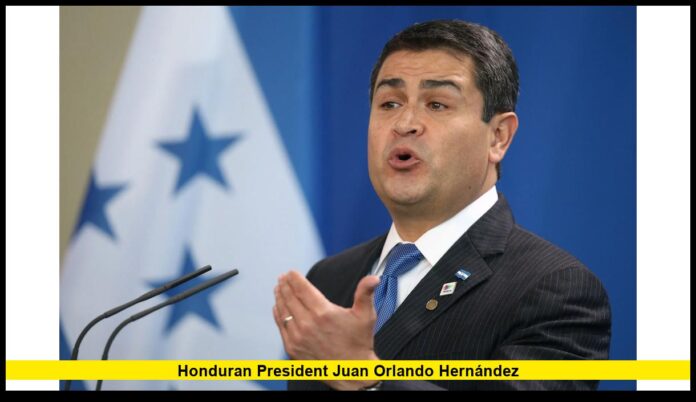
The name Honduran President Juan Orlando Hernández continues to make global headlines as the former leader of Honduras serves a lengthy sentence in a U.S. federal prison. Once one of Central America’s most influential political figures, Hernández’s dramatic fall from power reshaped Honduran politics and marked a defining moment in U.S.–Latin American anti-narcotics cooperation.
Table of Contents
From Power to Prosecution
Juan Orlando Hernández Alvarado held the Honduran presidency from January 2014 through January 2022. During his two terms, he portrayed himself as a strong U.S. ally on security and migration issues. Yet even while he stood alongside American officials pledging to curb drug trafficking, U.S. prosecutors were building a case that placed him at the center of the same criminal networks he claimed to fight.
After leaving office, Hernández lost presidential immunity. In February 2022, the U.S. requested his extradition on charges of conspiring to traffic narcotics and possessing illegal weapons. Honduras’ Supreme Court approved the request, and in April 2022, Hernández boarded a U.S. Drug Enforcement Administration aircraft bound for New York.
The U.S. Trial in New York
The federal trial began in early 2024 in the Southern District of New York. Prosecutors presented testimony from former traffickers and Honduran security officials who described a years-long arrangement in which Hernández accepted bribes from cartels in exchange for protection and political support.
Evidence outlined how drug proceeds were funneled into campaign funds during his presidential and congressional campaigns. Prosecutors argued that under his leadership, Honduras became a critical transit hub for cocaine shipments bound for the United States.
The defense maintained Hernández’s innocence, emphasizing his administration’s collaboration with U.S. agencies and pointing to prior honors he received from American officials for assisting in extraditions. Nevertheless, the jury found him guilty on all major counts in March 2024.
Sentencing and Imprisonment
On June 26 2024, U.S. District Judge P. Kevin Castel sentenced Juan Orlando Hernández to 45 years in prison, followed by five years of supervised release. The court also ordered the forfeiture of several million dollars in assets. The sentence effectively ensures that Hernández, now in his mid-50s, will spend the remainder of his life in U.S. custody.
He is currently held in a high-security federal facility managed by the Federal Bureau of Prisons. Officials have not publicly disclosed the exact location for security reasons, but he is believed to be in a northeastern U.S. penitentiary.
Appeals and Legal Developments
Hernández’s attorneys have filed an appeal challenging both the verdict and the sentence, arguing that the court improperly admitted witness testimony from individuals who sought reduced sentences in exchange for cooperation. As of December 2025, appellate proceedings remain pending, but no higher court has overturned or modified the conviction.
Legal experts note that while such appeals can take years, the evidence presented at trial—including recorded conversations, financial records, and coordinated testimony—makes reversal unlikely.
Political and Diplomatic Impact
The conviction of a former Honduran president in the United States has had sweeping implications. For Honduras, it exposed deep corruption within the political and security systems. For Washington, it reinforced a new precedent of prosecuting foreign leaders involved in transnational crime that affects U.S. interests.
Current President Xiomara Castro, who succeeded Hernández in 2022, has pledged to distance her administration from his legacy and strengthen judicial independence. Her government has cooperated with international anti-corruption missions while working to rebuild public trust in state institutions.
Meanwhile, public opinion in Honduras remains sharply divided. Some citizens view Hernández’s conviction as overdue justice, while others criticize the United States for exerting extraterritorial influence over Central American politics.
U.S. Policy Context
The U.S. Department of Justice has described the Hernández case as a cornerstone of its efforts to dismantle global narcotics networks that operate through political protection. American officials highlight that his conviction demonstrates that “no one, regardless of rank, is above the law.”
The case has also influenced ongoing policy debates about foreign aid to Central America. Lawmakers now emphasize stricter anti-corruption conditions tied to funding, particularly for security and migration programs in the Northern Triangle region (Honduras, Guatemala, and El Salvador).
Timeline: Key Moments in the Hernández Case
| Date | Event |
|---|---|
| January 2014 | Juan Orlando Hernández takes office as president of Honduras. |
| January 2022 | Leaves office; Xiomara Castro becomes president. |
| February 2022 | U.S. formally requests extradition. |
| April 2022 | Extradited to New York. |
| March 2024 | Convicted in U.S. federal court. |
| June 2024 | Sentenced to 45 years in prison. |
| December 2025 | Remains incarcerated; appeal unresolved. |
Public Reaction in Honduras and Abroad
In Tegucigalpa, large demonstrations followed both the extradition and the sentencing. Many Hondurans expressed frustration that corruption had eroded national dignity, while others felt relief that accountability had finally reached the highest level of power.
In the United States, Honduran immigrant communities have closely followed developments. Advocacy groups stress that justice in the Hernández case should lead to broader reforms that address poverty, inequality, and migration pressures that push many Hondurans northward.
The Broader Legacy
Juan Orlando Hernández’s downfall illustrates how entrenched corruption can undermine democratic institutions and international partnerships. His administration’s ties to trafficking networks hindered domestic progress on security and tarnished Honduras’s global image.
Even behind bars, Hernández’s case remains a reference point for anti-corruption movements across Latin America. Analysts view it as a warning that once-untouchable political elites can face justice beyond their borders.
The story of Honduran President Juan Orlando Hernández is far from forgotten. His conviction stands as a milestone in the fight against political corruption and drug trafficking, and the world will be watching closely to see whether his appeal changes anything in 2026.

