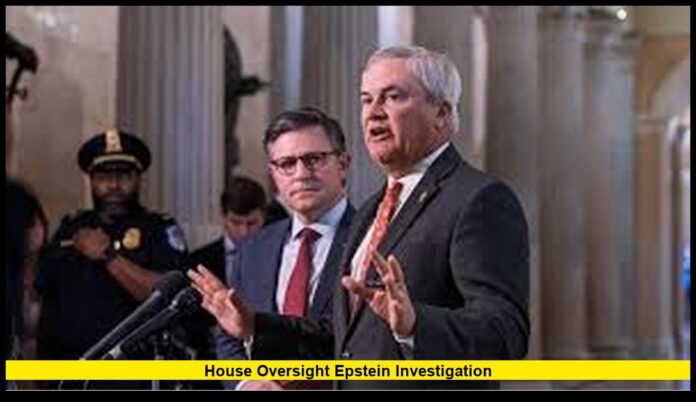
As of December 12, 2025, the House Oversight Epstein investigation continues to dominate headlines as lawmakers from both parties dig deeper into how Jeffrey Epstein — one of America’s most infamous sex offenders — was allowed to operate for so long and die while under federal watch.
The investigation, led by the House Oversight Committee, is now moving full speed ahead, demanding answers from the Bureau of Prisons (BOP) and the Department of Justice (DOJ) about what went wrong before and after Epstein’s 2019 death inside the Metropolitan Correctional Center (MCC) in New York.
This inquiry is not about reliving conspiracy theories. It’s about accountability, transparency, and reform — and ensuring that the same institutional failures never happen again.
Table of Contents
Why the House Oversight Epstein Investigation Matters
The Epstein case shook public confidence in the U.S. justice system. A wealthy and well-connected man accused of trafficking minors died in federal custody before his victims ever saw justice served.
The House Oversight Committee’s goal is to understand exactly how that happened. Lawmakers are focusing on three critical areas:
- Accountability: Who was responsible for Epstein’s safety and supervision at MCC?
- Transparency: Were key details or documents withheld from investigators or the public?
- Reform: How can Congress strengthen oversight to prevent similar failures in the future?
Committee Chairman James Comer (R-KY) said the hearings are about “facts and responsibility — not politics.” Democratic leaders, including Jamie Raskin (D-MD), agree that bipartisan cooperation is essential to restoring public trust.
What the Investigation Has Found So Far
In recent weeks, investigators have reviewed thousands of pages of evidence, including:
- Internal BOP emails and logs from the night of Epstein’s death.
- Inspection reports detailing security violations and broken equipment.
- Disciplinary records showing multiple guard and staff errors.
The findings reveal a disturbing pattern of negligence: Epstein was left unsupervised for hours, cameras outside his cell malfunctioned, and overworked guards falsified records to hide the lack of checks.
Despite Epstein’s previous suicide attempt, his special watch status had been lifted just days before his death. Lawmakers are now demanding to know who made that decision and why.
Hearings Scheduled for 2026
The House Oversight Epstein investigation is set to enter its most important phase in January 2026, when a series of high-profile hearings will take place.
Witnesses will include:
- Lamine N’Diaye, the warden of MCC during Epstein’s detention.
- Michael Horowitz, Inspector General for the Department of Justice.
- Senior BOP officials, who oversaw staffing and safety policies.
The committee will question these witnesses about why Epstein was left unsupervised, how security cameras failed, and whether evidence was intentionally destroyed or lost.
Lawmakers are also expected to scrutinize internal DOJ communications to determine whether high-ranking officials tried to minimize the fallout.
Bipartisan Effort for Accountability
One of the defining features of this investigation is how Republicans and Democrats are working together. Both sides recognize that Epstein’s death represents a broader failure of the federal government’s duty to protect inmates and preserve justice.
Rep. Nancy Mace (R-SC) called it “a national embarrassment” that such a high-profile detainee died in a federal facility.
Rep. Raskin (D-MD) added, “No matter who you are, the law must work the same way. Epstein’s case showed the opposite — and we’re fixing that.”
This unity has helped the committee maintain focus on facts, documentation, and solutions — not political finger-pointing.
Federal Failures Under the Microscope
The Bureau of Prisons is now at the center of the inquiry. Internal reports and staff interviews reveal systemic problems that go far beyond the Epstein case:
- Chronic understaffing at multiple federal facilities.
- Overworked guards, some clocking 70+ hours a week.
- Equipment failures, including malfunctioning surveillance systems.
- Ignored red flags, even after earlier incidents of inmate self-harm.
The committee has already determined that Epstein’s cellblock was understaffed on the night of his death. The two guards assigned to him were working double shifts and later admitted to falsifying logs.
Though they avoided jail time after plea deals, the Oversight Committee believes their leniency highlights a deeper culture of negligence within the federal system.
The Bigger Picture: Epstein’s Network and Financial Trail
While the committee’s immediate focus is on federal mismanagement, lawmakers are also examining how Epstein built and sustained his network of wealth and power without scrutiny for decades.
Congress has requested additional information from the Treasury Department’s Financial Crimes Enforcement Network (FinCEN) to trace Epstein’s business dealings, shell companies, and offshore accounts.
The goal is to determine whether existing financial oversight systems failed to detect — or deliberately ignored — suspicious activity tied to Epstein’s enterprises.
Chairman Comer explained, “This investigation isn’t just about one man’s crimes. It’s about understanding how systems of influence, money, and privilege worked to shield him from accountability.”
Department of Justice Oversight
The DOJ’s Office of the Inspector General (OIG) previously published a report identifying multiple procedural failures, but many in Congress believe the investigation did not go far enough.
Lawmakers are demanding answers on:
- Why Epstein’s security classification was reduced.
- Why protocol violations weren’t corrected after earlier warnings.
- Why key video evidence was lost despite internal rules requiring backups.
The House Oversight Committee wants to know if higher-level officials failed to act or intentionally avoided scrutiny. Several current and former DOJ employees have been asked to testify in 2026.
Legislative Action and Reform Plans
The Epstein case has reignited a push for major prison oversight reform. Multiple bills are now being drafted to prevent future lapses. Among them:
- The Federal Prison Transparency Act: Requires live monitoring and public reporting of inmate safety incidents.
- The Custodial Accountability Act: Establishes an independent review board for deaths in custody.
- The Prison Surveillance Integrity Act: Mandates dual storage systems to prevent video loss or tampering.
Lawmakers hope these reforms will bring lasting structural change to the Bureau of Prisons, which has faced criticism for years.
Public Reaction and Media Coverage
The Epstein story continues to captivate the American public. Every new piece of information released by the House Oversight Committee sparks renewed debate online and in the media.
Social media discussions have surged again, with hashtags like #EpsteinInvestigation and #OversightHearings trending nationwide.
Many Americans see the investigation as more than a quest for justice — it’s a test of government accountability. Survivor advocacy groups have praised Congress for pursuing the truth, while urging lawmakers not to stop until every responsible party is identified.
Major news networks have also covered the hearings closely, noting how this inquiry stands out for its bipartisan cooperation and factual grounding.
Next Steps and What to Expect
The House Oversight Committee is expected to release its first major report in early 2026, summarizing its findings and identifying responsible individuals and agencies.
That report will likely include recommendations for:
- Structural reform within the Bureau of Prisons.
- Enhanced DOJ oversight procedures.
- Mandatory public transparency for high-profile inmate management.
Additional hearings will continue through the spring, and subpoenas are already being prepared for more witnesses, including former prison administrators and senior Justice Department officials.
Chairman Comer has promised that “no one — regardless of title or position — will be above scrutiny.”
Beyond Epstein: A Call for Institutional Change
The House Oversight Epstein investigation has grown into something larger than one man’s story. It’s become a national reckoning with the flaws in America’s justice system — a reminder that power and privilege must never outweigh accountability.
Lawmakers hope their findings will lead to meaningful reform, stronger oversight, and the restoration of public trust in federal institutions.
For victims and their families, the ongoing investigation offers one final chance at transparency — and perhaps a measure of justice long overdue.
Do you think Congress will uncover all the facts about Epstein’s case? Share your thoughts in the comments below.

