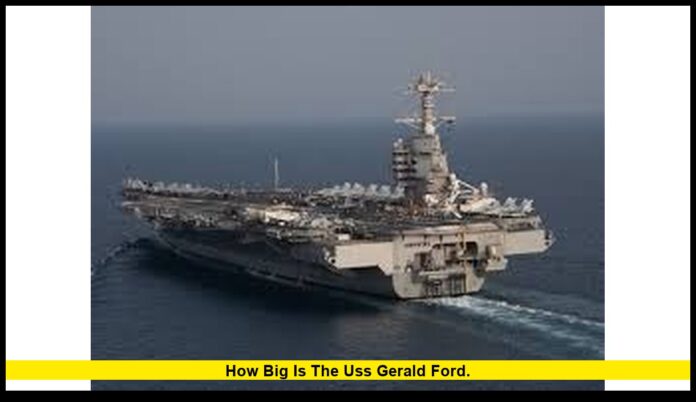
The question how big is the USS Gerald Ford has become increasingly common as this modern U.S. Navy supercarrier continues to draw national and international attention. The USS Gerald R. Ford (CVN-78) is not only the newest aircraft carrier in the United States fleet—it is the largest and most technologically advanced warship ever built. Its size, power, and design signal a new era of naval capability intended to support global operations and deter rising military competitors.
As of today, the carrier remains in active service and continues to participate in deployments, carrier strike group operations, and multinational training exercises. Its dimensions and capabilities are central to understanding why the United States invests so heavily in carrier technology and how this vessel strengthens U.S. presence at sea.
Table of Contents
Dimensions: The Scale of a Floating City
To understand the size of the USS Gerald Ford, imagine a floating city with the footprint of three football fields placed end to end. The scale is engineered to support both aircraft operations and the thousands of sailors and aviators who serve onboard.
Key Size Measurements of the USS Gerald R. Ford:
| Feature | Approximate Size / Capacity |
|---|---|
| Length | About 1,100 feet (more than 3 football fields) |
| Height | Around 250 feet from keel to mast top |
| Flight Deck Width | Roughly 256 feet across |
| Displacement | About 100,000 tons when fully loaded |
| Aircraft Capacity | Around 75+ aircraft, depending on mission |
| Crew Capacity | Approximately 4,500 personnel, including air wing |
The size is not only impressive physically—it creates operational benefits that smaller or older carriers cannot offer.
Why the USS Gerald Ford Is So Large
1. Increased Aircraft Launch and Recovery Ability
One of the major reasons for the ship’s size is to support high-volume air operations. The flight deck allows for more aircraft movement, faster takeoff cycles, and safer recovery patterns.
2. Expanded Power Systems
The ship is powered by two advanced nuclear reactors, providing nearly three times the power output of previous carrier classes. This allows future systems—such as laser defense weapons and advanced radar—to function without redesigning power systems.
3. Enhanced Storage and Endurance
A large fraction of the vessel is dedicated to storing aircraft spare parts, jet fuel, medical facilities, and thousands of meals per day. The size allows the carrier to remain at sea for months at a time without needing refueling.
How It Compares to Other U.S. Carriers
The USS Gerald Ford succeeds the Nimitz-class carriers that served as the Navy standard since the 1970s. While its length is similar to the Nimitz, the Gerald Ford features:
- A wider and more efficient flight deck
- More internal space for maintenance and aircraft movement
- Reduced crew workload through advanced automation
- A redesigned island (command tower) positioned further aft for better flight operations flow
These refinements allow up to 30% more aircraft launches per day than earlier carriers, even though the ships are roughly the same external size.
Inside the Ship: Life on a Massive Warship
Serving on the USS Gerald Ford means living within a self-sustaining floating community. The size of the carrier allows space for:
- Multiple dining halls
- Fitness centers
- Workshop and maintenance bays
- A medical clinic with surgical capabilities
- Sleeping quarters for thousands
Crew members often describe the carrier as a small city that never sleeps, where aviation, engineering, communications, logistics, security, and leadership work at all hours.
Advanced Technology That Requires Mass Scale
The ship’s size also supports revolutionary systems not used on earlier carriers.
Electromagnetic Aircraft Launch System (EMALS)
Instead of steam-powered catapults, the Gerald Ford uses electromagnetic energy to launch aircraft.
This increases takeoff efficiency and reduces stress on aircraft frames.
Advanced Arresting Gear (AAG)
This technology allows smoother and safer aircraft landings, especially for new, lighter, or unmanned aircraft.
Digital Command and Control Systems
The ship features modern tactical operations rooms that allow faster decision making and integrated communication across Navy fleets.
These systems all require larger internal volume and power availability, reinforcing why size is not just a physical measurement but a functional requirement.
Why Size Matters Strategically
The size of the USS Gerald Ford gives the United States several strategic advantages:
- Global Reach: The carrier can operate virtually anywhere in the world’s oceans.
- Deterrence: Few nations can match the impressive presence of a supercarrier.
- Humanitarian Capacity: The ship can deliver aid and support disaster relief rapidly.
- National Defense Projection: It allows the U.S. to respond to threats far from American shores.
The scale of the ship makes it a visible reminder of American maritime strength and a reassurance to allied nations who rely on U.S. naval stability.
Modern Relevance and Continued Role
As world powers continue developing advanced naval systems, the USS Gerald Ford remains a central piece of America’s maritime strategy. Its ability to deploy anywhere, support extensive air missions, and sustain operations independently makes it a critical asset for securing shipping routes, supporting allies, and responding to global challenges.
The question how big is the USS Gerald Ford goes beyond dimensions—its scale enables capability, deterrence, and readiness in a rapidly changing world.
Conclusion
The USS Gerald R. Ford is one of the largest and most capable naval vessels ever built. Its size enables more flight operations, greater endurance, and advanced systems built for the future of naval warfare. For Americans interested in national defense, the Gerald Ford represents both innovation and global presence.
What are your thoughts on the U.S. investing in next-generation carriers like the USS Gerald Ford? Share your views below and stay connected for more insights.

