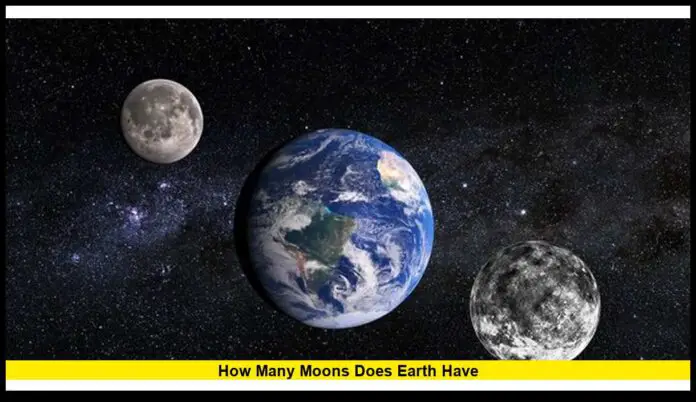
When it comes to one of the oldest questions in astronomy — how many moons does Earth have — most people instinctively answer “one.” After all, we’ve grown up gazing at that bright, familiar sphere lighting up our night sky.
But as scientists have discovered in recent years, Earth’s relationship with its moons is far more dynamic and complex than most realize. While our primary Moon is the only permanent natural satellite orbiting our planet, astronomers have confirmed that Earth also occasionally hosts temporary mini-moons — small asteroids briefly captured by Earth’s gravity before escaping back into space.
In other words, Earth doesn’t always have just one moon — sometimes, it has a few cosmic visitors orbiting alongside it.
Table of Contents
Earth’s Main Moon: The Constant Companion
Earth’s primary Moon, often simply called “the Moon,” has been orbiting our planet for roughly 4.5 billion years. It’s not only the most prominent object in our night sky but also a major stabilizing force for life on Earth.
Quick Facts About Earth’s Moon
- Diameter: 2,159 miles (3,474 km)
- Average Distance from Earth: 238,855 miles (384,400 km)
- Orbital Period: 27.3 days
- Surface Gravity: 1/6 of Earth’s
- Formation Theory: Believed to have formed after a massive impact between early Earth and a Mars-sized planet named Theia.
The Moon’s gravitational pull drives our ocean tides, helps stabilize Earth’s axial tilt, and influences various ecological and biological rhythms. It is, in every sense, Earth’s loyal partner in orbit — but not always its only one.
Mini-Moons: Earth’s Temporary Satellites
While our main Moon dominates the night sky, astronomers have found that Earth can occasionally trap small asteroids in its gravitational field, turning them into temporary mini-moons.
These objects — often only a few feet wide — orbit Earth for several months or years before breaking free. They are not permanent, but they are indeed natural satellites during their brief visits.
Famous Mini-Moons
2006 RH120
- Discovered in 2006 by astronomers at the Catalina Sky Survey in Arizona.
- Estimated size: 10 feet (3 meters) across.
- Orbited Earth from September 2006 to June 2007.
- Eventually escaped Earth’s gravity and continued orbiting the Sun.
2020 CD3
- Discovered in February 2020.
- Estimated size: 3 to 11 feet wide.
- Captured by Earth’s gravity around 2018 and stayed until early 2021.
- Its faint orbit was tracked before it drifted back into solar orbit.
Both of these temporary moons offered scientists unique opportunities to study how Earth’s gravity interacts with nearby space objects.
How Mini-Moons Form
Mini-moons are typically asteroids or fragments that pass close to Earth. When one enters Earth’s gravitational field at just the right angle and speed, it can be temporarily “caught” and pulled into orbit.
However, these orbits are unstable because the Sun’s gravity eventually pulls them back into space. Most mini-moons orbit Earth for a few months to a few years before escaping.
In simple terms, mini-moons are like cosmic hitchhikers — small travelers that circle our planet before continuing their journey around the Sun.
Quasi-Moons: The Cosmic Companions That Stay Nearby
Alongside mini-moons, astronomers have identified another type of Earth companion: quasi-moons.
Unlike true satellites, quasi-moons don’t orbit Earth directly. Instead, they orbit the Sun alongside Earth, staying in a synchronized position that makes them appear to orbit our planet.
The Most Famous Quasi-Moon: Kamoʻoalewa (2016 HO3)
- Discovered in 2016 using the Pan-STARRS telescope in Hawaii.
- Estimated size: 165–330 feet (50–100 meters).
- Follows a stable orbit near Earth’s path around the Sun.
- Has likely been accompanying Earth for centuries.
Kamoʻoalewa is sometimes referred to as Earth’s “second moon,” though technically it’s a co-orbital asteroid. NASA scientists believe it will remain near our planet for several hundred more years.
Are Mini-Moons Dangerous?
Despite their ominous name, mini-moons are not dangerous. They are too small to cause harm, and even if one entered Earth’s atmosphere, it would almost certainly burn up harmlessly as a meteor.
In fact, scientists are eager to study them. Mini-moons provide natural laboratories for understanding near-Earth asteroids and could become test targets for future asteroid capture or defense missions.
NASA and other space agencies are exploring ways to send robotic spacecraft to study or even retrieve these temporary moons to learn more about their composition.
Why Earth Can’t Have a Second Permanent Moon
Could Earth ever capture another large moon like our main one? Astronomers say it’s highly unlikely.
Here’s why:
- The Moon’s Gravity: Our main Moon’s strong gravitational influence makes it difficult for another large body to achieve a stable orbit around Earth.
- Solar Gravity: The Sun’s pull constantly affects nearby objects, disrupting potential long-term captures.
- Orbital Balance: Earth’s gravitational relationship with both the Sun and the Moon creates a delicate balance that doesn’t easily allow for a second permanent satellite.
So while Earth’s gravity occasionally grabs small objects, they never stick around long enough to become full-fledged moons.
The “Two Moons” Myth
The idea that Earth might have two moons isn’t new — it’s a myth that’s circulated for centuries.
In 1846, French astronomer Frédéric Petit claimed to have discovered a second moon orbiting Earth, but his observations were later proven false. More recently, viral social media posts have misinterpreted images of bright planets like Venus or Jupiter near the Moon as a “second moon.”
In truth, Earth has only one permanent natural satellite — the Moon we all know — though it can have temporary or quasi-companions that briefly share our orbit.
Why Understanding Earth’s Moons Matters
Studying Earth’s natural satellites, both permanent and temporary, helps astronomers better understand how gravity interacts with smaller celestial bodies. It also aids research into planetary defense, asteroid behavior, and space mission design.
Every time a mini-moon is captured, scientists gain valuable insight into how small objects move through near-Earth space — information that could one day protect us from larger, potentially hazardous asteroids.
Additionally, studying mini-moons and quasi-moons may help prepare for future space resource missions, where asteroids could be mined for minerals and fuel.
So, How Many Moons Does Earth Have?
Here’s the clear answer:
- Permanent Moons: 1 (our familiar Moon)
- Temporary Mini-Moons: 1 or 2 at any given time (captured asteroids)
- Quasi-Moons: 1 or more (co-orbital companions like Kamoʻoalewa)
In short, Earth always has one main moon, but it occasionally shares its orbit with a few smaller, short-term companions.
These discoveries show that Earth’s “moon system” is not static — it’s an ever-changing part of our solar neighborhood.
Final Thoughts
So, how many moons does Earth have? One permanent moon — and occasionally, a few fleeting friends.
Our planet’s gravitational pull makes it a natural magnet for wandering space rocks, some of which stay just long enough to be called mini-moons. While they may be temporary, their presence deepens our understanding of the dynamic, interconnected world we live in.
Next time you look at the Moon, remember — there could be more than one tiny companion orbiting alongside it, hidden from view but part of Earth’s celestial family.
What do you think? Should NASA explore Earth’s mini-moons up close? Share your thoughts in the comments!

