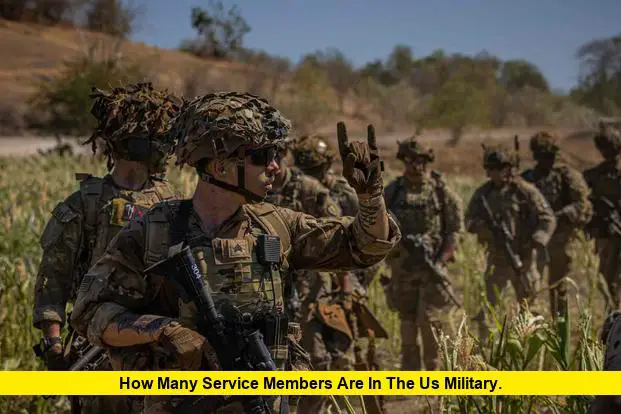
As of 2025, how many service members are in the US military remains a question of national importance, touching on defense readiness, global strategy, and public understanding of America’s armed forces. Based on the most recent verified data available today, the United States maintains one of the world’s largest and most capable military forces, with a substantial number of active-duty personnel supported by robust reserve and National Guard components.
This article presents a clear, factual, and current breakdown of U.S. military personnel numbers, explaining what those figures mean and why they matter.
Table of Contents
What Counts as a U.S. Military Service Member
To understand military size accurately, it’s important to define who is included in official counts.
A U.S. military service member is a uniformed individual serving in one of the armed forces branches. These include:
- Active-duty personnel serving full time
- Reserve members who train regularly and can be mobilized
- National Guard members serving under state or federal authority
Civilian employees of the Department of Defense, contractors, and veterans are not included in service member totals.
Active-Duty Military Personnel in 2025
As of the most recent verified figures in 2025, the United States has approximately 1.32 million to 1.33 million active-duty service members.
Active-duty personnel serve full time and form the operational backbone of the U.S. military. They are responsible for daily missions, overseas deployments, homeland defense, training operations, and global military presence.
These service members are distributed across all major branches of the armed forces and are continuously maintained to ensure readiness and rapid response capability.
Total Military Personnel Including Reserves and National Guard
When reserve and National Guard forces are included, the size of the U.S. military increases significantly.
- Reserve and National Guard personnel total approximately 760,000 to 800,000 members
- Combined with active-duty forces, the total number of U.S. military service members is roughly 2.1 million
This combined force represents the full pool of trained, uniformed personnel available for mobilization during national emergencies, large-scale conflicts, or extended overseas operations.
U.S. Military Branch Breakdown
While precise numbers vary slightly throughout the year due to recruitment cycles and separations, the overall structure of the U.S. military remains consistent.
U.S. Army
The Army is the largest branch by personnel count. It provides ground forces for combat, peacekeeping, logistics, and humanitarian missions worldwide.
U.S. Navy
The Navy maintains maritime dominance, operating fleets, submarines, and aircraft across the globe to protect trade routes and national interests.
U.S. Air Force
The Air Force delivers air superiority, global strike capabilities, intelligence operations, and rapid mobility.
U.S. Marine Corps
The Marine Corps is a highly mobile, expeditionary force designed for rapid response and amphibious operations.
U.S. Space Force
The newest branch focuses on space operations, satellite security, and space-based defense systems. It is the smallest service by personnel.
U.S. Coast Guard
The Coast Guard handles maritime security, law enforcement, and search and rescue. During wartime or national emergencies, it can operate under military command.
How the U.S. Military Compares Globally
In terms of total uniformed personnel, the United States ranks among the largest military forces in the world.
While some nations have larger troop counts, the U.S. military stands out for its global reach, advanced technology, training standards, and sustained readiness. Military size alone does not determine power, but personnel strength remains a foundational element of national defense.
Recruitment Trends Affecting Force Size
Military personnel numbers are influenced by recruitment and retention trends.
After facing challenges in prior years, recruitment showed improvement heading into 2025, helping stabilize active-duty strength and reserve participation. Each branch continues to adjust recruiting strategies to compete with civilian job markets while maintaining standards.
Recruitment success directly affects future force levels, readiness, and mission capability.
Defense Policy and Force Structure Decisions
Military size is not fixed. It is shaped by defense budgets, congressional authorization, and strategic planning.
Recent defense policy decisions aim to sustain troop levels while modernizing capabilities, particularly in areas such as cyber operations, space security, and advanced technology. These shifts may affect how personnel are distributed across branches but do not eliminate the need for a large, trained force.
Why These Numbers Matter
Understanding how many service members are in the US military goes beyond curiosity.
These figures influence:
- National security planning
- Military family support systems
- Veterans services funding
- Public confidence in defense readiness
Accurate personnel data helps Americans better understand the scale of commitment required to maintain national defense and global stability.
What do you think about the current size of the U.S. military? Share your perspective and stay connected for the latest verified updates on America’s armed forces.

