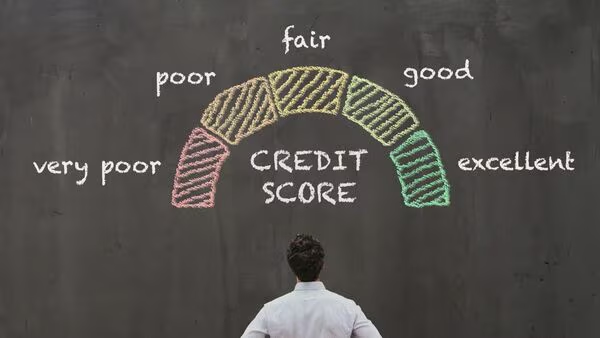
Many people ask: how much does a hard inquiry affect your credit score? As of September 1, 2025, the answer is clearer than ever. Credit scoring models have become more transparent, and new tools now show consumers the real impact of inquiries on their reports. While the effect is still considered small, it can matter when you are actively building or rebuilding your credit.
Table of Contents
What Is a Hard Inquiry?
A hard inquiry happens whenever you apply for credit and a lender checks your report. This includes credit cards, loans, auto financing, and mortgages. It signals that you are seeking new credit, which can influence how lenders view your risk.
Hard inquiries are different from soft inquiries, which occur when you check your own score, get prequalified offers, or when employers perform certain background checks. Soft inquiries have no effect on your score.
How Much Does a Hard Inquiry Affect Your Credit Score?
Here’s the breakdown in 2025:
| Credit Profile | Typical Drop | Notes |
|---|---|---|
| Strong, established credit | 3–5 points | Minor effect, quickly absorbed |
| Average history | 5–8 points | Slightly more noticeable |
| Thin or new credit files | 10–21 points | Can be significant |
| Multiple applications within 14–45 days | Counted as one | Rate-shopping window applies |
Most consumers see a decline of fewer than five points. But if you have little history or already low credit, the drop may be larger.
Why the Impact Varies
Several factors determine how much a hard inquiry lowers your score:
- Overall credit history length – The shorter your history, the greater the impact.
- Number of existing accounts – Established profiles handle inquiries better.
- Recent activity – Multiple applications within months raise risk signals.
- Type of credit – Mortgage and auto loan inquiries are grouped, while credit card inquiries each count separately.
This flexibility means no two people will experience the exact same result.
How Long Does a Hard Inquiry Stay on Your Credit?
- Active impact: 12 months
- Visible on report: 24 months
- Effect reduction: Gradually fades after a few months
In practice, most people recover from the dip within three to six months, especially if they pay bills on time and keep utilization low.
2025 Developments in Credit Scoring
This year has brought new updates that affect how inquiries are viewed:
- Lower impact for established borrowers – Models now place greater weight on payment history, lowering the relative penalty of inquiries.
- Real-time credit tracking apps – Consumers can now see an immediate estimate of score changes after an inquiry.
- Faster recovery timelines – Some models reduce the weight of inquiries after six months instead of waiting a full year.
- Enhanced transparency – Reports now label each inquiry clearly with the date, type, and expected expiration period.
These improvements make the process less mysterious and more manageable for everyday consumers.
Common Myths About Hard Inquiries
- Myth 1: One hard inquiry ruins your score.
Reality: A single inquiry has a small, temporary effect. - Myth 2: All inquiries count the same.
Reality: Mortgage and auto inquiries are grouped if done within a window. Credit card applications count individually. - Myth 3: Checking your credit lowers your score.
Reality: Soft inquiries never affect your score, even if you check daily.
Smart Strategies to Minimize Impact
- Time your applications carefully. Avoid multiple credit card applications in short bursts.
- Use prequalification tools. These use soft pulls, helping you gauge approval odds without harm.
- Keep inquiries for big purchases close together. Rate-shop for loans within the 14–45 day window.
- Monitor your credit report. Dispute any unauthorized or mistaken inquiries quickly.
- Strengthen other factors. Maintain low utilization and on-time payments to offset any small score dips.
The Bigger Picture
Hard inquiries make up about 10% of your overall score. The two most important factors—payment history and utilization—carry far more weight. This means a small dip from an inquiry won’t matter much if you consistently manage accounts responsibly.
For someone with a score in the 700s, a 5-point drop is barely noticeable. For someone just above a qualifying threshold—say, 620 for a mortgage—timing inquiries strategically becomes critical.
Realistic Scenarios in 2025
- Scenario 1: Applying for a new credit card
Expect a drop of 5–8 points, which usually recovers in months. - Scenario 2: Shopping for a car loan
Ten inquiries within two weeks will count as one, minimizing impact. - Scenario 3: First credit account for a student
The dip may be closer to 15 points because of the short history.
These examples show that context matters more than the inquiry itself.
FAQs
Q: Can multiple inquiries stop me from getting approved?
Not usually, unless you apply for many credit cards in a short time. Lenders focus on overall risk, not just inquiries.
Q: Do inquiries hurt more if my score is already low?
Yes, thin or low-credit files can experience larger drops. Established profiles are less affected.
Q: How can I remove a hard inquiry?
Only unauthorized inquiries can be removed through a dispute. Legitimate ones stay for two years but fade in impact.
Final Thoughts
The question how much does a hard inquiry affect your credit score is less intimidating once you see the facts. In 2025, most people lose just a few points, recover quickly, and can still build credit effectively. The key is managing applications wisely, spacing them out, and focusing on bigger scoring factors like payment history and utilization.
Use inquiries strategically, and they’ll become stepping stones toward better opportunities rather than setbacks.
Disclaimer
This article is for informational purposes only and does not constitute financial advice. Always review your personal situation and consult a licensed financial professional before making credit decisions.

