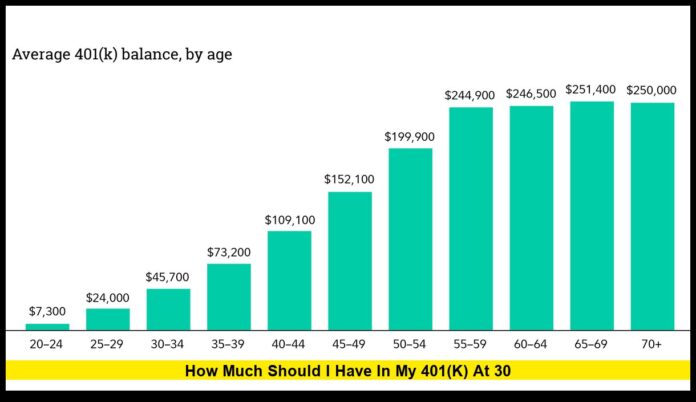
Opening your retirement-savings journey early is crucial, and the question “how much should I have in my 401(k) at 30” is one many Americans ask. As of 2025, the most widely accepted guideline suggests that a 30-year-old should aim to have about one times their annual salary saved in their 401(k) plan or equivalent by this age. Here’s a full breakdown of what this means, why it matters, and what you can do if you’re behind.
Table of Contents
Current Benchmark Numbers for 30-Year-Olds
- The average 401(k) balance for people in their 30s is approximately $190,000, while the median balance is around $75,000.
- The “1× salary by age 30” rule remains a strong benchmark, meaning if you earn $70,000 a year, your goal should be to have around $70,000 saved.
- This target balances career stage, income growth potential, and the time value of money—giving savers a realistic goal for early adulthood.
If you’ve reached or surpassed that level, you’re generally on track for a healthy retirement trajectory.
Why the Benchmark “1× Salary by Age 30” Matters
- Compound Growth Advantage: Savings in your 20s and early 30s benefit from decades of compounding returns.
- Behavioral Discipline: Having a milestone motivates consistent contributions, which is more effective than sporadic investing.
- Flexibility: The goal adjusts to your income. Someone earning $120,000 should ideally have about $120,000 saved, while a $50,000 earner should aim for around $50,000.
- Early Momentum: Hitting this target helps you build momentum toward future benchmarks—3× salary by 40, 6× by 50, and so on.
How to Interpret These Numbers for Your Situation
Not everyone’s financial situation fits a single mold. Understanding where you stand is key:
- Your Income: The “1× rule” scales naturally—higher earners have larger targets, but also more savings potential.
- Career Stage: Those who pursued higher education or changed fields later may start saving later and need to ramp up faster.
- Employer Match: Always contribute enough to earn your full company match—it’s essentially free money added to your retirement fund.
- Investment Performance: Market fluctuations impact balances; short-term declines don’t define your long-term success.
- Other Savings Accounts: IRAs, Roth IRAs, and HSAs with investment options can complement your 401(k).
If You’re Behind on Your 401(k) at 30
If your current balance is below your annual salary, don’t panic. Many people catch up quickly in their 30s with consistent effort. Try these practical steps:
- Boost Contributions: Gradually raise your 401(k) contribution by 1% or 2% every few months until you reach 10-15% of your income.
- Max Out Employer Match: Always contribute enough to capture the full match. Missing it leaves free money on the table.
- Automate Increases: Set your employer’s plan to automatically raise your contribution percentage annually.
- Invest for Growth: With decades ahead, a growth-oriented allocation (stocks and index funds) can maximize compounding potential.
- Reduce Debt: Paying down high-interest debt creates more space to invest.
- Check Annually: Revisit your 401(k) statement each year and compare it to your salary.
Examples of What “On Track” Looks Like
| Annual Salary | Target by Age 30 (1× Salary) | Goal |
|---|---|---|
| $50,000 | $50,000 | Aim to have at least $50k saved. |
| $80,000 | $80,000 | Target about $80k in total savings. |
| $120,000 | $120,000 | Aim for around $120k in your 401(k). |
If your balance is, for example, $30,000 on a $75,000 salary, you’re not alone. Increasing your contribution rate and staying invested can close that gap within a few years.
Why Many 30-Year-Olds Fall Short
Even though the target is clear, the average American often falls behind due to several common factors:
- Late Workforce Entry: Many start saving only after college or graduate school.
- Student Debt: Loan repayments can delay retirement savings.
- High Living Costs: Rising rent, childcare, and healthcare costs limit saving capacity.
- Job Changes: Moving between jobs sometimes interrupts contributions or cashes out small balances.
- Market Volatility: Economic downturns can temporarily reduce account values.
Falling short of the benchmark doesn’t mean failure—it just means you need to prioritize saving more aggressively now.
Smart 401(k) Strategies in Your 30s
- Take Advantage of Raises: Each raise is an opportunity to increase your contribution without feeling the loss in take-home pay.
- Consider Roth Options: If your employer offers a Roth 401(k), it allows you to pay taxes now and withdraw tax-free later.
- Diversify: A mix of domestic and international stocks, plus some bonds, creates balance.
- Avoid Early Withdrawals: Early 401(k) withdrawals incur taxes and penalties, plus lost future growth.
- Use Compound Interest: Reinvest dividends and let your money grow automatically.
By focusing on long-term habits, you can make up for a slow start and exceed the benchmarks by mid-career.
How to Stay Consistent
Consistency outweighs timing. Contributing steadily every paycheck builds wealth faster than trying to time the market. Here are practical ways to stay disciplined:
- Automate contributions and let them increase over time.
- Avoid checking your account daily—market dips are normal.
- Celebrate milestones, like hitting $25,000, $50,000, or $100,000.
- Track progress annually and adjust when your salary or expenses change.
Your 30s are often the decade where compounding really takes off, setting the foundation for your future.
Projected Retirement Path if You Stay on Track
If you start with one year’s salary saved at 30 and continue contributing 10-15% with market returns averaging 6-7%, you could reach:
| Age | Target Multiple of Salary | Goal Example ($80k Salary) |
|---|---|---|
| 30 | 1× | $80,000 |
| 40 | 3× | $240,000 |
| 50 | 6× | $480,000 |
| 60 | 8× | $640,000 |
| 67 | 10× | $800,000+ |
These targets represent a comfortable retirement range for most middle-income earners, assuming continued saving and investment growth.
Common Misconceptions
- Myth 1: Employer contributions count toward your personal limit.
Reality: Employer match doesn’t reduce your annual personal cap. - Myth 2: You must max out to benefit.
Reality: Even smaller, regular contributions accumulate significantly. - Myth 3: It’s too late to start saving at 30.
Reality: You still have decades for compound growth—starting now is powerful.
The Bottom Line
When evaluating how much you should have in your 401(k) at 30, the rule of thumb is clear: aim for about one year’s worth of your salary saved. Whether you’re right on target or a bit behind, the key is to keep contributing, take advantage of employer matches, and let compounding work for you. Your 30s are the decade to establish strong habits that pay off exponentially by retirement age.
Disclaimer: This article is for informational purposes only and does not constitute financial or investment advice. Readers should consult a qualified financial advisor for personalized recommendations.
FAQ
Q: Is one year’s salary saved by 30 realistic?
A: Yes, it’s a practical target for most workers, assuming consistent saving since their early-to-mid 20s.
Q: What if I started saving late?
A: Increase your contribution rate and consider additional investment vehicles like an IRA to catch up.
Q: How much should I contribute to my 401(k)?
A: Aim for 10-15% of your gross income, including employer match.
Q: Does this benchmark include other retirement accounts?
A: The rule mainly applies to your 401(k), but IRAs or similar accounts contribute to your overall goal.
Q: What happens if I can’t meet the benchmark by 30?
A: Don’t stress—just commit to higher contributions now and stay consistent. Even small increases compound significantly over time.
If you’re working toward retirement, use this benchmark as motivation to stay consistent and focused on your financial goals. Comment below with where you stand or how you plan to boost your savings this year.

. See the latest 2025 benchmarks and how to get on track.)