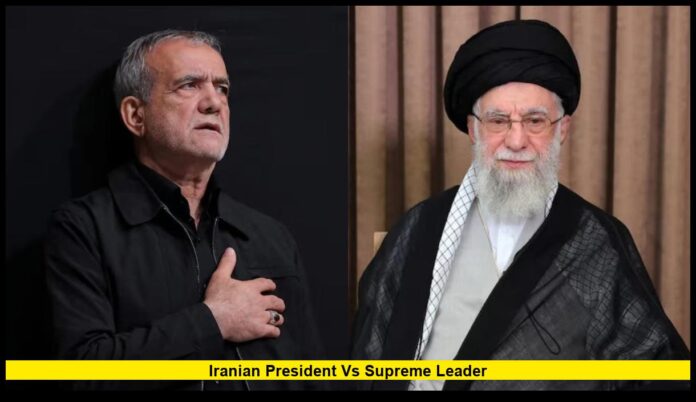
The debate around iranian president vs supreme leader remains central to understanding Iran’s political system in 2026, especially as President Masoud Pezeshkian governs under the authority of Supreme Leader Ayatollah Ali Khamenei. While the president manages daily government operations, Iran’s constitution grants the Supreme Leader ultimate authority over the military, judiciary, and key national policies.
This unique leadership structure shapes how Iran makes decisions on domestic policy, foreign relations, and national security. For U.S. audiences following Middle East politics, understanding the relationship between these two roles helps explain how power actually works inside the Islamic Republic.
Table of Contents
How Iran’s Leadership System Works
Iran operates under a political system created after the 1979 Islamic Revolution. The system blends elected institutions with powerful religious oversight.
Two positions dominate the government structure:
- Supreme Leader
- President
Both roles influence the country’s direction, but they hold very different levels of authority.
The Supreme Leader sits at the top of the political hierarchy. The president serves as the highest elected official but must operate within limits set by the Supreme Leader.
This relationship explains much of Iran’s internal political dynamics.
Who Is Iran’s Supreme Leader
Ayatollah Ali Khamenei has served as Iran’s Supreme Leader since 1989. He succeeded Ayatollah Ruhollah Khomeini, the founder of the Islamic Republic.
The Supreme Leader holds extensive powers defined by Iran’s constitution.
These powers include control over:
- The armed forces
- The Islamic Revolutionary Guard Corps (IRGC)
- The judiciary
- State broadcasting
- Key national security decisions
The Supreme Leader also appoints several powerful officials. These include the head of the judiciary and members of important oversight councils.
In practice, this position represents the highest authority in Iran’s political and religious system.
Who Is Iran’s President in 2026
Iran elected Masoud Pezeshkian as president in July 2024. He took office after the death of President Ebrahim Raisi in a helicopter crash in May 2024.
Pezeshkian is a former heart surgeon and longtime parliament member. He previously served as Iran’s health minister.
His campaign emphasized economic reform and engagement with the international community. After winning the election, he became the ninth president of the Islamic Republic.
Despite holding the presidency, his authority remains limited by the constitutional power of the Supreme Leader.
Iranian President vs Supreme Leader: Key Differences
The comparison between the iranian president vs supreme leader highlights how Iran divides power between elected leadership and religious authority.
| Position | Supreme Leader | President |
|---|---|---|
| Role | Highest authority in Iran | Highest elected official |
| Control of military | Yes | No |
| Foreign policy influence | Direct authority | Implements policies |
| Appointment power | Appoints key officials | Appoints cabinet ministers |
| Election | Selected by Assembly of Experts | Elected by public vote |
This structure ensures that elected governments operate under religious oversight.
The president manages administration and economic policy, but strategic decisions remain in the hands of the Supreme Leader.
Responsibilities of the Iranian President
The president leads the executive branch of government. This role involves managing day-to-day governance and implementing national policies.
Key responsibilities include:
- Managing the national budget
- Overseeing ministries and government agencies
- Proposing economic policies
- Signing international agreements approved by leadership
- Representing Iran in diplomatic meetings
The president appoints cabinet ministers. Parliament must approve those appointments.
Despite these responsibilities, major security decisions require approval from higher authorities within the system.
Powers of the Supreme Leader
The Supreme Leader holds authority that extends across nearly every major institution in Iran.
Major powers include:
- Commander-in-chief of the armed forces
- Authority over national security policy
- Appointment of military commanders
- Appointment of the head of the judiciary
- Appointment of half the members of the Guardian Council
The Guardian Council reviews laws passed by parliament and approves election candidates.
Through these powers, the Supreme Leader maintains influence over legislation, security, and political oversight.
How the Two Roles Interact
The relationship between the president and the Supreme Leader often determines how policies move forward.
The president may introduce economic reforms or diplomatic initiatives. However, major changes require support from the Supreme Leader and other powerful institutions.
Several bodies also influence decision-making:
- Supreme National Security Council
- Guardian Council
- Assembly of Experts
These institutions reinforce the authority of the Supreme Leader while still allowing elected officials to participate in governance.
Recent Political Context in Iran
Iran’s political landscape shifted in 2024 after President Ebrahim Raisi died in a helicopter crash in northwestern Iran.
The accident killed several officials and prompted a snap presidential election. Iranian law required the country to hold the election within weeks.
Masoud Pezeshkian won the vote after a runoff election in July 2024. His victory marked a shift toward a more moderate political figure within Iran’s political spectrum.
Even with a new president, the overall structure of authority remains unchanged because the Supreme Leader retains ultimate power.
Foreign Policy and Decision Making
Foreign policy decisions highlight the difference between the two roles.
The president often participates in diplomatic meetings and international forums. However, strategic direction comes from the Supreme Leader and the national security establishment.
Key areas influenced by this leadership structure include:
- Nuclear negotiations
- Regional security policies
- Military strategy
- Relations with the United States and Europe
The Supreme Leader sets the broader framework. The president helps implement those policies through diplomacy and government agencies.
Why This Power Structure Matters Globally
The leadership dynamic between Iran’s president and Supreme Leader shapes the country’s role in global politics.
For U.S. policymakers and international observers, understanding this system helps explain how decisions emerge from Tehran.
When presidents propose reforms or diplomatic engagement, the Supreme Leader’s approval determines whether those plans move forward.
This structure also explains why policy shifts can move slowly.
Even after elections bring new leadership, the broader ideological direction of the Islamic Republic remains consistent.
Future Political Questions in Iran
Political discussions in Iran often focus on the balance of authority between elected officials and religious leadership.
Several issues continue to shape the national conversation:
- Economic pressures inside Iran
- Relations with Western countries
- Regional conflicts in the Middle East
- Leadership succession in the future
Any major political change will likely involve both institutions working within the country’s constitutional framework.
The interaction between these roles will continue to define Iran’s governance model.
Understanding Iran’s Unique Political System
The comparison between the iranian president vs supreme leader reveals how Iran blends democratic elections with powerful religious oversight.
The president manages government operations and public administration. The Supreme Leader holds final authority over national security, military forces, and major political decisions.
This structure has defined the Islamic Republic for more than four decades.
It remains one of the most distinctive governing systems in modern international politics.
What are your thoughts on Iran’s leadership structure and how it affects global politics? Share your perspective in the comments and join the conversation.

